Time-Weighted Return: Step-By-Step Guide For Investors
Master the time-weighted return metric to accurately gauge investment performance, free from cash flow distortions.
The
time-weighted return (TWR)
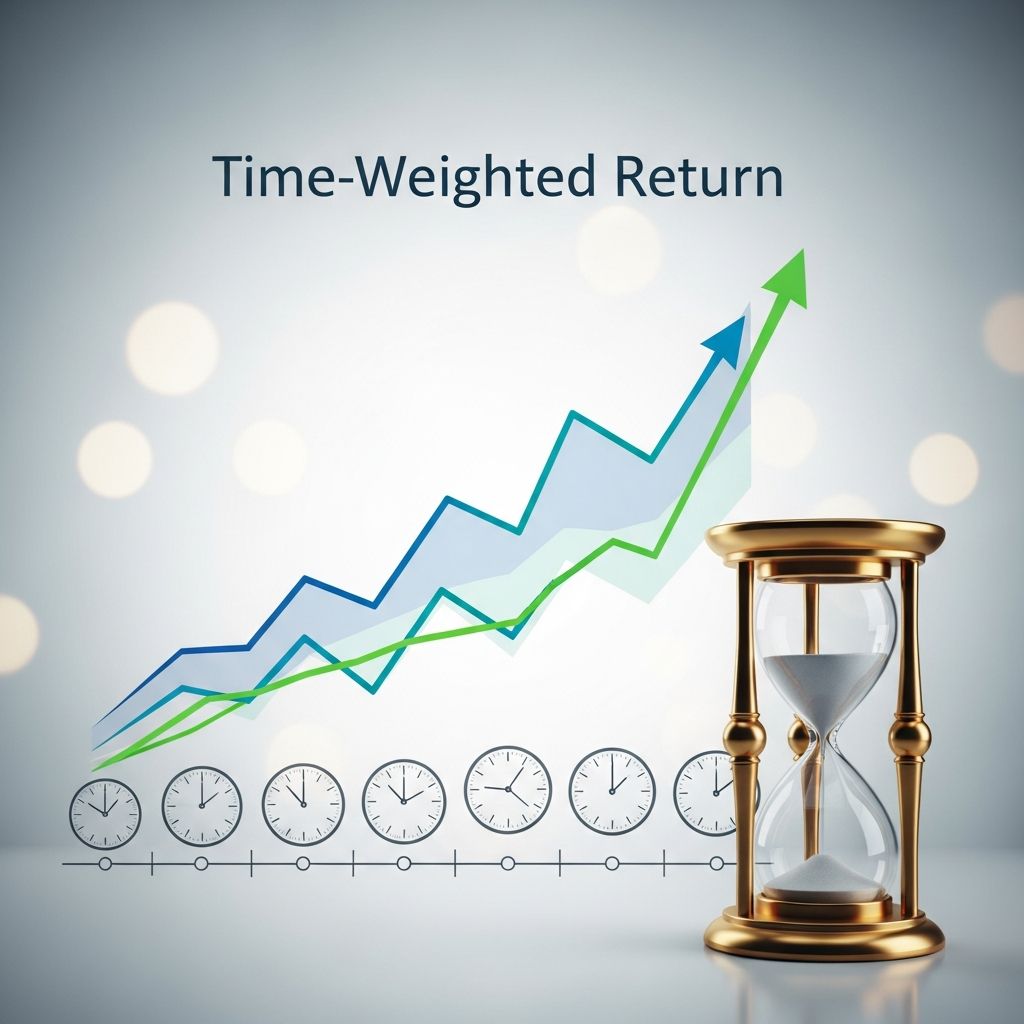
is a vital metric in investment analysis that reveals a portfolio’s genuine performance by neutralizing the effects of external cash movements. This approach ensures investors see the pure impact of market conditions and asset choices over time.Understanding the Core Concept of TWR
At its essence, TWR dissects a portfolio’s history into distinct phases separated by cash inflows or outflows. By computing returns for each phase and then geometrically linking them, TWR delivers a compounded growth rate that mirrors what the investments achieved independently of investor timing decisions.
This method gained prominence because traditional return calculations can mislead when funds enter or exit irregularly. For instance, a large deposit just before a market dip might make performance appear worse, even if the underlying assets performed well. TWR strips away such noise, providing clarity for comparisons across funds or managers.
Why TWR Matters for Investors
Investors rely on TWR to benchmark portfolios against indices or peers fairly. Portfolio managers favor it for performance reporting since it highlights their skill rather than client deposit patterns.
- Eliminates bias from cash flow timing
- Enables apples-to-apples comparisons
- Reflects manager effectiveness accurately
- Standard in mutual funds and benchmarks
Without TWR, evaluations could favor portfolios with lucky cash flow timing, obscuring true value creation.
Step-by-Step Calculation Guide
Computing TWR involves segmenting the period and applying a geometric formula. Here’s the process:
- Identify sub-periods: Mark each date with deposits, withdrawals, or valuation changes.
- Calculate holding period return (HPR) for each: Use HPR = (Ending Value – Beginning Value – Cash Flow) / (Beginning Value + Cash Flow)
- Compound the returns: TWR = [(1 + HPR1) × (1 + HPR2) × … × (1 + HPRn)] – 1
This formula ensures each sub-period contributes proportionally to the total.
A Simple Numerical Example
Suppose you start with $10,000. After three months, it grows to $11,000. You add $5,000, making it $16,000. Over the next three months, it reaches $17,600.
| Sub-Period | Start Value | Cash Flow | End Value | HPR |
|---|---|---|---|---|
| 1 | $10,000 | $0 | $11,000 | 10% |
| 2 | $11,000 | $5,000 | $17,600 | 10% |
TWR = (1 + 0.10) × (1 + 0.10) – 1 = 21%.
Handling Complex Scenarios
For multiple flows, repeat the HPR for each interval. Tools like spreadsheets simplify this, but understanding the logic prevents errors.
TWR Versus Other Return Metrics
TWR stands apart from simpler measures by design.
Compared to Simple Rate of Return
Basic rate of return (RoR) = (End Value – Start Value) / Start Value ignores flows, suiting single investments but failing portfolios with activity.
TWR vs. Money-Weighted Return (MWR)
| Aspect | TWR | MWR (IRR) |
|---|---|---|
| Cash Flow Impact | Eliminated | Included |
| Best For | Manager performance | Personal results |
| Calculation | Geometric linking | Solves for IRR |
MWR, or internal rate of return, weighs larger flows more heavily, reflecting personal timing success.
Example: Poor timing yields negative MWR but positive TWR, showing investments worked despite actions.
Practical Applications in Portfolio Management
Professionals use TWR for:
- Fund reporting to standards bodies
- Comparing to S&P 500 or similar
- Evaluating advisor skill
- Client statements free of deposit bias
In volatile markets, TWR maintains focus on asset selection over liquidity events.
Advanced Considerations and Limitations
While powerful, TWR assumes daily valuations, which may not hold for illiquid assets. True TWR requires precise timing.
Modifications like modified Dietz approximate it for less data. Investors should verify calculation methods in reports.
Tools and Software for TWR
Excel functions or platforms like Morningstar automate TWR. Input dates, values, and flows for instant results.
Investment apps often display TWR alongside MWR for full insight.
Frequently Asked Questions
What makes TWR superior for performance tracking?
TWR isolates market and manager effects, ideal for objective assessments.
Can retail investors calculate TWR easily?
Yes, with spreadsheets following the sub-period method.
Is TWR always higher than MWR?
No, depends on cash flow timing relative to performance.
Does TWR apply to all asset types?
Best for liquid portfolios; adjustments needed for private equity.
How often should TWR be reviewed?
Quarterly or annually for long-term trends.
Implementing TWR in Your Strategy
To leverage TWR:
- Track all transactions precisely
- Use it for manager selection
- Combine with MWR for personal review
- Seek reports using GIPS standards
This dual approach balances professional evaluation with individual outcomes.
References
- Time-Weighted Return: What It Is and How To Calculate It — Bankrate. 2023. https://www.bankrate.com/investing/what-is-time-weighted-return-how-to-calculate/
- What Is the Time-Weighted Return (TWR)? — SmartAsset. 2023. https://smartasset.com/investing/time-weighted-return
- What Is Time-Weighted Return (TWR) and How to Calculate It — WealthArc. 2023. https://www.wealtharc.com/insights-articles/what-is-time-weighted-return-twr-how-to-calculate-it
- What Is Time-Weighted Rate of Return? — Chase. 2023. https://www.chase.com/personal/investments/learning-and-insights/article/what-is-time-weighted-rate-of-return
- Time-weighted vs. money-weighted rates of return — Sharesight. 2023. https://www.sharesight.com/blog/time-weighted-vs-money-weighted-rates-of-return/
- True Time-Weighted Return — Confluence. 2023. https://www.confluence.com/true-time-weighted-return/
- What’s the Difference? TWR vs. IRR — Common Fund. 2023. https://www.commonfund.org/hubfs/03%20Research%20Center/Articles/Whats%20the%20Difference_%20TWR%20vs%20IRR%20.pdf
Similar Articles








Read full bio of medha deb