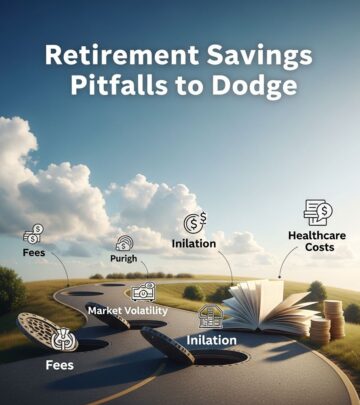
Why You Can’t Postpone Retirement Planning & How to Start
Delaying retirement planning risks financial insecurity; discover urgent reasons to start now and practical steps to build your future securely.

Retirement planning is not a distant concern—it’s a critical process that demands immediate attention regardless of your age or career stage. Postponing it can lead to severe financial shortfalls, as the power of compounding, rising longevity, and economic uncertainties amplify the costs of delay. This article explores the compelling reasons you cannot afford to wait and provides a clear roadmap to kickstart your retirement journey today.
The Power of Compounding: Time Is Your Greatest Asset
One of the most profound reasons to begin retirement planning now is the magic of
compounding interest
. This financial principle allows your investments to generate earnings not just on your initial contributions but also on the accumulated interest over time. Starting early harnesses this exponential growth, turning modest savings into substantial nest eggs.Consider a 25-year-old investing $5,000 annually at a 7% average annual return. By age 65, this could grow to over $1 million. Delay until age 35, and the same contributions yield only about $600,000—a loss of $400,000 due solely to lost compounding years. The earlier you start, the less you need to save monthly to reach your goals.
- Rule of 72: Divide 72 by your expected return rate to estimate doubling time. At 7%, savings double every 10.3 years.
- Historical Context: U.S. stock market averages around 7-10% annually after inflation, per long-term S&P 500 data.
- Impact of Delay: Each decade postponed roughly triples the monthly savings required.
Without early action, you’ll face higher contributions later, straining current budgets amid life’s expenses like mortgages, education, and family needs.
Increasing Life Expectancy: Retirement Now Spans Decades
Modern advancements in healthcare mean Americans are living longer. According to the Social Security Administration, a 65-year-old today has a 50% chance of living past 85, with many reaching 90 or beyond. This
longevity risk
transforms retirement from a 10-15 year phase into a 20-30 year (or longer) endeavor, demanding far more savings.Traditional planning assumed shorter retirements, but today’s reality requires planning for 25+ years of expenses without earned income. Inflation erodes purchasing power— at 3% annually, $50,000 today equals just $27,000 in 25 years. Failing to account for this leaves many retirees depleting funds prematurely.
| Age at Retirement | Expected Lifespan | Retirement Duration | Required Savings (at 4% withdrawal) |
|---|---|---|---|
| 62 | 85+ | 23+ years | $1.15M+ for $46K/year |
| 67 | 90+ | 23+ years | $1.15M+ for $46K/year |
| 72 | 95+ | 23+ years | $1.15M+ for $46K/year |
Postponing planning ignores these shifts, risking outliving your savings—a scenario affecting millions.
The Decline of Traditional Pensions and Social Security Uncertainty
Corporate pensions, once a retirement staple, have largely vanished. Only 15% of private-sector workers now have defined-benefit plans, down from 35% in 1980, per the Bureau of Labor Statistics. Future retirees must self-fund primarily through personal savings and 401(k)s.
Social Security faces solvency issues; the 2024 Trustees Report projects trust fund depletion by 2035, potentially reducing benefits to 83% of scheduled amounts. Relying on it as more than supplemental income is unwise—plan for it covering just 40% of pre-retirement needs at best.
- Shift to Defined Contribution: 401(k)s place responsibility on individuals.
- Replacement Rates: Pensions once provided 40-50%; now, savers must bridge the gap.
- Policy Risks: Benefit cuts or age hikes loom amid demographic pressures.
Delaying adaptation to this landscape leaves you underprepared for self-reliant retirement.
Market Volatility and Sequence of Returns Risk
Retirement timing coincides with market cycles unpredictably.
Sequence of returns risk
occurs when poor market performance hits early in retirement, forcing sales of depreciated assets and permanent portfolio damage. Historical data shows early downturns (e.g., 2008 crash) can deplete 30-year portfolios under standard withdrawals.Starting now builds resilience through diversification and time to recover. Low-cost index funds historically outperform active strategies over decades, smoothing volatility.
- Build a 3-5 year cash buffer for withdrawals.
- Maintain 60/40 stock/bond allocation, adjusting gradually.
- Avoid panic selling during downturns.
Rising Healthcare and Long-Term Care Costs
Healthcare expenses dominate late-life budgets. Fidelity estimates a 65-year-old couple needs $315,000 for medical costs in retirement (2023 data, adjusted). Medicare covers basics but gaps in premiums, deductibles, and long-term care—averaging $100,000+ lifetime—remain.
Postponing Health Savings Accounts (HSAs) or insurance forfeits tax-advantaged growth. Longevity exacerbates this: nursing home costs hit $9,000/month, uninsured for most.
- HSA Triple Tax Advantage: Pre-tax contributions, tax-free growth, tax-free medical withdrawals.
- Medigap Policies: Bridge Medicare gaps post-65.
- Prevention Now: Healthy habits reduce future costs.
Inflation’s Silent Erosion of Purchasing Power
Inflation averages 3% annually, doubling prices every 24 years. Fixed incomes lose value rapidly; $60,000 today buys like $30,000 in two decades. Retirement portfolios must outpace this via growth assets like stocks.
Delay compounds the problem: shorter investment horizons limit inflation-beating returns. TIPS and diversified equities are key hedges.
How to Start Your Retirement Planning Today
Don’t let procrastination derail your future. Follow these steps:
1. Assess Your Current Situation
Calculate net worth (assets minus liabilities) and track expenses for one month. Use free tools like Mint or spreadsheets.
2. Set Clear, Realistic Goals
Define retirement age, lifestyle, and annual needs (e.g., 70-80% of current income). Factor 25-30 year duration.
3. Create a Budget and Cut Waste
Aim for 50/30/20 rule: 50% needs, 30% wants, 20% savings/debt. Trim dining out, subscriptions.
4. Build an Emergency Fund
Save 3-6 months’ expenses in high-yield savings before aggressive investing.
5. Maximize Tax-Advantaged Accounts
- 401(k): Contribute enough for employer match—free money.
- IRA: Roth for tax-free withdrawals if eligible.
- HSA: If high-deductible health plan.
6. Invest Wisely for Growth
Adopt low-cost index funds (e.g., Vanguard VTI). Use target-date funds for simplicity. Rebalance annually.
7. Pay Off High-Interest Debt
Prioritize credit cards (average 20%+ APR) over low-rate mortgages.
8. Increase Earnings and Savings Rate
Side hustles, raises, negotiate salary. Target 15-20% savings rate.
9. Plan for Healthcare and Insurance
Fund HSA; review life/disability coverage.
10. Review and Adjust Annually
Life changes—update projections yearly.
Frequently Asked Questions (FAQs)
Q: How much should I save for retirement?
A: Aim for 10-15x your final salary by retirement. Use 25x annual expenses rule (4% safe withdrawal rate).
Q: What if I’m starting late, like in my 40s or 50s?
A: Aggressively save 25-50% of income, max retirement accounts, downsize lifestyle, consider semi-retirement.
Q: Is the 4% rule still valid?
A: It’s a guideline; adjust for longevity—consider 3-3.5% or flexible spending based on portfolio value.
Q: Should I buy long-term care insurance?
A: Yes, if family history or assets to protect; shop in 50s for best rates.
Q: Can I retire early?
A: Possible with high savings rate (50%+), frugality, and side income—explore FIRE movement strategies.
References
- A Summary of the 2024 Annual Reports — Social Security Administration. 2024-05-06. https://www.ssa.gov/oact/TRSUM/
- Fidelity Retiree Health Care Cost Estimate — Fidelity Investments. 2023-08-21. https://www.fidelity.com/viewpoints/retirement/retiree-health-care-costs
- National Average Retail Food and Energy Prices — U.S. Bureau of Labor Statistics. 2024-12-11. https://www.bls.gov/charts/consumer-price-index/consumer-price-index-average-price-data.htm
- Retirement Topics – Benefits & Payments — Internal Revenue Service. 2024-01-15. https://www.irs.gov/retirement-plans/plan-participant-employee/retirement-topics-benefits
- Long-Run Risks of Retirement Portfolios — Federal Reserve Board. 2023-11-01. https://www.federalreserve.gov/econres/notes/feds-notes/long-run-risks-of-retirement-portfolios-20231103.htm
Similar Articles








Read full bio of medha deb