Taxation Without Representation: Definition & Historical Impact
Understand taxation without representation and its role in democratic governance and history.
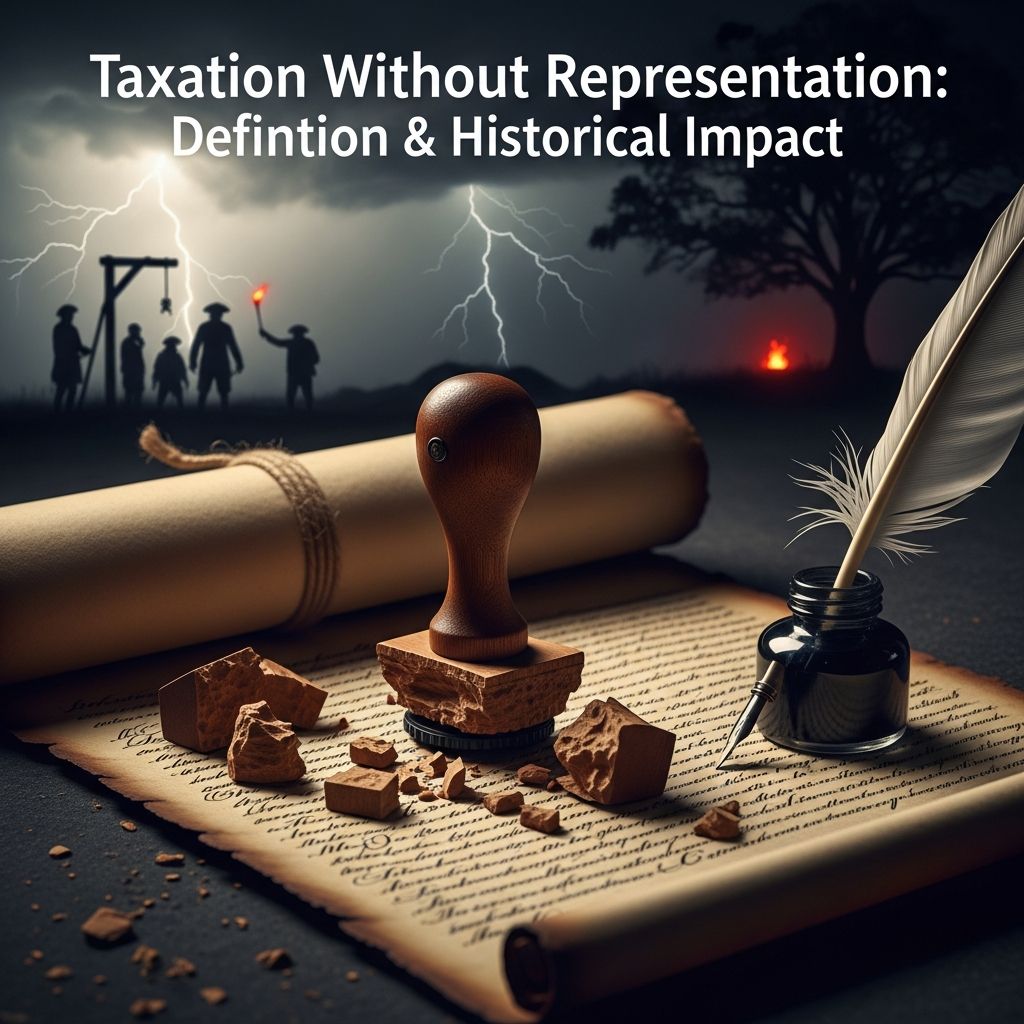
Taxation without representation is a fundamental concept in political and economic discourse that challenges the core principles of democratic governance. This term refers to the imposition of taxes on individuals, businesses, or communities without granting them a voice in the decision-making process regarding tax policies and allocation of tax revenues. The concept gained prominence during the American colonial period and remains relevant in contemporary discussions about fairness, accountability, and democratic participation in government.
Understanding Taxation Without Representation
At its core, taxation without representation signifies a situation where people are taxed by a government authority but lack adequate representation to influence how those taxes are collected, spent, or managed. This violation of democratic principles creates a power imbalance where taxpayers bear the financial burden without possessing the political means to shape policies affecting their finances.
The fundamental issue with taxation without representation is that it contradicts the basic tenet of democracy—that individuals should have meaningful participation in decisions that directly impact their lives. When taxpayers cannot participate in the legislative process or elect representatives who advocate for their interests, they become disenfranchised members of society forced to comply with financial obligations they had no role in establishing.
The concept encompasses more than just the inability to vote on tax measures. It includes the absence of transparent communication about how tax revenues are allocated, limited access to the decision-making bodies that determine tax policies, and insufficient mechanisms for taxpayers to hold government officials accountable for fiscal decisions.
Historical Origins and the American Revolution
The phrase “no taxation without representation” emerged as a powerful political slogan during the 1760s in colonial America, particularly in response to British taxation policies imposed on the American colonies. The slogan is largely attributed to Massachusetts lawyer James Otis, who articulated the injustice of taxing a population that possessed no voting rights or elected representatives in the British Parliament.
The tension between colonial America and Great Britain intensified with the Stamp Act of 1765, which imposed direct taxes on colonists requiring them to purchase specially stamped paper for legal documents and publications. This legislation galvanized colonial opposition and became the catalyst for widespread protests. Otis famously declared that taxation without representation was tyranny—a sentiment that resonated throughout the thirteen colonies and became the rallying cry for independence movements.
In response to growing discontent, delegates from various colonies assembled for the Stamp Act Congress in New York City in October 1765. This congress drafted the Declaration of Rights and Grievances, which formally declared that British taxes imposed on the colonies without colonial consent were unlawful. The declaration challenged the legitimacy of Parliamentary authority to tax the colonists and argued that such taxation violated fundamental principles of justice and liberty.
Although the Declaration of Rights and Grievances initially had limited effect on British policymakers, sustained American protests led by organizations such as the Sons of Liberty—whose motto explicitly referenced “no taxation without representation”—ultimately forced Parliament to repeal the Stamp Act in 1766. However, Parliament simultaneously passed the Declaratory Act, asserting that the British government retained the right to tax the colonies in any manner it chose. This paradoxical action perpetuated the fundamental grievance and contributed to escalating tensions that eventually culminated in the American Revolution.
Core Principles and Democratic Implications
Taxation without representation violates several fundamental principles essential to democratic societies:
Democratic Participation: In a functioning democracy, citizens should have the opportunity to participate in governmental decision-making, particularly regarding financial matters that directly affect their livelihoods. When this participation is denied, the legitimacy of government authority is undermined.
Accountability and Transparency: Democratic governments must remain accountable to their constituents. Taxation without representation eliminates mechanisms through which citizens can hold officials responsible for fiscal policies and spending decisions. Lack of transparency regarding how tax revenues are utilized erodes public trust in governmental institutions.
Consent of the Governed: A cornerstone of legitimate governance is that authority derives from the consent of those governed. When taxpayers have no voice in establishing tax obligations, they are subjected to financial burdens without meaningful consent, challenging the legitimacy of government authority itself.
Fairness and Justice: The concept addresses fundamental questions of fairness—whether it is just to impose financial obligations on individuals or groups who lack the political power to resist or negotiate such impositions.
Modern Examples and Contemporary Applications
While the phrase originated during the American colonial period, the principle of taxation without representation continues to manifest in various contemporary contexts:
Corporate Taxation and Offshore Havens: Multinational corporations frequently exploit legal loopholes and utilize offshore tax havens to minimize their tax obligations. This practice effectively allows large corporations to avoid taxation while smaller businesses and individual taxpayers bear a disproportionate tax burden. This creates a form of modern taxation without representation, where affected taxpayers lack mechanisms to influence corporate tax policy or hold corporations accountable for tax avoidance strategies.
Local Government and Property Taxes: In some jurisdictions, property owners may face increased property taxes determined by government bodies in which they have minimal representation or influence. Business owners may be taxed on commercial properties through decisions made by elected officials who do not adequately represent their interests or concerns.
Disenfranchised Communities: Throughout the world, certain population groups remain excluded from meaningful political participation, yet face taxation. This historical problem persists in authoritarian regimes and societies with limited democratic institutions, where specific groups or industries are heavily taxed without representation in governing bodies.
Digital Taxation: As governments develop new taxation frameworks for digital economies and technology companies, questions arise regarding whether affected businesses and consumers have adequate representation in the policymaking process. Many stakeholders argue that the rapid pace of digital tax regulation outpaces meaningful public consultation and participation.
Impact on Taxpayers and Society
The effects of taxation without representation extend beyond individual financial consequences. When taxpayers lack representation in the tax policy process, several negative outcomes emerge:
Taxpayers experiencing taxation without representation frequently report feeling marginalized, excluded, and powerless. This emotional response manifests as diminished civic engagement, reduced trust in governmental institutions, and lower levels of voluntary tax compliance. Citizens who perceive tax systems as unjust or unrepresentative may become less motivated to fulfill their tax obligations, potentially leading to widespread tax evasion or resistance movements.
The absence of taxpayer representation in decision-making processes reduces government accountability. Officials who operate without constituent oversight face minimal consequences for poor fiscal decisions, wasteful spending, or misallocation of tax revenues. This accountability deficit can result in government inefficiency, corruption, and erosion of public trust in democratic institutions.
When specific groups or industries are taxed without representation, they bear disproportionate financial burdens compared to better-represented constituencies. This creates systemic inequities where political power translates directly into tax advantages, undermining principles of fairness and equal treatment under law.
Solutions and Addressing the Problem
Addressing taxation without representation requires deliberate commitment to democratic principles and institutional reform:
Enhanced Democratic Participation: Governments should establish mechanisms enabling meaningful taxpayer participation in tax policy decisions. This includes public hearings, community consultations, and transparent explanation of proposed tax changes before implementation.
Representative Advocacy: Ensuring that elected officials genuinely represent taxpayers’ interests requires strengthening democratic institutions, improving campaign finance transparency, and reducing the influence of wealthy special interests in political decision-making.
Transparency and Accountability: Governments should publish detailed information regarding how tax revenues are collected and allocated. Regular audits, public reporting of fiscal decisions, and accessible mechanisms for taxpayer complaints enhance accountability and public understanding.
Legal and Constitutional Protections: Strengthening constitutional protections and legal frameworks that enshrine taxpayer rights and require government representation in tax matters provides foundational safeguards against arbitrary taxation.
Tax System Reform: Comprehensive tax system reform should address loopholes that allow corporations and wealthy individuals to avoid taxation while shifting burdens to middle and lower-income taxpayers. Equitable tax structures ensure that representation and fairness principles are upheld.
Frequently Asked Questions
What is the basic definition of taxation without representation?
Taxation without representation occurs when a government imposes taxes on individuals or entities without providing them meaningful representation in the decision-making process regarding tax policies, collection methods, or revenue allocation. It means being taxed without having elected representatives advocating for your interests in legislative bodies that determine tax policies.
How does taxation without representation violate democratic principles?
This practice contradicts fundamental democratic principles by denying citizens participation in decisions affecting their financial obligations. Democracy requires that people have voice in decisions impacting their lives, and taxation without representation denies this basic right, undermining governmental legitimacy.
What is a practical example of taxation without representation?
A practical example occurs when a government imposes new taxes on a specific industry or demographic without allowing affected parties representation in the governing bodies making these decisions. For instance, a business owner facing new commercial property taxes determined by officials they did not elect or influence represents modern taxation without representation.
How did the phrase originate in American history?
The phrase “no taxation without representation” emerged during the 1760s as colonial Americans protested British taxation policies. Massachusetts lawyer James Otis is credited with popularizing the slogan in response to the Stamp Act of 1765, which imposed taxes on colonists lacking representation in British Parliament. This rallying cry became central to American independence movements.
How does modern taxation without representation differ from historical examples?
While historical taxation without representation involved complete exclusion from political processes, modern examples often involve inadequate or insufficient representation. Examples include multinational corporations using tax havens to avoid obligations while other taxpayers shoulder burdens, or specific communities facing tax policies developed without their meaningful input.
What role does accounting play in addressing taxation without representation?
Accounting plays a crucial role by providing transparency regarding tax revenue collection and allocation. Comprehensive financial reporting, audits, and accessible accounting records enable taxpayers to understand how their contributions are used and hold governments accountable for fiscal decisions, partially addressing representation deficits.
How can societies work toward reducing taxation without representation?
Societies can address this issue by promoting democratic participation through public consultations, strengthening taxpayer advocacy mechanisms, ensuring transparent communication about tax policies, reforming tax systems to eliminate unfair loopholes, and establishing legal protections for taxpayer rights. Enhanced accountability and equitable representation in tax policy decisions are essential.
Conclusion
Taxation without representation remains a significant concern in contemporary democratic societies, despite historical progress since the American Revolution. The principle—that people should have voice in decisions affecting their financial obligations—represents a cornerstone of legitimate governance and democratic legitimacy. Whether addressing corporate tax avoidance, ensuring adequate representation in local tax decisions, or reforming systems that exclude specific populations from political participation, societies must continually recommit to the principle that taxation derives legitimacy from the consent and representation of those being taxed. By strengthening democratic institutions, enhancing transparency, and ensuring meaningful taxpayer participation in policy decisions, modern democracies can better uphold this fundamental principle and maintain public trust in governmental institutions.
References
- What Does Taxation Without Representation Mean? — Bizmanualz. 2024. https://www.bizmanualz.com/library/taxation-without-representation
- No Taxation Without Representation Slogan — EBSCO Research Starters, Political Science. 2024. https://www.ebsco.com/research-starters/political-science/no-taxation-without-representation-slogan
Similar Articles








Read full bio of medha deb