Taxable Accounts vs. IRAs: Key Choices
Discover how taxable brokerage accounts and IRAs differ in taxes, limits, and flexibility to optimize your investment strategy for any goal.
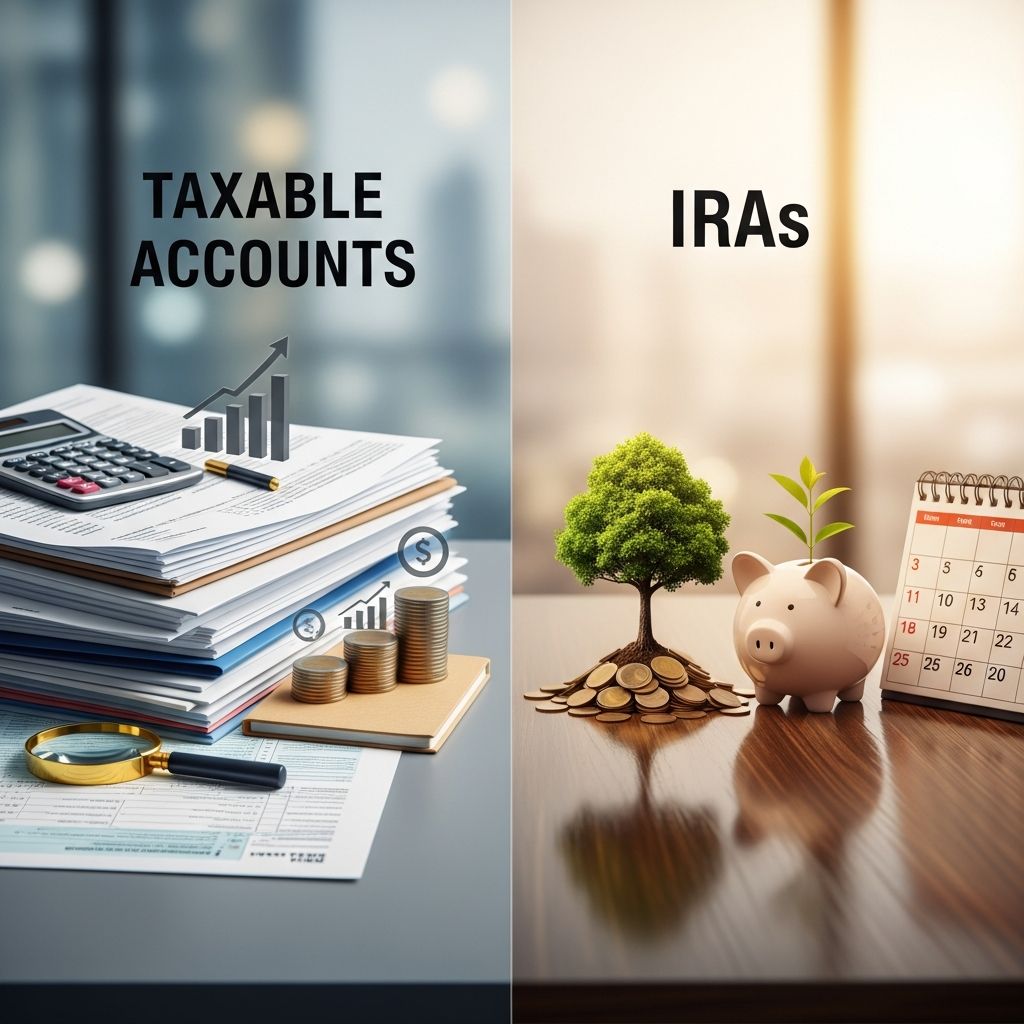
Investment accounts come in various forms, each designed to serve distinct financial needs. Taxable brokerage accounts provide unrestricted access to funds and unlimited investing capacity, ideal for diverse goals. In contrast, Individual Retirement Accounts (IRAs) prioritize long-term retirement through tax incentives but impose strict rules on contributions and access. Understanding these distinctions empowers investors to align their choices with personal objectives, timelines, and tax situations.
Defining the Core Investment Vehicles
A
taxable brokerage account
functions as a versatile platform for purchasing stocks, bonds, ETFs, mutual funds, and other securities. It operates without IRS-imposed restrictions on how much you deposit or when you withdraw, making it suitable for emergency funds, home purchases, or speculative trading. Earnings from dividends, interest, or capital gains trigger immediate tax liabilities in the year realized, regardless of reinvestment.IRAs, however, are specialized retirement wrappers. They encompass
Traditional IRAs
, where contributions may reduce current taxable income and growth occurs tax-deferred until withdrawal, andRoth IRAs
, funded with after-tax dollars for potential tax-free qualified distributions. Both types shield investments from annual taxes on growth, but access before age 59½ often incurs penalties.Tax Implications: The Fundamental Divide
Tax treatment marks the primary divergence. In taxable accounts, short-term capital gains (assets held under one year) face ordinary income tax rates, while long-term gains benefit from preferential rates up to 20%, plus a 3.8% net investment income tax for high earners. Dividends qualify as qualified (15% rate) or ordinary, taxed annually.
Traditional IRAs defer taxes: deductible contributions lower adjusted gross income now, with withdrawals taxed as ordinary income. Roth IRAs flip this—non-deductible contributions yield tax-free growth and qualified withdrawals, ideal if expecting higher future tax brackets. Per IRS guidelines, Roth eligibility phases out at modified adjusted gross incomes of $153,000 for singles and $242,000 for joint filers in 2026.
| Feature | Taxable Brokerage Account | Traditional IRA | Roth IRA |
|---|---|---|---|
| Contribution Tax | After-tax dollars | Often deductible | After-tax (non-deductible) |
| Growth Taxes | Annual on realized gains/dividends | Deferred until withdrawal | Tax-free if qualified |
| Withdrawal Taxes | Capital gains on sales | Ordinary income | Tax-free if qualified |
Contribution Rules and Limits
Taxable accounts impose no caps, allowing deposits of any amount anytime, funded via cash, transfers, or securities. This suits high earners exceeding IRA thresholds or those pursuing aggressive accumulation.
IRAs cap contributions annually: $7,500 for under-50s and $8,600 for 50+ in 2026, per IRS adjustments for inflation. These limits apply per person, separate from employer plans like 401(k)s, enabling combined tax-advantaged savings up to $30,500 or more. Eligibility hinges on earned income matching or exceeding contributions.
- Traditional IRA deductions phase out based on income and workplace plan coverage: full for singles under $81,000 MAGI in 2026.
- Roth direct contributions unavailable above income limits, though backdoor strategies exist for high earners.
Access and Withdrawal Flexibility
Taxable accounts offer complete liquidity—no age restrictions or penalties. Sell assets freely, though triggering taxes on gains. This appeals for near-term needs like education funding or business ventures.
IRAs enforce retirement focus: pre-59½ withdrawals from earnings face 10% penalties plus taxes, barring exceptions like first-home buys ($10,000 lifetime Roth limit) or medical expenses. Post-59½, Traditional distributions are penalty-free but taxable; Roth qualified withdrawals (account open 5+ years) are entirely tax-free. Required Minimum Distributions (RMDs) begin at age 73 for Traditional IRAs, absent in Roths.
Investment Opportunities Within Each Account
Both vehicles support broad portfolios: individual stocks, bonds, index funds, options (with broker approval), and alternatives like REITs. Taxable accounts may edge in margin trading or concentrated positions without IRA prohibitions on certain collectibles or life insurance.
IRA custodians mirror these options, though some impose fees or limit exotics. Employer-linked IRAs (SEP, SIMPLE) expand self-employed access, with higher limits like 25% of compensation up to $69,000 for SEPs in 2026.
Strategic Applications for Different Life Stages
Young Professionals Building Wealth
Early-career individuals benefit from Roth IRAs for tax-free compounding over decades. Max contributions alongside taxable accounts for house down payments or travel, balancing growth and access.
Mid-Career Families Balancing Goals
With mortgages and college looming, taxable accounts fund predictable expenses without penalties. Simultaneously max Traditional IRAs for deductions amid peak earnings, reducing current taxes.
Pre-Retirees Maximizing Tax Efficiency
Near retirement, Roth conversions ladder Traditional balances, filling low-tax years. Taxable accounts provide bridge funding to avoid IRA penalties or RMDs.
Retirees in Distribution Phase
Taxable assets offer penalty-free income, preserving IRA tax advantages. Sequence withdrawals strategically: taxable first, then Traditional, Roth last for tax minimization.
Pros and Cons at a Glance
| Account Type | Advantages | Disadvantages |
|---|---|---|
| Taxable Brokerage |
|
|
| Traditional IRA |
|
|
| Roth IRA |
|
|
Combining Accounts for Comprehensive Planning
Most investors thrive using both: IRAs for tax-sheltered core retirement, taxable for supplemental goals. Annual maxing IRAs ($7,500+) then overflow to brokerage builds diversified, resilient portfolios. Track basis meticulously in taxable accounts for tax-loss harvesting, offsetting gains.
Rebalance across accounts yearly, selling high-basis lots in taxable to minimize taxes. Consider tax-location: place tax-inefficient bonds in IRAs, growth stocks in taxable for lower long-term rates.
Frequently Asked Questions
Can you fund both a taxable account and IRA simultaneously?
Yes, no rules prohibit parallel contributions. IRA limits stand alone, while taxable accepts unlimited funds.
Do brokerage withdrawals incur penalties?
No penalties apply, but sales trigger capital gains taxes based on holding period and income.
Who qualifies for Roth IRA contributions?
2026 phase-outs: singles $153,000-$173,000 MAGI; joint filers $242,000-$262,000. Backdoor Roth circumvents for higher incomes.
What counts as earned income for IRA contributions?
Wages, salaries, self-employment, commissions—must equal or exceed contributions. Pensions, Social Security do not qualify.
Are brokerage accounts FDIC-insured?
No, SIPC covers up to $500,000 securities/cash against broker failure, not market losses. IRAs follow suit.
Steps to Open and Optimize Your Accounts
- Assess goals: Retirement? Use IRA. Flexible needs? Taxable first.
- Check eligibility: Verify IRA income/deduction rules via IRS Publication 590.
- Select provider: Compare fees, tools, investment access at Fidelity, Vanguard, Schwab.
- Fund strategically: Direct deposit to automate max IRA, then brokerage.
- Monitor taxes: Harvest losses annually; project Roth conversions.
Integrating these accounts holistically elevates wealth building. Consult tax professionals for personalized advice amid evolving rules.
References
- Retirement topics – IRA contribution limits — Internal Revenue Service. 2025-11-01. https://www.irs.gov/retirement-plans/plan-participant-employee/retirement-topics-ira-contribution-limits
- Publication 590-A (2025), Contributions to Individual Retirement Arrangements (IRAs) — Internal Revenue Service. 2025-01-15. https://www.irs.gov/publications/p590a
- Brokerage account vs. IRA: Key differences explained — M1 Finance. 2025-01-10. https://m1.com/knowledge-bank/brokerage-account-vs-ira/
- Roth IRA vs. brokerage account: What’s the difference? — Fidelity Investments. 2025-03-20. https://www.fidelity.com/learning-center/smart-money/roth-ira-vs-brokerage-account
- Brokerage Account vs. Individual Retirement Account (IRA) — SmartAsset. 2025-02-15. https://smartasset.com/investing/brokerage-account-vs-ira
- Topic no. 451, Individual retirement arrangements (IRAs) — Internal Revenue Service. 2025-04-05. https://www.irs.gov/taxtopics/tc451
Similar Articles








Read full bio of medha deb