Tax Rules For Mutual Funds And ETFs: Tax-Smart Strategies
Navigate the complexities of taxation on mutual funds and ETFs to optimize your investment returns and minimize unexpected tax bills.

Investing in mutual funds and exchange-traded funds (ETFs) offers diversification and professional management, but these vehicles come with specific tax consequences that can impact your net returns. Taxes arise from income distributions like dividends and interest, as well as capital gains realized by the fund or when you sell shares. Grasping these rules helps investors make informed choices to preserve wealth.
Core Taxable Events in Fund Investments
Funds generate taxable income in multiple ways. Primarily, they distribute dividends and interest earned from underlying holdings to shareholders, who must report this as income regardless of whether it’s reinvested. Additionally, when funds sell securities at a profit, they pass net capital gains to investors annually, creating tax liabilities even if you hold your shares.
Selling your fund shares triggers personal capital gains taxes based on your holding period. Short-term gains (held one year or less) are taxed at ordinary income rates up to 37%, while long-term gains benefit from preferential rates of 0%, 15%, or 20%, depending on income. High-income investors may also face a 3.8% Net Investment Income Tax (NIIT) on gains if modified adjusted gross income exceeds $200,000 (single) or $250,000 (joint filers) in 2026.
Dividend and Interest Taxation Explained
Mutual funds and ETFs pass through income from stocks, bonds, and other assets. Qualified dividends from domestic or certain foreign stocks held over 60 days qualify for long-term capital gains rates (0%-20%). Nonqualified dividends and interest from taxable bonds are taxed at ordinary income rates up to 37%.
- Qualified dividends: Lower rates apply if holding periods are met; common in equity funds.
- Interest income: From bond funds, fully taxable at ordinary rates federally.
- Frequency: Funds must distribute at least 90% of net income annually, often quarterly for dividend funds.
Municipal bond funds offer tax-exempt interest at the federal level, appealing for high-tax-bracket investors, though state taxes may apply if not issued in your state.
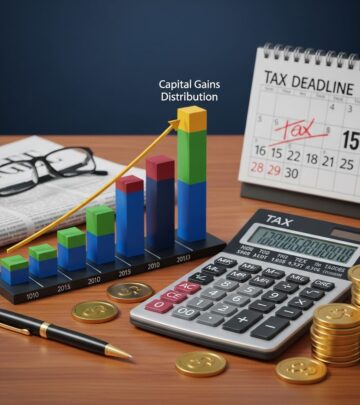
Capital Gains Distributions: The Hidden Tax Trap
Unlike individual stocks, funds realize gains from portfolio turnover, such as rebalancing or meeting redemptions. By law, net gains after losses are distributed to shareholders yearly, taxed at long-term rates if the fund held assets over a year, even for recent buyers.
This creates ‘buy-high, tax-immediately’ scenarios where new investors pay taxes on prior gains without benefiting from appreciation. Mutual funds often distribute more capital gains due to cash redemptions forcing asset sales, while ETFs minimize this through in-kind mechanisms.
| Fund Type | Typical Capital Gains Distributions | Reason |
|---|---|---|
| Mutual Funds | Higher frequency and amount | Cash redemptions trigger sales |
| ETFs | Lower, often zero | In-kind redemptions avoid sales |
| Active Funds | Highest | Frequent trading |
| Passive Index Funds | Lowest | Minimal turnover |
Data shows passive ETFs and low-turnover active ETFs distribute far fewer gains than mutual funds, enhancing after-tax performance.
Why ETFs Often Outperform on Tax Efficiency
ETFs trade like stocks on exchanges, using a creation/redemption process with authorized participants (APs). When shares are redeemed, APs receive baskets of underlying securities ‘in-kind’ rather than cash, allowing funds to offload low-basis (appreciated) assets without realizing gains. This ‘heartbeats’ trades defer taxes.
Mutual funds, conversely, pay cash for redemptions, often selling securities and triggering taxable gains shared by all shareholders. Studies indicate ETFs deliver average annual tax savings of 1.05% over active mutual funds since 2012, higher in growth or small-cap styles.
- In-kind transfers: ETFs hand over securities, avoiding sales.
- Custom baskets: Post-2019 SEC Rule 6c-11, ETFs optimize by redeeming appreciated holdings.
- Lower turnover: Passive ETFs track indexes with minimal changes.
Result: ETFs rarely distribute capital gains, letting gains compound tax-deferred until you sell.
Selling Shares: Your Control Over Taxes
When you sell fund shares, gains are calculated as sale price minus cost basis (purchase price plus reinvested distributions). Use methods like average cost, FIFO, or specific ID to optimize.
Long-term holdings (over one year) qualify for lower rates. ETFs’ tax deferral builds larger embedded gains, but step-up in basis at death erases taxes for heirs. Futures-based or commodity ETPs follow different rules, like 60/40 long/short-term split (60% at 0%-20%, 40% at ordinary rates up to 26.8% blended).
Tax Strategies for Fund Investors
Minimize taxes through placement and tactics:
- Tax-advantaged accounts: Hold in IRAs or 401(k)s for deferral; taxes apply on withdrawal.
- Asset location: Place tax-inefficient funds (high-dividend, turnover) in retirement accounts; tax-efficient ETFs in taxable.
- Tax-loss harvesting: Sell losers to offset gains, carrying forward excess.
- Hold long-term: Qualify for lower rates; avoid frequent trading.
- ETF conversions: Mutual funds converting to ETFs boost efficiency via in-kind process.
For international funds, foreign tax credits offset withholding taxes on dividends.
Special Cases: Bonds, Commodities, and Currency
Bond ETFs distribute interest at ordinary rates but avoid frequent gains via in-kind redemptions. Commodity ETPs using futures apply 60/40 tax treatment, regardless of holding period.
Foreign currency ETPs vary: ’40 Act funds like equities; grantor trusts as ordinary income; partnerships as 60/40. Always check prospectus for structure.
2026 Tax Rates and Thresholds
| Income Type | Tax Rates (Single Filer) | Thresholds (2026 Est.) |
|---|---|---|
| Ordinary Income/Short-term Gains | 10%-37% | Up to $609,350 |
| Qualified Dividends/Long-term Gains | 0%/15%/20% | 0%: <$47,025; 15%: $47,026-$518,900; 20%: over |
| NIIT | 3.8% | Over $200,000 |
Rates indexed for inflation; consult IRS for joint filers.
Frequently Asked Questions
Do ETFs ever distribute capital gains?
Rarely, due to in-kind redemptions, but cash sales for rebalancing or small funds can trigger them.
Are mutual fund taxes avoidable in taxable accounts?
No, distributions are mandatory; choose low-turnover funds to minimize.
How does holding period work for fund gains?
Fund’s holding period determines long/short-term for distributions; your period for personal sales.
Can I reinvest distributions tax-free?
No, taxes due on distributions even if reinvested; they adjust cost basis.
Are muni bond funds always tax-free?
Federal yes, but AMT or state taxes may apply.
Planning for Tax-Smart Investing
Review fund turnover ratios, past distributions, and structures annually. Tax efficiency compounds over time, potentially adding significant value. Work with advisors for personalized strategies, especially with NIIT or state taxes.
References
- ETFs and tax efficiency: What you need to know — State Street Global Advisors. 2023. https://www.ssga.com/us/en/individual/resources/education/etfs-and-tax-efficiency-what-you-need-to-know
- ETFs and Taxes: What You Need to Know — Charles Schwab. 2025. https://www.schwab.com/learn/story/etfs-and-taxes-what-you-need-to-know
- Tax Efficiency: ETF vs Mutual Fund — TurboTax (Intuit). 2024. https://turbotax.intuit.com/tax-tips/investments-and-taxes/tax-efficiency-etf-vs-mutual-fund/L1sYF0Ec3
- Tax efficiency of ETFs — J.P. Morgan Asset Management. 2024. https://am.jpmorgan.com/us/en/asset-management/adv/insights/etf-insights/tax-efficiency-of-etfs/
- The Role of Taxes in the Rise of ETFs — Harvard Law School Forum on Corporate Governance. 2025-05-22. https://corpgov.law.harvard.edu/2025/05/22/the-role-of-taxes-in-the-rise-of-etfs/
- ETF tax benefits: Why ETFs can be efficient investments — Invesco US. 2024. https://www.invesco.com/us/en/insights/tax-benefits-of-etfs.html
- How mutual funds & ETFs are taxed — Vanguard Investor Resources. 2025. https://investor.vanguard.com/investor-resources-education/taxes/how-mutual-funds-etfs-are-taxed
Similar Articles








Read full bio of Sneha Tete