Tariff Checks: Will Trump Actually Send You a $2,000 ‘Dividend’?
Exploring Trump's $2,000 tariff dividend proposal and what it means for American households.
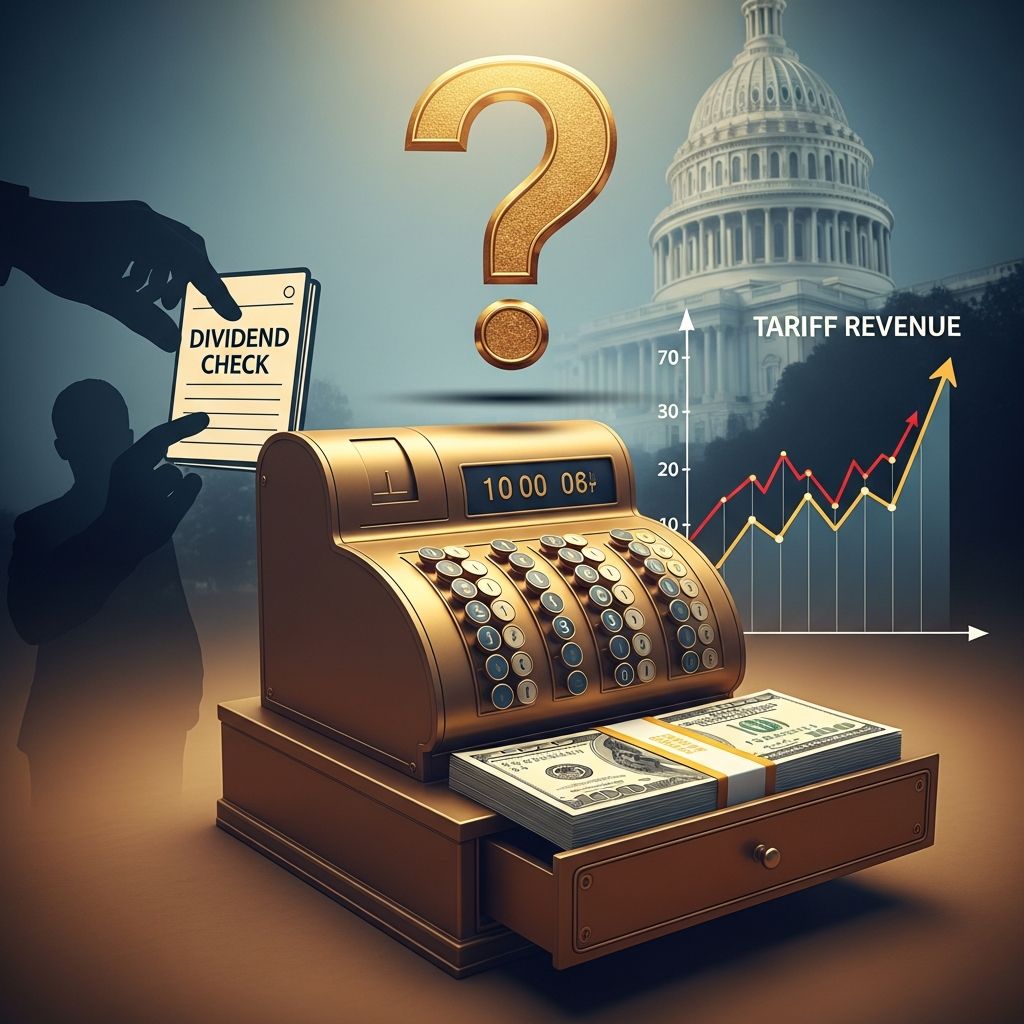
President Trump has repeatedly highlighted the substantial revenue generated from tariffs—money paid by American businesses that often gets passed along to consumers. Recently, Trump proposed returning this revenue to Americans through $2,000 payments described as ‘tariff dividends.’ However, experts and administration officials have raised serious questions about whether this plan is financially viable and how it would actually be implemented.
Understanding Trump’s Tariff Dividend Proposal
In recent statements, Trump outlined an ambitious plan to distribute tariff revenue directly to middle and lower-income Americans. ‘We’re going to issue a dividend to our middle income people and lower income people of about $2,000,’ Trump stated. ‘And we’re going to use the remaining tariffs to lower our debt.’ The proposal aims to provide immediate relief to Americans struggling with affordability while simultaneously reducing the national debt—a dual objective that has drawn significant scrutiny from budget experts.
The $2,000 figure represents a substantial commitment. If executed as described, it would mean direct payments to millions of Americans, positioning the plan as a modern version of pandemic-era stimulus checks. However, the proposal remains largely conceptual, lacking the detailed policy framework and legislative roadmap necessary for implementation.
The Budget Gap Problem
Budget analysts have identified a critical flaw in Trump’s tariff dividend plan: there simply isn’t enough revenue to fund it. Erica York, vice president of federal tax policy at the Tax Foundation, has performed detailed calculations showing substantial shortfalls.
According to York’s analysis, if the rebates were limited to people making under $100,000 annually, the cost would exceed the amount of revenue tariffs generate. ‘So you’ll see at least a $100 billion gap there between what we can expect the tariffs to generate for the U.S. government versus what the president is promising to spend on tariff rebates for American citizens,’ York explained.
The math becomes even more challenging when considering broader eligibility criteria. Even if payments were restricted solely to individuals earning $75,000 or less annually, the calculations still reveal insufficient revenue to cover the proposed distribution. This mathematical reality suggests that implementing the plan as described would actually increase the federal deficit—the opposite of Trump’s stated objective to reduce national debt through tariff revenue.
How the Plan Might Actually Work
White House officials have begun clarifying that the tariff dividend might not take the form of direct checks to taxpayers, despite Trump’s rhetoric suggesting otherwise. Treasury Secretary Scott Bessent indicated on Sunday that voters might receive the money through alternative mechanisms already in place.
‘The $2,000 dividend could come in lots of forms,’ Bessent said. ‘It could be just the tax decreases that we are seeing on the president’s agenda. You know, no tax on tips, no tax on overtime, no tax on Social Security.’
This explanation suggests that the administration might be redefining what constitutes a ‘tariff dividend’ to include tax benefits already passed or proposed, rather than actual cash distributions. The distinction is significant: while tax cuts provide financial benefits, they function differently than direct payments and may reach different populations or provide varying levels of assistance.
The Supreme Court Complication
Trump’s tariff revenue messaging creates a legal and rhetorical problem for the administration at a critical moment. The Supreme Court recently heard arguments challenging the constitutionality of some Trump tariffs, with opponents arguing that Congress—not the president—possesses the power to levy taxes.
In response, administration lawyers argued before the justices that revenues aren’t the primary purpose of the tariffs. ‘These are regulatory tariffs,’ Solicitor General John Sauer told the Court. ‘They are not revenue-raising tariffs. The fact that they raise revenue is only incidental.’
This creates a contradiction: the administration simultaneously argues to the Supreme Court that tariffs aren’t primarily about raising revenue while Trump publicly brags about tariff revenue and proposes spending it on dividends. Treasury Secretary Bessent attempted to resolve this tension by suggesting the tariffs are ultimately meant to bring businesses back to the United States, regardless of revenue generation. However, the tension between these positions undermines the administration’s legal arguments and highlights the political and constitutional complexities surrounding the proposal.
Congressional Authorization Requirements
Regardless of how the tariff dividend is structured, Congress would need to authorize any payments to Americans. This requirement introduces substantial political uncertainty. Even if the federal government were fully operational and focused on the proposal, there’s no guarantee that Congress would approve the plan.
The legislative path forward remains unclear, particularly given partisan divisions and competing fiscal priorities. Budget hawks may oppose the plan due to deficit concerns, while other lawmakers might question the policy’s underlying logic or prefer alternative uses of tariff revenue. The need for congressional approval means that Trump’s proposal, currently more aspirational than concrete, would require negotiation, compromise, and legislative support to become reality.
Tariff Revenue Reality and Calculations
Understanding actual tariff revenue figures helps contextualize the proposal’s feasibility. The U.S. Treasury tracks daily tariff collections through its Daily Treasury Statement. However, important distinctions exist between gross and net tariff revenue.
Gross tariff revenue represents the raw collections before accounting for refunds and administrative adjustments. Net tariff revenue, which removes certain adjustments and accounts for tariff refunds, typically represents 80 to 85 percent of gross revenue. Additionally, non-partisan scoring organizations like the Joint Committee on Taxation account for an income and payroll tax offset of approximately 25 percent when calculating true economic revenue from excise taxes like tariffs.
These calculations mean that actual available revenue from tariffs is substantially lower than headline figures might suggest. The compounding effects of these adjustments significantly narrow the gap between tariff collections and proposed spending, making budget experts’ concerns about the $2,000 dividend plan even more acute.
Impact on Consumer Prices
While the dividend proposal focuses on distributing revenue back to Americans, tariffs themselves increase consumer costs. American businesses subject to tariffs often pass the costs to consumers through higher prices on goods ranging from groceries to furniture to prescriptions. This creates a complex economic dynamic: while some Americans might receive tariff dividends, many would simultaneously experience higher prices due to tariff-related costs.
The net economic benefit to consumers depends on multiple factors, including the size of dividend distributions, the breadth of eligible recipients, and the extent to which tariff-related price increases affect individual households. For some Americans, dividend payments might exceed increased costs, while for others, the opposite could be true.
Expert Skepticism and Political Context
Budget experts have expressed skepticism about the proposal’s framing and feasibility. Erica York characterized the initiative as more political messaging than serious policy development: ‘To me, this seems less of a thought out policy proposal and more of, “A $2,000 check sounds good. People are struggling with affordability. They’re tired of inflation. What can I say to make them think I’m trying to do something?”‘
This assessment highlights that the proposal may reflect political priorities—addressing voter concerns about affordability—rather than a carefully designed fiscal policy. The $2,000 figure itself carries political weight; it’s substantial enough to seem meaningful to struggling Americans while remaining within a conceptually manageable range.
Comparison with Previous Stimulus Programs
| Characteristic | COVID-19 Stimulus Checks | Proposed Tariff Dividend |
|---|---|---|
| Funding Source | Federal appropriations/deficit spending | Tariff revenue (disputed availability) |
| Direct Payments | Yes, as direct checks | Unclear; possibly tax adjustments |
| Eligibility | Broadly based on income/tax filing status | Proposed focus on middle/lower income |
| Amount Per Person | Up to $1,200-$1,400 per check | $2,000 proposed |
| Congressional Approval | Required and obtained | Required but status uncertain |
| Implementation Timeline | Months (multiple tranches) | Not determined |
Key Takeaways for American Households
Several important points emerge from analyzing Trump’s tariff dividend proposal:
Budget Mathematics Don’t Add Up: Current tariff revenue projections fall substantially short of funding $2,000 payments to all eligible Americans, creating a potential $100+ billion shortfall.
Implementation Remains Unclear: The administration has not specified whether payments would be direct checks, tax adjustments, or other mechanisms, complicating expectations about how and when Americans would receive benefits.
Congressional Action Required: Even if the administration clarifies the proposal, Congress must approve any payment distribution, introducing additional uncertainty about whether the plan will proceed.
Tariffs Still Increase Prices: Regardless of dividend distribution, tariffs continue to increase consumer prices across numerous product categories, potentially offsetting dividend benefits for many households.
Deficit Impact Concerns: If implemented without sufficient revenue, the plan could increase federal deficits rather than reduce them, contradicting stated objectives.
Frequently Asked Questions (FAQs)
Q: When will Americans receive tariff dividend checks?
A: No specific timeline has been announced. The proposal remains conceptual without concrete implementation details or congressional approval.
Q: How much tariff revenue is actually available?
A: Current projections suggest insufficient revenue to fund $2,000 payments to all eligible Americans, with analysts identifying a $100+ billion shortfall.
Q: Could the payment be distributed as tax cuts instead of checks?
A: Yes. Treasury Secretary Bessent indicated the $2,000 dividend could take the form of tax benefits already implemented, such as exemptions on tips, overtime, or Social Security income.
Q: Will tariff-related price increases offset the dividend benefits?
A: Possibly. The net benefit depends on individual circumstances. Some households may receive more in dividends than they pay in tariff-related price increases, while others may experience the opposite.
Q: Does Congress need to approve this proposal?
A: Yes. Any form of direct payment or significant fiscal commitment would require congressional authorization, which is not guaranteed.
Q: Who would be eligible for the $2,000 dividend?
A: Trump proposed targeting middle and lower-income Americans, but specific income thresholds and eligibility criteria have not been formally defined.
Q: How does this relate to the Supreme Court tariff cases?
A: The administration’s emphasis on tariff revenue for dividends contradicts its Supreme Court argument that tariffs are regulatory rather than revenue-focused, creating legal complications.
References
- Trump floats tariff ‘dividends’ even while plan shows major flaws — Oregon Public Broadcasting. 2025-11-11. https://www.opb.org/article/2025/11/11/trump-2000-dollar-tariff-checks/
- How Much Are U.S. Tariffs Raising in Revenue? — Bipartisan Policy Center. 2025. https://bipartisanpolicy.org/explainer/tariff-tracker/
- U.S. Treasury Department Daily Treasury Statement — U.S. Department of the Treasury. https://fiscal.treasury.gov/reports-statements/dts/current.html
- Tariff Revenue Data and Analysis — U.S. International Trade Commission. https://www.usitc.gov/
Similar Articles








Read full bio of medha deb