Tangible Common Equity: Definition, Calculation & Importance
Understand tangible common equity and how it measures financial stability and asset strength.
Tangible Common Equity: Definition, Calculation and Importance
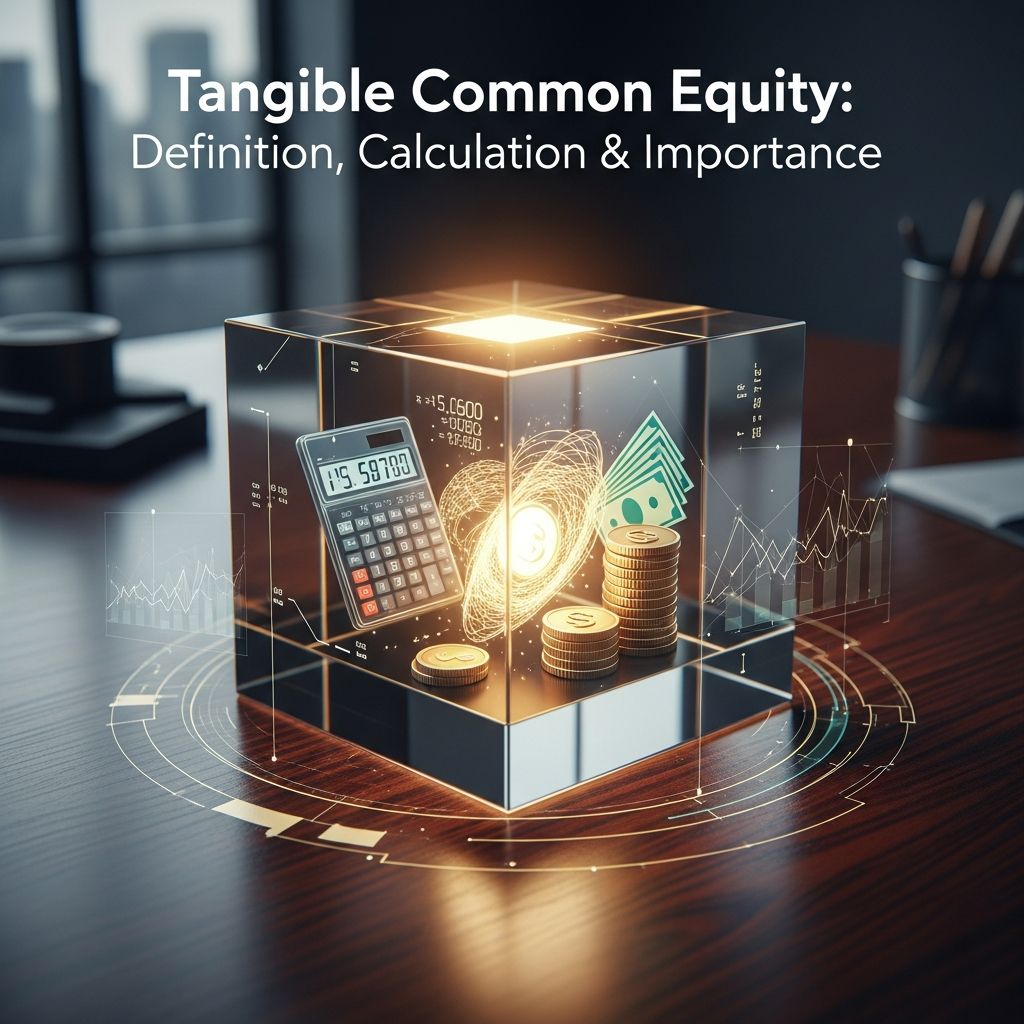
Tangible Common Equity (TCE) represents a critical financial metric that provides investors, creditors, and analysts with a clearer understanding of a company’s true financial position. Unlike conventional equity measures that include intangible assets, TCE focuses exclusively on the real, readily available capital that a company possesses. This distinction becomes particularly important during periods of economic uncertainty or financial stress, when the ability to quantify actual, liquidatable resources becomes paramount.
In essence, Tangible Common Equity measures the portion of a company’s equity that remains after removing intangible assets such as goodwill, patents, trademarks, and brand value. By concentrating on tangible assets—those with physical presence like property, equipment, inventory, and cash—TCE offers a more conservative and realistic assessment of a company’s financial strength compared to broader equity measures. This metric has gained significant prominence, particularly in the banking and financial services sectors, where regulatory bodies use it to evaluate institutional resilience.
What Is Tangible Common Equity?
Tangible Common Equity refers to the subset of shareholders’ equity that represents the ownership stake of common shareholders after excluding both preferred equity and intangible assets. The metric answers a fundamental question: if a company were forced to liquidate its assets immediately, how much real capital would be available to cover obligations and distribute to common shareholders?
The “tangible” component of TCE encompasses all physical assets and liquid resources that can be readily converted to cash or used to settle debts. These include real estate, manufacturing equipment, inventory, cash reserves, accounts receivable, and marketable securities. The “common equity” portion specifies that the measure applies only to ordinary shareholders, excluding preferred shareholders who hold different classes of ownership with their own claim priorities.
The significance of TCE became particularly evident during the 2008-2009 financial crisis, when many financial institutions appeared solvent based on traditional equity measures but lacked sufficient tangible assets to absorb mounting losses. This experience demonstrated that traditional accounting measures could mask underlying vulnerabilities in financial institutions, leading regulators and investors to embrace TCE as a more transparent indicator of true financial strength.
How to Calculate Tangible Common Equity
The calculation of Tangible Common Equity follows a straightforward formula that removes layers of non-physical value from a company’s equity base. Understanding this calculation enables investors to perform their own analysis and verify reported figures.
The fundamental formula for calculating TCE is:
TCE = Total Common Equity − Intangible Assets
Breaking down the components of this formula:
Total Common Equity represents the total value of ownership held by common shareholders, as reported on the company’s balance sheet. This figure includes common stock, retained earnings, and other comprehensive income attributable to common shareholders. To find this value, subtract total liabilities from total assets, then deduct any preferred equity.
Intangible Assets encompass all non-physical assets that lack a tangible presence. Primary examples include goodwill (the premium paid in acquisitions above the fair value of acquired assets), patents, trademarks, copyrights, brand names, software licenses, customer relationships, and other intellectual property. These assets, while potentially valuable, cannot be physically touched or readily converted to cash in most circumstances.
Example Calculation of Tangible Common Equity
To illustrate how TCE calculation works in practice, consider a hypothetical manufacturing company called ABC Industries with the following balance sheet information:
Total Common Equity: $750 million
Goodwill: $150 million
Patents and Trademarks: $75 million
Other Intangible Assets: $25 million
Using the TCE formula:
TCE = $750 million − ($150 million + $75 million + $25 million)
TCE = $750 million − $250 million = $500 million
In this example, ABC Industries’ Tangible Common Equity would be $500 million. This represents the company’s “real” equity capital—the amount available if the company needed to liquidate its tangible assets to meet financial obligations. The $250 million in intangible assets, while contributing to the company’s market value and competitive position, would not be available as a buffer against unexpected losses in a crisis scenario.
Why Is Tangible Common Equity Important?
TCE serves multiple critical functions in financial analysis and decision-making across different stakeholder groups. Understanding these applications reveals why this metric has become increasingly important in modern financial markets.
Financial Health Assessment: A high TCE indicates that a company maintains a robust foundation of tangible assets that can absorb unexpected losses and economic downturns. Companies with substantial tangible equity demonstrate greater financial resilience and stability, making them lower-risk investments for conservative investors.
Risk Evaluation: In financial institutions particularly, TCE serves as a crucial risk indicator. Banks and insurance companies with strong TCE ratios demonstrate superior capacity to withstand significant financial stress, loan defaults, and market volatility. Regulators monitor TCE as a key prudential measure when assessing institutional soundness.
Acquisition and Valuation Analysis: When evaluating companies for acquisition or merger purposes, TCE provides a realistic estimate of underlying asset value independent of intangible asset valuations that may be subjective or temporary. This grounding in physical reality makes TCE particularly valuable for distressed asset acquisitions and value investing strategies.
Comparative Industry Analysis: TCE enables meaningful comparisons between companies within the same industry by normalizing for different capital structures and acquisition histories. This standardization helps identify which firms maintain stronger asset foundations relative to their equity bases.
Industry Applications and Variations
The relevance and utility of TCE varies significantly across different business sectors, reflecting the distinct asset compositions and financial structures of different industries.
Banking and Financial Services: TCE holds paramount importance in the banking sector, where regulatory frameworks explicitly incorporate tangible common equity requirements. Banks must maintain minimum TCE ratios to ensure they possess sufficient loss-absorbing capacity. The 2008 financial crisis reinforced this emphasis, as regulators recognized that banks relying heavily on intangible assets and complex financial instruments faced systemic risks.
Manufacturing and Retail: For traditional industries emphasizing physical operations, TCE represents a highly relevant metric. Manufacturing companies with substantial machinery, facilities, and inventory maintain meaningful tangible equity. Similarly, retail enterprises with numerous store locations and merchandise inventory possess significant tangible assets that support their balance sheets.
Technology Sector: Technology companies present a contrasting scenario where intangible assets often represent the primary source of value. Software firms, biotechnology companies, and innovative technology enterprises derive value primarily from intellectual property, patents, and proprietary technology rather than physical assets. For these companies, high intangible asset levels relative to equity are normal and expected, making TCE a less critical metric for evaluation. In technology valuations, traditional profitability metrics and growth measures often provide more meaningful insights than tangible asset bases.
Real Estate and Infrastructure: Real estate investment trusts (REITs) and infrastructure companies maintain substantial tangible assets that directly correspond to their business operations and revenue generation. For these enterprises, TCE remains a highly relevant measure reflecting actual property and infrastructure holdings.
Tangible Common Equity Versus Total Equity
Understanding the distinction between TCE and total equity clarifies why analysts emphasize the more conservative tangible measure in specific contexts.
| Metric | Definition | Assets Included | Best Used For |
|---|---|---|---|
| Total Equity | All assets minus all liabilities | Tangible and intangible assets | Overall ownership stake valuation |
| Tangible Common Equity | Common equity minus intangible assets and goodwill | Only physical, tangible assets | Financial stability assessment during stress |
Total Equity represents the comprehensive value of all company assets minus liabilities, encompassing both tangible and intangible components. This metric appears on balance sheets as stockholders’ equity and reflects the accounting-based net worth of the enterprise. While total equity provides a complete picture of ownership value under normal circumstances, it can obscure underlying vulnerabilities when companies carry substantial intangible asset valuations.
Tangible Common Equity focuses exclusively on readily liquidatable resources, providing a stress-tested view of available capital. The exclusion of intangible assets becomes critically important during financial crises, when brand value, patents, and goodwill may lose relevance while debt obligations remain fixed. Historical examples demonstrate that companies with seemingly healthy total equity can rapidly deteriorate when forced to liquidate primarily tangible assets to meet obligations.
For example, consider a financial services firm with $5 billion in total equity composed of $3 billion in tangible assets and $2 billion in goodwill from acquisitions. Its total equity appears robust, but its tangible common equity of only $3 billion represents its actual loss-absorption capacity before facing solvency concerns.
The Tangible Common Equity Ratio
The TCE Ratio provides a standardized metric for comparing tangible equity levels across companies of different sizes by relating tangible common equity to total assets.
TCE Ratio = Tangible Common Equity ÷ Total Assets
This ratio expresses tangible common equity as a percentage of total assets, revealing what proportion of total assets consists of tangible equity held by common shareholders. A higher TCE ratio indicates greater financial strength and loss-absorption capacity relative to the company’s total asset base. Investors typically view TCE ratios exceeding 8-10% favorably for financial institutions, though appropriate benchmarks vary by industry and regulatory environment.
The TCE ratio enables direct comparisons between institutions with vastly different asset sizes. A large multinational bank and a regional bank can be meaningfully compared using their respective TCE ratios, whereas absolute TCE figures would provide little analytical value given the size disparity.
Tangible Common Equity and Company Valuation
TCE plays a significant role in determining company valuations, particularly for businesses in financial distress or facing bankruptcy risks. In acquisition scenarios, buyers often discount valuations based on intangible assets that may not materialize post-acquisition, instead focusing on tangible asset bases as reliable value anchors.
Value investors and distressed asset specialists utilize TCE to identify potentially undervalued opportunities where stock prices have declined below tangible asset values. This approach, sometimes called “net-net investing,” seeks securities trading below their liquidation value calculated on a tangible asset basis.
During company liquidations or restructurings, creditors and stakeholders reference TCE extensively to establish priority claims and determine recovery rates. The tangible asset base defines the actual resources available for distribution, making TCE the operative metric in these circumstances.
Frequently Asked Questions
What is the difference between Tangible Common Equity and Total Equity?
Total Equity includes all company assets (both tangible and intangible) minus liabilities, representing comprehensive ownership value. Tangible Common Equity excludes intangible assets like goodwill, patents, and intellectual property, focusing exclusively on physical assets. This makes TCE more conservative and useful for assessing financial stability during economic stress.
Why is Tangible Common Equity important for banks?
Banks require strong TCE to absorb loan losses and unexpected financial shocks. Regulators use TCE ratios to assess whether banks maintain sufficient loss-absorption capacity before facing insolvency. This became especially evident during the 2008 financial crisis when TCE emerged as a critical solvency indicator.
How does TCE differ across industries?
TCE relevance varies by industry. For banks, manufacturing, and retail firms with substantial physical assets, TCE represents a crucial metric. For technology companies relying on intellectual property and intangible value, TCE is less critical since their value derives primarily from non-physical assets.
Can a company have negative Tangible Common Equity?
Yes, companies can report negative TCE when intangible assets and goodwill exceed total common equity. This situation indicates that the company has accumulated losses or made acquisitions at prices substantially exceeding tangible asset values. Negative TCE signals financial weakness and reduced loss-absorption capacity.
How is TCE used in investment analysis?
Investors compare company stock prices to tangible common equity per share to identify potentially undervalued securities trading below their tangible asset backing. Value investors particularly utilize TCE to find opportunities where market pessimism has depressed valuations below fundamental tangible asset support.
References
- Tangible Common Equity: What Is It, Calculation and Importance — Investing.com Academy. 2025. https://www.investing.com/academy/analysis/tangible-common-equity-definition/
- Return on Tangible Equity (ROTE): Formula + Calculator — Wall Street Prep. 2024. https://www.wallstreetprep.com/knowledge/return-on-tangible-equity-rote/
- Return on Tangible Equity — Financial Edge Training. 2022-03-18. https://www.fe.training/free-resources/fig/return-on-tangible-equity/
Similar Articles








Read full bio of Sneha Tete