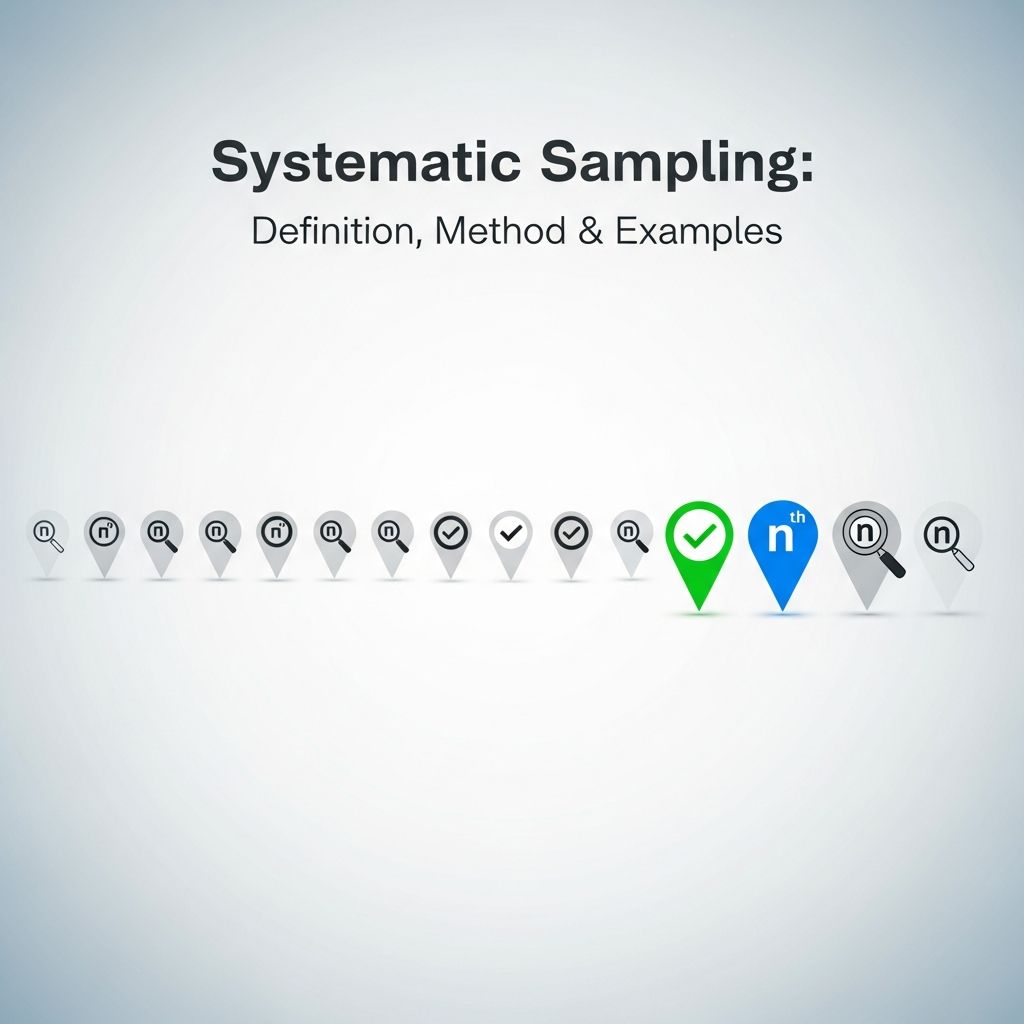
Systematic Sampling: Definition, Method & Examples
Master systematic sampling: A structured probability method for selecting representative data samples efficiently.
What Is Systematic Sampling?
Systematic sampling is a probability sampling method that involves selecting every nth element from a population to create a representative sample. This structured approach to data selection provides researchers with an efficient and unbiased way to gather information from large populations without analyzing every individual element. Unlike completely random selection methods, systematic sampling follows a predetermined pattern that ensures consistent spacing throughout the dataset, making it particularly valuable for financial analysis, market research, quality control, and academic studies.
The method is also known as systematic random sampling because it combines elements of both randomness and structure. Researchers begin by establishing a random starting point and then proceed to select subjects at fixed intervals throughout the population. This combination of initial randomization and systematic selection helps maintain objectivity while ensuring efficient data collection.
How Systematic Sampling Works
The systematic sampling process follows a straightforward, structured approach that any researcher can implement. Understanding the mechanics of this method is essential for applying it correctly in various research contexts.
The first step involves determining the total population size and the desired sample size. From these figures, researchers calculate the sampling interval, represented as k, by dividing the total population by the desired sample size. For example, if a researcher has a population of 1,000 individuals and wants a sample of 100, the sampling interval would be 10 (1,000 ÷ 100 = 10).
Once the interval is established, the researcher selects a random starting point within the first interval. This could involve using a random number generator or another randomization method to choose a number between 1 and k. After this initial random selection, the researcher then selects every kth element from the population list. For instance, if the random starting point is 5 and the interval is 10, the researcher would select elements 5, 15, 25, 35, and so forth throughout the entire population.
Key Steps in Systematic Sampling
Implementing systematic sampling involves following a clear, methodical process:
Step 1: Define the Population
Establish the complete population from which you will sample. This can be done either before data collection begins (by obtaining a complete list) or during the data collection process. When sampling ahead of time, you select subjects from a prepared list at regular intervals. When sampling during collection, you systematically approach subjects in real-time, considering location and timing factors.
Step 2: Determine Sample Size
Decide how many elements you need in your sample. This decision depends on your research goals, available resources, and the desired level of accuracy.
Step 3: Calculate the Sampling Interval
Use the formula: k = N ÷ n, where N is the population size and n is the desired sample size. This interval determines the spacing between selected elements.
Step 4: Select the Random Starting Point
Choose a random number between 1 and k to begin your selection. This ensures the initial randomness that makes the method a probability sampling technique.
Step 5: Select Every kth Element
Beginning from your random starting point, systematically select every kth element from the population list until you have completed your desired sample size.
Advantages of Systematic Sampling
Systematic sampling offers numerous benefits that make it an attractive choice for researchers across various disciplines:
Cost-Effectiveness
When dealing with large datasets, analyzing every element can be prohibitively expensive and time-consuming. Systematic sampling reduces the number of data points needed while maintaining representativeness, resulting in significant savings in time, labor, and computational resources. This makes it particularly valuable for organizations with limited budgets or tight timelines.
Simplicity and Ease of Implementation
Unlike more complex sampling methods, systematic sampling is straightforward to understand and execute. Researchers don’t need advanced statistical knowledge to apply this method, making it accessible to a wide range of practitioners.
Reduced Sampling Bias
By selecting data points at regular intervals following a random start, systematic sampling significantly reduces bias compared to non-probability sampling methods. The fixed pattern prevents researchers from inadvertently favoring certain elements, ensuring more objective sample selection.
Uniform Data Distribution
Systematic sampling ensures samples are spread evenly across the entire dataset. This uniform distribution is crucial in fields like finance, where data can vary significantly over time. It prevents the concentration of data points in any particular period or region, providing a balanced view of the overall population.
Effective Trend Detection
Because systematic sampling maintains regular spacing throughout the dataset, it often reveals patterns and trends that might be missed with simple random sampling. This is particularly valuable in financial markets, where detecting patterns in price movements, trading volumes, and market volatility is essential.
Efficient Resource Management
This method requires fewer calculations than many other probability sampling techniques, allowing for quick and efficient implementation. It’s ideal for organizations that need to analyze large datasets regularly but have time constraints.
Disadvantages and Limitations
Despite its many advantages, systematic sampling has certain limitations researchers should consider:
Periodicity Problems
If the population has a cyclical or periodic pattern that aligns with the sampling interval, the results may be biased. For example, if sampling every seventh day from weekly sales data, you might consistently capture the same day of the week, missing important variations.
Requires an Ordered Population
Systematic sampling works best when the population is randomly ordered or arranged alphabetically. If the population list has an inherent pattern or bias in its ordering, the sample may not be truly representative.
Less Effective for Heterogeneous Populations
When populations contain distinct subgroups with different characteristics, systematic sampling may not capture all important variations. In such cases, stratified sampling might be more appropriate.
Complete Population List Required
Researchers must have access to a complete, organized list of the population. This can be challenging or impossible in certain research contexts where population boundaries are unclear or constantly changing.
Systematic Sampling vs. Other Sampling Methods
| Sampling Method | Selection Process | Bias Reduction | Best Used When |
|---|---|---|---|
| Systematic Sampling | Every nth element at regular intervals after random start | High – Regular intervals reduce bias | Large homogeneous datasets, time-constrained projects |
| Simple Random Sampling (SRS) | Each element has equal chance of selection, completely random | High – True randomness | Small to medium populations with adequate resources |
| Stratified Sampling | Population divided into subgroups, then samples randomly selected from each | High – Ensures representation of all subgroups | Heterogeneous populations with distinct subgroups |
| Cluster Sampling | Population divided into clusters, entire clusters randomly selected | Medium – Depends on cluster homogeneity | Geographically dispersed populations with natural groupings |
Practical Applications of Systematic Sampling
Financial Analysis
In finance, systematic sampling is beneficial when analyzing stock prices over extended periods. Rather than examining millions of individual price points, analysts might select every 100th price to create a manageable sample that still represents overall market trends. This approach helps identify patterns in price movements while significantly reducing computational demands.
Quality Control
Manufacturing and production companies use systematic sampling to inspect products. For example, inspectors might examine every 50th item coming off an assembly line, ensuring consistent quality while avoiding the cost of inspecting every unit.
Market Research
Researchers conducting surveys often use systematic sampling to select respondents from customer databases. This ensures geographic and temporal diversity while maintaining efficiency.
Academic Research
Systematic sampling is widely used in educational research to select student populations, in medical research to select patient records, and in social science studies to analyze behavioral data.
When to Use Systematic Sampling
Systematic sampling is most appropriate in certain circumstances:
Large, Homogeneous Datasets: When populations are relatively uniform and large in size, systematic sampling provides efficient, representative samples with minimal bias.
Time and Resource Constraints: Organizations with limited time or budget should consider systematic sampling because it requires fewer calculations than other probability methods and can be implemented quickly.
Low Risk of Periodicity: When the dataset is unlikely to exhibit periodic patterns, systematic sampling provides reliable results. However, if seasonal trends or market cycles are present and align with the sampling interval, other methods may be more appropriate.
Continuous Data Collection: When data collection occurs over time or in sequence, systematic sampling can be efficiently applied by selecting every nth observation as it occurs.
Systematic Sampling Example
Consider a researcher studying customer satisfaction at a retail chain with 5,000 customers in a database. The researcher wants a sample of 200 customers. Using systematic sampling:
First, calculate the sampling interval: 5,000 ÷ 200 = 25
Next, select a random starting point between 1 and 25, say the number 12.
Then, select every 25th customer: customers 12, 37, 62, 87, 112, and so forth through the entire database.
This process yields a representative sample of 200 customers spread evenly throughout the customer database, ensuring various demographics and purchase patterns are represented.
Frequently Asked Questions
Q: Is systematic sampling qualitative or quantitative?
A: Systematic sampling is a quantitative method used for collecting numerical data and analyzing patterns in large datasets. It’s a key tool for quantitative research in finance, science, and market analysis, though the data collected can sometimes include qualitative elements.
Q: Why is systematic sampling considered better than simple random sampling?
A: Systematic sampling is often preferred for large datasets because it’s easier to implement, reduces bias through regular intervals, ensures uniform sample distribution, is more cost-effective, and efficiently detects trends over time compared to simple random sampling.
Q: Can systematic sampling be used for small populations?
A: While systematic sampling can be used for small populations, it’s most efficient and beneficial for large datasets. For smaller populations, simple random sampling or other methods might be more practical.
Q: How do I handle periodicity in systematic sampling?
A: If you suspect periodicity in your data, analyze your population list for patterns before applying systematic sampling. If strong periodicity exists that aligns with your sampling interval, consider using stratified sampling or adjusting your sampling interval to avoid the periodic pattern.
Q: What’s the difference between systematic sampling and stratified sampling?
A: Systematic sampling selects every nth item at regular intervals after a random starting point, while stratified sampling divides the population into subgroups (strata) based on shared characteristics and then randomly selects samples from each subgroup.
References
- Systematic Sampling in Finance — OneMoneyWay. 2025. https://onemoneyway.com/en/dictionary/systematic-sampling/
- What Is Systematic Sampling? Definition & Examples — QuillBot Research. 2025. https://quillbot.com/blog/research/systematic-sampling/
- Systematic Sampling: Definition, Examples, and Types — QuestionPro. 2025. https://www.questionpro.com/blog/systematic-sampling/
- Systematic Sampling: A Step-by-Step Guide with Examples — Scribbr. 2025. https://www.scribbr.com/methodology/systematic-sampling/
Similar Articles








Read full bio of Sneha Tete