Systematic Risk: Definition, Examples, and Measurement
Understanding market risk: What systematic risk is, how it differs from unsystematic risk, and how to measure it using beta.
What is Systematic Risk?
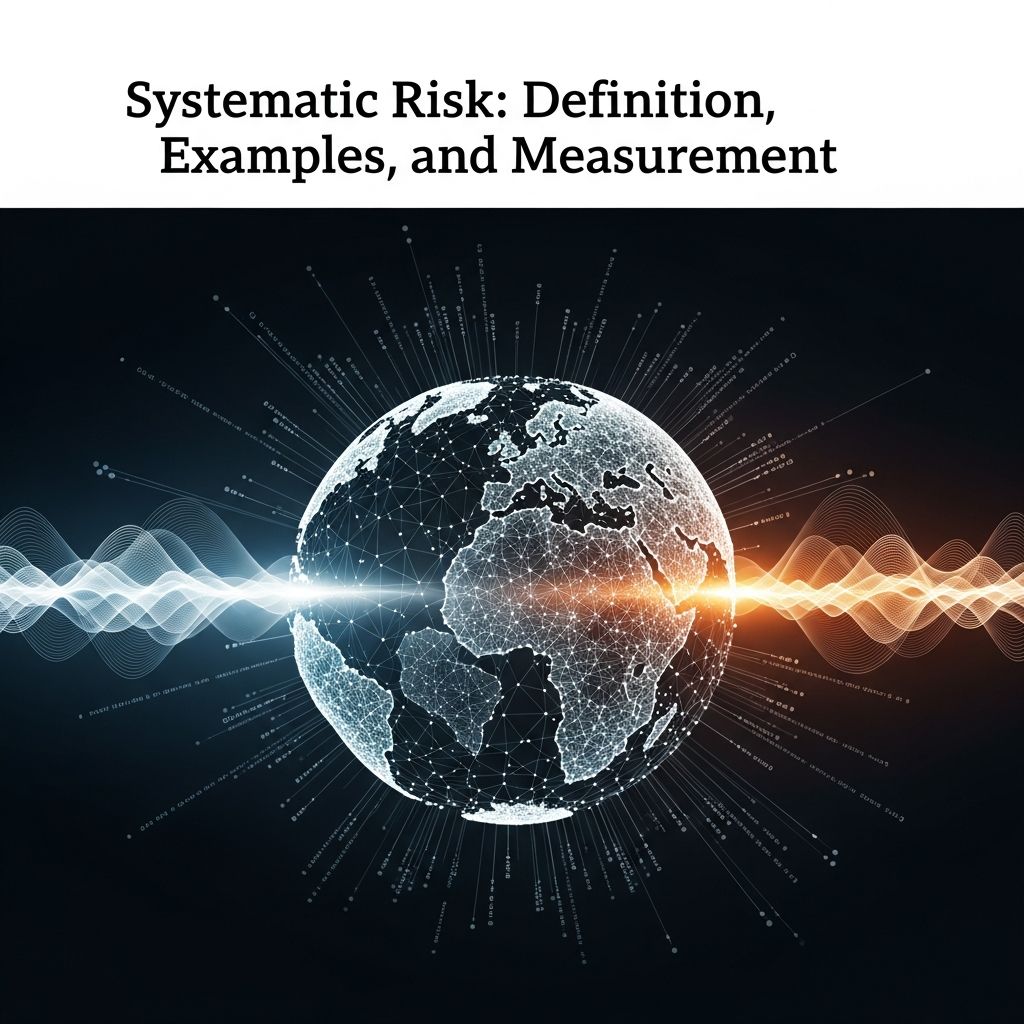
Systematic risk, also known as market risk, represents the risk inherent to the entire financial market and economy as a whole, rather than affecting only one specific company or industry. This type of risk stems from macroeconomic factors and external events that impact all investments across the market simultaneously. Because systematic risk affects the broader economy and financial system, it cannot be eliminated through portfolio diversification alone, unlike unsystematic risk, which is specific to individual companies or securities.
The far-reaching scope of systematic risk means that when it manifests, entire sectors and markets are placed in vulnerable positions. While some companies and industries recover quickly from systematic shocks, others suffer severe monetary damages that can lead to bankruptcy or liquidation. Understanding systematic risk is crucial for investors and financial professionals seeking to build resilient investment strategies and manage potential losses across their portfolios.
Understanding the Definition of Systematic Risk
Systematic risk encompasses all the risk factors that are beyond the control of any single company or individual investor. These external factors create market-wide effects that influence security prices regardless of how well-managed a particular company might be. Unlike unsystematic risk, which can be mitigated through careful security selection and portfolio construction, systematic risk persists across all investments in the market.
The definition of systematic risk extends to include market risk, interest rate risk, purchasing power risk, and exchange rate risk. Market risk, which constitutes almost two-thirds of total systematic risk, arises from the herd mentality of investors and their tendency to move in the same direction, causing security prices to move together. Interest rate risk affects fixed-income securities, as bond prices move inversely to market interest rates. These interconnected risks demonstrate why systematic risk cannot be completely avoided through diversification strategies alone.
Causes and Sources of Systematic Risk
Systematic risk emerges from macroeconomic events and external factors that create domino effects throughout the global financial system. Several key sources contribute to systematic risk exposure across all investments:
- Global recessions and economic downturns
- Geopolitical events and conflicts
- Pandemic outbreaks and health crises
- Natural disasters and environmental catastrophes
- Monetary policy changes and inflation
- Currency crashes and exchange rate fluctuations
- Market crashes and widespread corrections
- Interest rate changes and credit market disruptions
These macroeconomic factors create systemic vulnerabilities that affect all market participants simultaneously. When a global recession occurs, for example, companies across industries experience declining sales and reduced profitability. During periods of high inflation driven by monetary policy changes, all investors face reduced purchasing power and increased borrowing costs. Natural disasters and pandemics disrupt supply chains and consumer behavior across entire economies, creating widespread market stress.
Systematic Risk versus Unsystematic Risk: Key Differences
In corporate finance and investment management, total risk is segmented into two distinct categories: systematic risk and unsystematic risk. Understanding the differences between these two types of risk is critical for effective risk management and portfolio construction.
| Characteristic | Systematic Risk | Unsystematic Risk |
|---|---|---|
| Scope | Affects entire market and economy | Specific to individual companies or sectors |
| Diversifiability | Non-diversifiable; cannot be eliminated through diversification | Diversifiable; can be reduced through portfolio diversification |
| Causes | Macroeconomic events and external factors | Company-specific factors like management, product quality |
| Mitigation | Hedging strategies, asset allocation, cash holdings | Portfolio diversification across sectors and securities |
| Investor Compensation | Investors are compensated through higher expected returns | Investors are not compensated for taking on unnecessary risk |
Unsystematic risk, also called company-specific risk, diversifiable risk, or idiosyncratic risk, represents risks particular to individual corporations. These include management quality, sales performance, market share competition, product recalls, labor disputes, and brand reputation. The critical distinction is that unsystematic risk can be substantially reduced through portfolio diversification—holding securities across multiple companies, industries, and sectors that have minimal correlation with one another.
Research shows that owning just 20 stocks from several different sectors can eliminate approximately 56% of unsystematic risk, while owning 200 or more stocks (or a broad-based index fund) can eliminate approximately 61% of stock risk. However, the remaining risk cannot be diversified away because it represents systematic risk affecting the entire market.
Historical Example: The Dot-Com Bubble (2001)
The dot-com bubble of 2001 serves as a compelling historical example of systematic risk in action. After years of strong economic growth driven by rapidly expanding technology companies, the internet bubble suddenly burst, creating catastrophic effects throughout the financial system. The collapse demonstrated how interconnected market participants and economies had become through technology sector exposure.
When the bubble popped, trillions of dollars in market capitalization disappeared as technology companies with inflated valuations failed or dramatically declined in value. The shock reverberated through entire financial markets, spreading far beyond the technology sector itself. Even well-established companies in unrelated industries experienced stock price declines as investor confidence eroded and the broader economy entered recession. This event illustrated that systematic risk affects all market participants regardless of individual company fundamentals or industry diversification.
How to Measure Systematic Risk: Beta and CAPM
The most common and widely accepted measure of systematic risk is beta (β), which quantifies the sensitivity of an individual security or portfolio to overall market risk and volatility. Beta reflects how much a security’s price movements correlate with and respond to broader market movements, typically measured against the S&P 500 index.
Understanding the Beta Coefficient
The beta coefficient is estimated by regressing the historical returns of a security against the returns of a stock market index. The calculation reveals the relationship between individual security returns and market returns. The broader equities market always has a beta of 1.0, which serves as the baseline reference point for interpretation:
- Beta = 1.0: The security moves in lockstep with the broader market; its systematic risk equals the market average
- Beta > 1.0: The security is more volatile than the market; it experiences larger price swings and higher systematic risk
- Beta < 1.0: The security is less volatile than the market; it exhibits lower systematic risk and more stable pricing
- Beta near 0 or negative: The security moves independently of or inversely to market movements; negative beta securities provide portfolio diversification benefits
For example, a technology stock with a beta of 1.5 is 50% more volatile than the market, meaning it tends to rise 15% when the market rises 10%, and fall 15% when the market falls 10%. Conversely, a utility stock with a beta of 0.7 is 30% less volatile than the market, moving more gradually in response to market changes.
The Capital Asset Pricing Model (CAPM)
Beta forms the core component of the Capital Asset Pricing Model (CAPM), which establishes the relationship between market risk and expected return. The CAPM framework recognizes that investors should be compensated for bearing systematic risk, which cannot be eliminated through diversification. The expected return on a security is primarily a function of systematic risk rather than unsystematic risk, since the latter can be diversified away.
Under CAPM, if a security has higher beta (greater systematic risk), investors demand a higher expected return to compensate them for that additional risk exposure. Conversely, securities with lower beta warrant lower expected returns because they expose investors to less market risk. This relationship ensures that investors are fairly compensated for the systematic risk they cannot avoid, while encouraging them to diversify away unsystematic risk for which they receive no compensation.
Strategies for Managing Systematic Risk
While systematic risk cannot be completely eliminated through diversification, several strategies can help mitigate its impact on investment portfolios:
Asset Allocation and Asset Classes
Strategic allocation across different asset classes with low or negative correlation can reduce portfolio vulnerability to systematic risk. Holding quality bonds, commodities like gold (which often exhibits negative beta), fixed-rate annuities, and certificates of deposit provides portfolio stability when equity markets decline. This approach is known as portfolio optimization—achieving higher risk-adjusted returns without accepting additional systematic risk.
Hedging Strategies
Hedging techniques such as short selling, options strategies, and futures contracts allow investors to protect against systematic market declines. By taking positions that benefit when markets fall, investors offset potential losses from their long equity holdings during market downturns.
Cash Holdings
Maintaining cash reserves and fixed-income positions reduces overall portfolio exposure to systematic equity market risk. While cash generates lower returns during bull markets, it provides stability and capital preservation during market crises.
Diversification Beyond Stocks
Reducing overall stock exposure and incorporating alternative investments creates natural hedges against market-wide systematic risk. Real estate, commodities, and international securities can move differently than domestic equity markets.
Systematic Risk in Bond Markets
Interest rate risk represents a significant form of systematic risk affecting fixed-income securities. Bond prices move inversely to market interest rates, creating two opposing components: price risk and reinvestment risk. Price risk emerges when bond prices decline due to rising interest rates, while reinvestment risk occurs when declining interest rates reduce earnings from reinvesting interest and dividend income. These risks work in opposite directions, but interest rate changes remain the primary source of systematic risk for bonds and other fixed-income investments.
Frequently Asked Questions
Q: Can systematic risk be completely eliminated through diversification?
A: No, systematic risk cannot be completely eliminated through diversification because it affects the entire market simultaneously. However, systematic risk can be reduced through asset allocation across different asset classes, hedging strategies, and maintaining cash holdings. Unsystematic risk can be substantially eliminated through diversification, but systematic risk persists across all market-exposed investments.
Q: What does a beta of 2.0 indicate about a security?
A: A beta of 2.0 indicates that the security is twice as volatile as the market. When the market rises 10%, the security typically rises 20%; when the market falls 10%, the security typically falls 20%. This high beta reflects greater systematic risk and typically warrants higher expected returns to compensate investors for the additional volatility.
Q: Is systematic risk the same as market risk?
A: Systematic risk and market risk are closely related terms, with market risk constituting approximately two-thirds of total systematic risk. While the terms are often used interchangeably, systematic risk encompasses market risk plus other forms of broad economic risk like interest rate risk, purchasing power risk, and exchange rate risk.
Q: How does inflation represent systematic risk?
A: Inflation represents systematic risk because rising prices reduce purchasing power across the entire economy, affecting all investors and businesses simultaneously. Inflation erodes investment returns, increases borrowing costs, and creates uncertainty about future cash flows, impacting all securities in the market regardless of individual company performance or industry.
Q: Why are investors compensated for systematic risk but not unsystematic risk?
A: Investors are compensated for systematic risk because it cannot be avoided through diversification and affects all market participants. However, investors are not compensated for unsystematic risk because it can be eliminated through proper portfolio diversification. Rational investors should not expect returns for taking on risks they could have easily avoided through better portfolio construction.
References
- Systematic Risk Definition and Measurement — Wall Street Prep. Accessed 2025. https://www.wallstreetprep.com/knowledge/systematic-risk/
- Learn How to Identify and Calculate Systematic Risk — Corporate Finance Institute. Accessed 2025. https://corporatefinanceinstitute.com/resources/career-map/sell-side/risk-management/systematic-risk/
- Systematic and Unsystematic Risk in Financial Markets — International Capital Financial Services. Accessed 2025. https://icfs.com/financial-knowledge-center/systematic-and-unsystematic-risk
Similar Articles








Read full bio of Sneha Tete