Swing Trading: A Guide to Short-Term Trading Strategies
Master swing trading fundamentals: strategies, techniques, and risks for capturing market price swings.
What is Swing Trading?
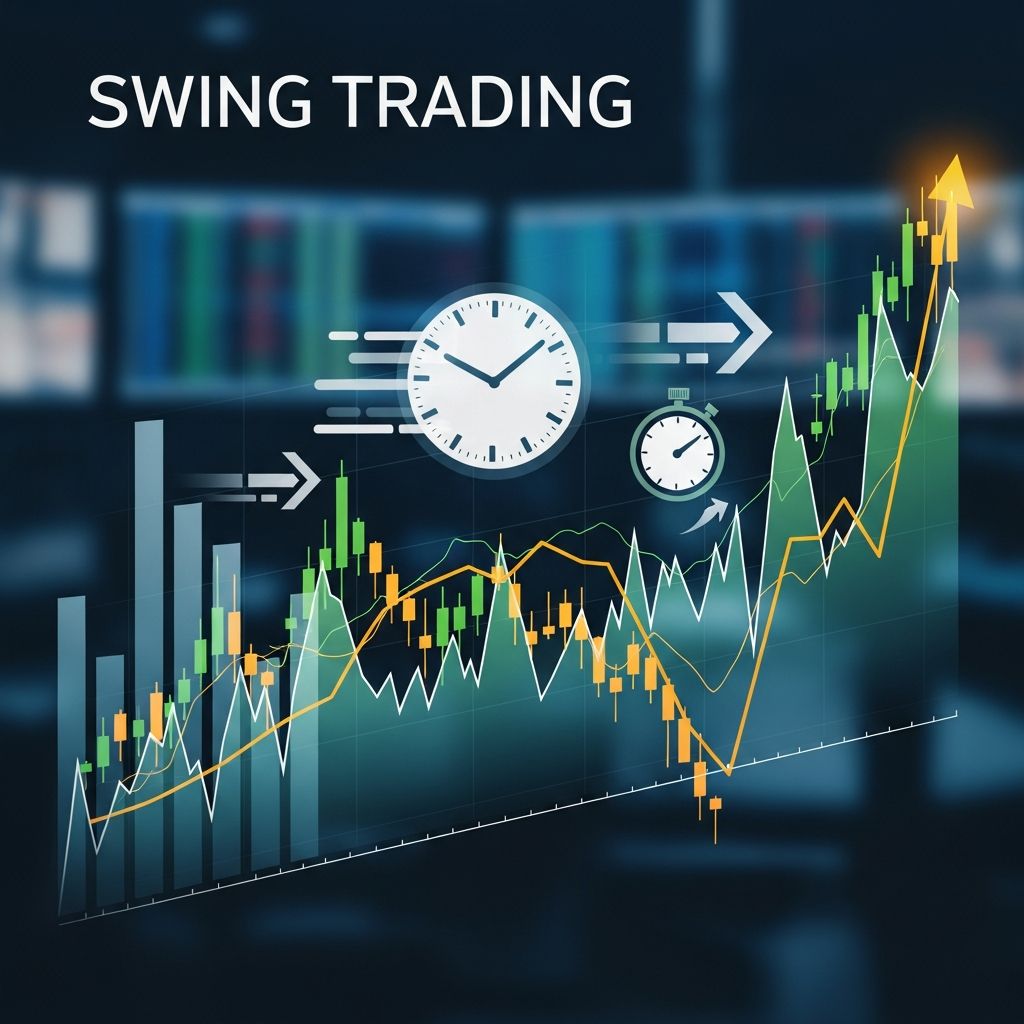
Swing trading is a trading strategy that focuses on capturing gains over a period of days to weeks by holding positions in financial securities. Unlike day traders who close all positions by market close, swing traders maintain their positions through multiple trading sessions, seeking to profit from short-term price swings or ”swings” in the market. This approach sits between the rapid-fire world of day trading and the long-term perspective of buy-and-hold investing.
Swing traders analyze price patterns and technical indicators to identify entry and exit points. The fundamental premise is that markets rarely move in straight lines; instead, they oscillate between support and resistance levels. By recognizing these patterns and momentum shifts, swing traders attempt to capture profits from predictable price movements without committing to long-term investment strategies.
How Swing Trading Works
Swing trading relies on identifying key technical levels and momentum indicators to determine when to enter and exit trades. Here’s how the process typically unfolds:
- Market Analysis: Swing traders examine charts and technical indicators to identify trending or ranging markets. They look for securities that exhibit clear price patterns and momentum.
- Entry Signals: Traders establish entry criteria based on technical indicators such as moving averages, relative strength index (RSI), or breakouts from consolidation patterns. These signals indicate potential price movements in a desired direction.
- Position Management: Once in a position, swing traders monitor price action and adjust stops to protect capital. They may scale in or out of positions as price moves in their favor.
- Exit Strategy: Trades are closed when price targets are reached or when technical indicators suggest momentum is reversing. Exit rules are predetermined to enforce discipline.
Key Characteristics of Swing Trading
Swing trading possesses several defining characteristics that distinguish it from other trading methodologies:
- Timeframe: Positions are typically held from a few days to several weeks, capturing short-term price swings without the minute-to-minute intensity of day trading.
- Technical Focus: Swing traders primarily rely on technical analysis, chart patterns, and momentum indicators rather than fundamental analysis.
- Lower Trade Frequency: Compared to day traders, swing traders execute fewer trades but attempt to capture larger percentage moves in each trade.
- Reduced Stress: With fewer daily monitoring requirements than day trading, swing trading may suit traders seeking a more balanced approach to market participation.
- Capital Requirements: While less intensive than day trading, swing trading still requires adequate capital and margin availability to manage positions effectively.
Popular Swing Trading Strategies
Successful swing traders employ various proven strategies to identify and capitalize on price movements. Here are the most popular approaches:
Support and Resistance Trading
This fundamental strategy involves identifying price levels where buying or selling pressure consistently emerges. Traders buy when price approaches support levels (expecting bounce) and sell near resistance levels (expecting pullback). These levels often represent psychological price points where institutional traders manage positions.
Moving Average Crossovers
Traders use crossovers of short-term and long-term moving averages as entry and exit signals. When a faster-moving average crosses above a slower one, it signals upward momentum, suggesting a buy opportunity. Conversely, a downward cross indicates potential selling pressure.
Breakout Trading
This strategy capitalizes on price breakouts from consolidation patterns. After a period of tight trading, breakouts often lead to significant directional moves. Traders enter positions after confirming a breakout with volume confirmation, betting on continuation.
Channel Trading
Swing traders identify parallel support and resistance lines forming a trading channel. Prices bouncing between these lines provide predictable entry points near the lower channel and exit points near the upper channel.
Momentum-Based Trading
This approach uses momentum indicators like the RSI, Stochastic Oscillator, or MACD to identify overbought or oversold conditions. Traders anticipate mean reversion when extreme momentum readings suggest a price correction is imminent.
Technical Indicators Used in Swing Trading
Swing traders rely on specific technical tools to enhance decision-making and timing:
| Indicator | Purpose | Application |
|---|---|---|
| Moving Averages (MA) | Identify trend direction and momentum | Crossovers signal potential entry/exit points |
| Relative Strength Index (RSI) | Measure momentum and overbought/oversold conditions | Readings above 70 suggest overbought; below 30 suggest oversold |
| MACD | Identify trend changes and momentum shifts | Crossovers and histogram divergences signal trade opportunities |
| Bollinger Bands | Identify volatility and potential reversals | Price touching upper/lower bands suggests extreme conditions |
| Stochastic Oscillator | Identify momentum and overbought/oversold levels | Signals potential reversals at extreme readings |
Advantages of Swing Trading
Swing trading offers several compelling benefits for traders seeking intermediate-term participation in financial markets:
- Lower Time Commitment: Compared to day trading, swing trading requires less constant monitoring, making it suitable for those with other commitments.
- Larger Profit Potential: By capturing multi-day to multi-week moves, swing traders can capture larger percentage gains than scalpers or day traders.
- Less Stress: Without second-by-second decision-making pressure, swing trading can be mentally less demanding than day trading.
- Reduced Transaction Costs: Fewer trades mean lower commission costs and less impact from bid-ask spreads compared to high-frequency trading approaches.
- Better Risk-Reward Ratios: Swing trading typically offers favorable risk-to-reward ratios, with potential profits often exceeding initial risk per trade.
- Accessibility: Swing trading is accessible to retail traders with moderate capital and doesn’t typically require day trader registration requirements in many jurisdictions.
Risks and Challenges in Swing Trading
Despite its advantages, swing trading presents significant risks and challenges that traders must understand:
- Overnight Gap Risk: Markets can gap significantly at the open, potentially creating unexpected losses for traders holding overnight positions.
- Whipsaw Trades: False breakouts and quick reversals can trigger stop-losses before the trade develops as anticipated.
- Emotional Decision-Making: Holding positions over multiple days increases emotional attachment to trades, potentially leading to poor exit decisions.
- Market Volatility: Sudden market events or economic announcements can cause sharp, unpredictable price movements that invalidate trading plans.
- Slippage: When market conditions deteriorate, traders may not be able to execute exit orders at intended price levels.
- Capital Requirements: Adequate capital and margin availability are essential; insufficient funds can force premature position exits.
- Learning Curve: Developing consistent profitability requires significant time, education, and experience with market dynamics.
Swing Trading vs. Other Trading Styles
Understanding how swing trading compares to alternative approaches helps traders select the most suitable strategy:
| Trading Style | Timeframe | Number of Trades | Analysis Type | Capital Needed |
|---|---|---|---|---|
| Day Trading | Minutes to hours | Multiple daily | Technical/Chart | $25,000+ |
| Swing Trading | Days to weeks | 5-20 monthly | Technical/Momentum | $5,000-$25,000 |
| Position Trading | Weeks to months | 1-5 monthly | Fundamental/Technical | Varies |
| Buy-and-Hold Investing | Years to decades | Occasional | Fundamental | Varies |
Essential Skills for Swing Traders
Success in swing trading requires developing and mastering specific competencies:
- Technical Analysis: Proficiency in reading charts, identifying patterns, and interpreting technical indicators is fundamental.
- Risk Management: Ability to calculate appropriate position sizes and set effective stop-loss levels protects capital.
- Discipline: Following trading rules consistently, even during losing streaks, is critical for long-term success.
- Emotional Control: Managing fear and greed ensures rational decision-making during volatile market conditions.
- Market Knowledge: Understanding market structure, liquidity, and how different asset classes behave improves trading accuracy.
- Adaptability: Adjusting strategies to changing market conditions and being willing to sit out unfavorable markets is important.
Getting Started with Swing Trading
For those interested in pursuing swing trading, here are essential initial steps:
- Education: Study technical analysis, trading psychology, and risk management through books, courses, and practice.
- Practice: Use paper trading or demo accounts to practice strategies without risking real capital.
- Develop a Plan: Create detailed trading plans specifying entry criteria, exit rules, and position sizing before trading live.
- Start Small: Begin with small position sizes to manage risk while developing experience and confidence.
- Keep Records: Maintain detailed trade journals to analyze performance and identify areas for improvement.
- Continuous Learning: Markets evolve; successful traders continuously update their knowledge and refine their approaches.
Frequently Asked Questions
Q: How much money do I need to start swing trading?
A: Most swing traders start with $5,000 to $25,000. This provides adequate capital for proper position sizing and margin requirements. Larger accounts allow for more flexibility in trade management, though the exact amount depends on your broker’s requirements, the assets you trade, and your risk tolerance.
Q: How often should swing traders monitor their positions?
A: Unlike day traders who monitor positions continuously, swing traders typically check their positions once or twice daily. Before market open to prepare for potential gaps, and after hours to assess daily performance is typically sufficient for managing swing trades effectively.
Q: What assets can I swing trade?
A: Swing trading can be applied to stocks, ETFs, forex pairs, commodities, and cryptocurrency. The key requirement is sufficient volatility and liquidity. More volatile assets provide better swing trading opportunities but also carry increased risk.
Q: Can swing trading be done part-time?
A: Yes, swing trading is well-suited for part-time traders due to its longer timeframes and lower monitoring requirements compared to day trading. Many swing traders maintain other employment while trading during evening hours and weekends.
Q: What is the typical win rate for swing traders?
A: Profitable swing traders typically achieve win rates between 50-60%, meaning they win slightly more than half their trades. Success depends more on favorable risk-to-reward ratios than win percentage—a trader can be profitable with a 40% win rate if winning trades are significantly larger than losing trades.
Q: How does swing trading differ from scalping?
A: Scalpers hold positions for minutes to hours seeking small, quick profits. Swing traders hold positions for days to weeks targeting larger percentage moves. Scalping requires constant monitoring and generates significantly more trading activity than swing trading.
References
- Technical Analysis of Financial Markets — Murphy, John J. New York Institute of Finance. 2016. https://www.palgrave.com/gp/book/9780134100029
- A Complete Guide to the Futures Markets — Schwager, Jack D. John Wiley & Sons. 2018. https://www.wiley.com/en-us/A+Complete+Guide+to+the+Futures+Markets-p-9781119041924
- Market Microstructure Theory — O’Hara, Maureen. Blackwell Publishers. 1995. https://doi.org/10.1002/9780470996737
- SEC Office of Investor Education and Advocacy — U.S. Securities and Exchange Commission. Updated 2024. https://www.sec.gov/investor
- Trading for a Living: Psychology, Trading Tactics, Money Management — Elder, Alexander. John Wiley & Sons. 2002. https://www.wiley.com/en-us/Trading+for+a+Living-p-9780471592242
Similar Articles








Read full bio of Sneha Tete