Swap: Definition, Types, and How They Work in Finance
Master financial swaps: Understanding derivative contracts that exchange cash flows between parties.

What Is a Swap?
A swap is a derivative contract between two parties that involves the exchange of financial instruments or cash flows. The most common forms of swaps are interest rate swaps and currency swaps, where parties agree to exchange predetermined cash flows on specific dates in the future. Swaps enable financial market participants to manage risks, reduce costs, or gain exposure to different financial instruments without directly purchasing or selling them.
Swaps are traded over-the-counter (OTC), meaning they are customized agreements between two parties rather than standardized contracts traded on exchanges. This flexibility allows participants to tailor swap agreements to meet their specific financial needs and objectives.
Understanding Swaps
Swaps function as a mechanism for transforming one type of cash flow into another. By entering into a swap agreement, two parties exchange obligations, allowing each to benefit from different market conditions or manage exposure to specific financial risks. The parties involved typically do not exchange principal amounts directly; instead, they exchange interest payments, foreign currencies, or other financial obligations.
Key Characteristics of Swaps:
- Bilateral Agreement: Swaps are negotiated between two parties without involvement from a central exchange or clearinghouse.
- Customizable Terms: Parties can customize the notional amount, payment frequency, duration, and other terms to match their specific requirements.
- Counterparty Risk: Both parties face the risk that the counterparty may default on their obligations.
- No Initial Exchange: Typically, no money changes hands at the inception of a swap agreement.
- Periodic Settlements: Payments are made on predetermined dates, often semi-annually or annually.
Types of Swaps
Various types of swaps exist in financial markets, each serving different purposes and addressing different hedging or investment objectives. Understanding the major categories helps investors and financial managers select appropriate instruments for their needs.
Interest Rate Swaps
Interest rate swaps are the most common type of swap agreement. In a typical interest rate swap, two parties exchange fixed-rate interest payments for floating-rate (variable) interest payments on the same notional principal amount. For example, a company with a fixed-rate loan might swap payments with another party that has a floating-rate loan, allowing both to potentially reduce borrowing costs or manage interest rate risk.
Interest rate swaps help organizations:
- Convert fixed-rate debt to floating-rate debt or vice versa
- Reduce borrowing costs by leveraging comparative advantages in credit markets
- Manage exposure to interest rate fluctuations
- Align payment obligations with cash flow expectations
Currency Swaps
Currency swaps involve the exchange of principal and interest payments in different currencies. One party exchanges debt denominated in one currency for debt denominated in another currency. Currency swaps enable multinational corporations and financial institutions to manage foreign exchange risk, reduce funding costs, or gain access to foreign capital markets.
Currency swaps typically include:
- Exchange of principal amounts at the initiation and termination of the contract
- Exchange of periodic interest payments in respective currencies
- Fixed or floating interest rates in either or both currencies
Commodity Swaps
Commodity swaps allow parties to exchange cash flows based on commodity prices, such as oil, gold, or agricultural products. One party might exchange a floating price for a fixed price, enabling producers and consumers to hedge against price volatility in commodity markets.
Credit Default Swaps (CDS)
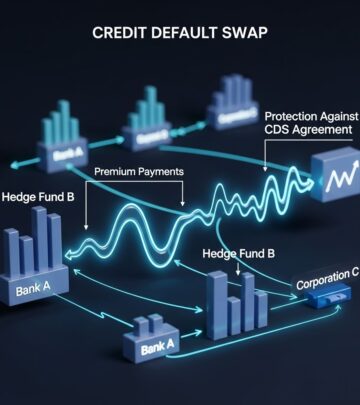
Credit default swaps represent contracts where one party (the protection buyer) pays premiums to another party (the protection seller) in exchange for compensation if a specific credit event occurs, such as a default or credit rating downgrade. CDS contracts allow investors to hedge credit risk or speculate on the creditworthiness of entities.
Equity Swaps
Equity swaps involve the exchange of cash flows based on equity index returns or individual stock performance. These swaps enable investors to gain exposure to equity market movements without directly owning shares or to offset existing equity positions.
How Swaps Work: A Practical Example
Consider a practical example of an interest rate swap:
Scenario: Company A has a $10 million fixed-rate loan at 5% per annum. Company B has a $10 million floating-rate loan based on LIBOR plus 2%. Both companies want to reduce their borrowing costs by exchanging payment obligations.
Swap Agreement: The two companies enter into an interest rate swap agreement with a notional principal of $10 million and a maturity of five years. Under the swap:
- Company A agrees to pay Company B: LIBOR + 2% on the $10 million
- Company B agrees to pay Company A: 5% fixed on the $10 million
Outcome: If LIBOR averages 3%, Company A effectively pays 5% on its original fixed-rate loan and receives LIBOR + 2%, resulting in a net floating-rate exposure. Company B effectively converts its floating-rate obligation into a fixed 5% payment. Both parties benefit if they can optimize their cost of capital through this arrangement.
Advantages of Swaps
Swaps offer numerous advantages to financial market participants:
- Cost Reduction: Parties can reduce funding costs by exploiting comparative advantages in different debt markets.
- Risk Management: Swaps enable organizations to hedge against interest rate, currency, and commodity price risks.
- Flexibility: OTC swaps can be customized to meet specific requirements and preferences of the parties involved.
- Access to Markets: Swaps allow organizations to access capital markets and currencies that might otherwise be unavailable or expensive.
- Portfolio Optimization: Investors can adjust portfolio exposure without buying or selling underlying securities.
Disadvantages and Risks of Swaps
While swaps provide valuable financial tools, they also carry significant risks and disadvantages:
- Counterparty Risk: Both parties face the possibility that the counterparty defaults on payment obligations, particularly during market stress.
- Complexity: Swaps are complex financial instruments requiring sophisticated analysis and understanding of market dynamics.
- Liquidity Risk: Exiting a swap position before maturity can be difficult, and negotiating an exit may result in unfavorable pricing.
- Basis Risk: If the referenced benchmark (such as LIBOR) doesn’t perfectly match the party’s actual borrowing costs, basis risk emerges.
- Valuation Difficulty: Determining fair value and accounting treatment of swaps requires specialized expertise.
- Regulatory Risk: Regulatory changes can affect swap valuation, collateral requirements, and market practices.
The Swap Market
The global swap market represents one of the largest OTC derivative markets. Interest rate swaps dominate the swap market in terms of notional value outstanding. Major financial institutions, including banks, insurance companies, hedge funds, and corporations, actively participate in the swap market.
Market characteristics include:
- Decentralized Trading: Swaps trade through telephone, electronic trading platforms, and broker networks.
- Market Size: The global notional amount of outstanding swaps exceeds hundreds of trillions of dollars.
- Major Participants: Large financial institutions serve as market makers, providing liquidity and competitive pricing.
- Regulation: Post-2008 financial crisis reforms have increased transparency, standardization, and central clearing requirements for certain swaps.
Swaps vs. Other Derivatives
| Characteristic | Swaps | Forwards | Futures | Options |
|---|---|---|---|---|
| Trading Venue | OTC | OTC | Exchange-Traded | Both |
| Standardization | Customized | Customized | Standardized | Standardized (Exchanges) |
| Settlement | Periodic/Final | At Maturity | Daily Mark-to-Market | At Exercise |
| Counterparty Risk | High | High | Low | Varies |
| Initial Cost | None Typically | None | Margin Required | Premium Required |
Frequently Asked Questions About Swaps
Q: What is the primary purpose of a swap?
A: The primary purpose of a swap is to allow two parties to exchange cash flows to reduce costs, manage risk, or gain exposure to different financial instruments without directly buying or selling them.
Q: Are swaps suitable for individual investors?
A: Swaps are primarily designed for institutional investors, corporations, and financial institutions. Individual investors typically do not participate directly in swap markets due to complexity, minimum transaction sizes, and counterparty risk considerations.
Q: How is a swap valued?
A: Swaps are valued by calculating the present value of expected future cash flows. The valuation depends on current interest rates, credit spreads, and the creditworthiness of the counterparties involved.
Q: What happens if one party wants to exit a swap early?
A: If one party wants to exit a swap before maturity, they must negotiate with the counterparty or enter into an offsetting swap with another party. The exit may result in significant costs depending on market conditions and remaining contract terms.
Q: How do regulations affect the swap market?
A: Post-2008 financial crisis regulations have increased transparency, mandated central clearing for certain standardized swaps, imposed margin requirements, and established reporting obligations to reduce systemic risk.
Q: What is the difference between a plain vanilla swap and exotic swaps?
A: Plain vanilla swaps are standard agreements with simple terms, typically involving fixed-for-floating interest rate exchanges. Exotic swaps incorporate more complex features, multiple underlying assets, or non-standard terms tailored to specific investor needs.
References
- Interest Rate Derivatives — International Swaps and Derivatives Association (ISDA). 2024. https://www.isda.org/
- Derivatives and Hedging — U.S. Securities and Exchange Commission (SEC). 2024. https://www.sec.gov/
- Understanding Financial Derivatives — Federal Reserve Board. 2023. https://www.federalreserve.gov/
- OTC Derivatives Market Analysis — Bank for International Settlements (BIS). 2024-06. https://www.bis.org/
- Swap Market Conventions and Best Practices — International Swaps and Derivatives Association (ISDA). 2023. https://www.isda.org/
Similar Articles








Read full bio of Sneha Tete