Subprime Mortgage Crisis: Effects and Timeline
Understanding the subprime mortgage crisis: causes, timeline, and lasting economic impacts.
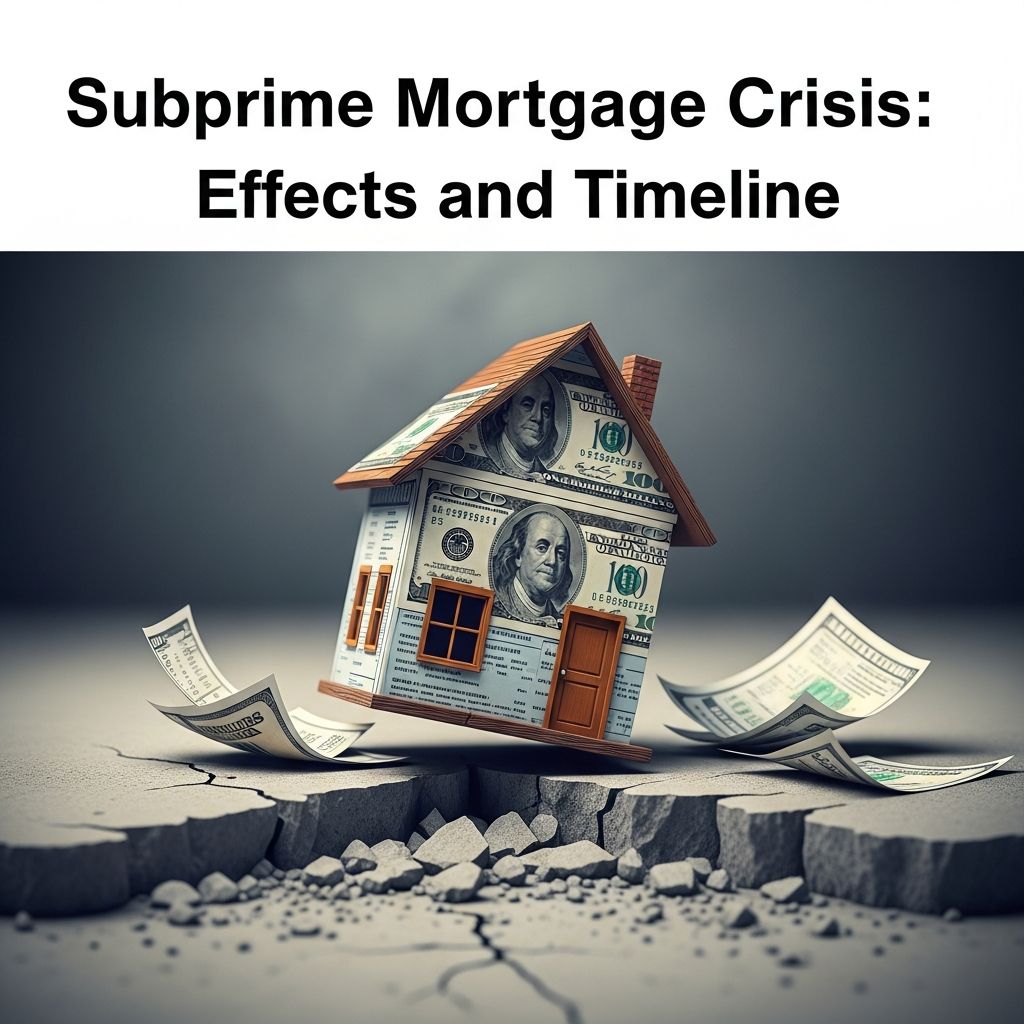
Understanding the Subprime Mortgage Crisis: Effects and Timeline
The subprime mortgage crisis stands as one of the most significant financial catastrophes in modern history, fundamentally reshaping the American economy and global financial markets. Occurring between 2007 and 2010, this multinational financial crisis emerged from the collapse of the United States housing bubble and became a primary catalyst for the broader 2008 financial crisis. The crisis was characterized by unprecedented numbers of borrowers defaulting on mortgage payments, leading to mass foreclosures and the devaluation of housing-related securities that infected the entire financial system.
What Is a Subprime Mortgage?
Understanding the subprime mortgage crisis requires first comprehending what subprime mortgages actually are. The Federal Reserve defines subprime mortgages as loans made to borrowers perceived to have high credit risk, often because they lack a strong credit history or possess other characteristics associated with high probabilities of default. The term “subprime” refers to the borrower’s credit rating rather than the loan itself. During the housing boom of the 1990s and early 2000s, financial institutions increasingly extended mortgage loans to people who would have typically been denied credit under more conservative lending policies.
These mortgages frequently featured adjustable-rate mortgage (ARM) structures, particularly the problematic 2-28 loans where borrowers enjoyed low initial “teaser” rates for two years before rates reset dramatically higher for the remaining 28-year term. This structure proved catastrophic when housing prices began declining and interest rates rose, as borrowers suddenly faced monthly payments they could not afford.
Timeline of the Crisis
The Boom Period: 1995-2005
The modern subprime mortgage market began in 1995, initially appearing as an innovative way to extend homeownership to underserved populations. During this period, the housing market experienced what many viewed as perpetual price appreciation. Encouraged by easy initial loan terms and the long-term trend of rising housing prices, borrowers assumed they could quickly refinance at better terms or sell properties at profits. From 1998 to early 2002, subprime mortgage default rates rose gradually from around 10 percent to almost 15 percent, reflecting the economy’s weakness following the dot-com bubble collapse and the 9/11 attacks.
The Peak and Burst: 2006-2007
The housing bubble peaked in approximately 2006. By 2006, sophisticated investment institutions domestically and internationally began recognizing that their vast portfolios of subprime mortgages and derivatives were far riskier than assumed, leading to significant financial losses. This realization triggered a downward spiral in financial markets. As interest rates began rising and housing prices started declining moderately in 2006-2007, borrowers who had counted on refinancing suddenly found themselves unable to do so.
More than twenty-five subprime lending firms declared bankruptcy in February and March 2007, rattling the Dow Jones Industrial Average and signaling broader systemic problems. The easy initial terms on many adjustable-rate mortgages expired simultaneously, causing monthly payments to reset sharply higher. Borrowers who had obtained 100 percent financing at the market’s peak discovered their debt loads now exceeded their home values, making refinancing impossible.
The Collapse: 2007-2010
Mortgage default and foreclosure rates accelerated dramatically as the crisis deepened. What began as a housing market correction transformed into a full financial catastrophe as defaults hit the highest levels seen in recent years. As more borrowers stopped making mortgage payments, foreclosures increased and the supply of homes for sale surged, placing severe downward pressure on housing prices and further reducing homeowners’ equity.
The decline in mortgage payments simultaneously reduced the value of mortgage-backed securities, eroding the net worth and financial health of banks and investment firms. This vicious cycle lay at the heart of the crisis’s severity and persistence.
Root Causes of the Crisis
Structural and Regulatory Failures
The U.S. Financial Crisis Inquiry Commission reported in January 2011 that the crisis was avoidable and caused by widespread failures in financial regulation, including the Federal Reserve’s failure to stem the tide of toxic mortgages. The shadow banking system—which includes investment banks and other non-depository financial entities—had grown to rival the traditional depository banking system in scale yet operated without equivalent regulatory safeguards. When this system experienced the equivalent of a bank run, the entire financial architecture trembled.
Economists surveyed by the University of Chicago in 2017 rated the causal factors in order of importance: flawed financial sector regulation and supervision ranked first, followed by underestimating risks in financial engineering such as collateralized debt obligations (CDOs), mortgage fraud and bad incentives, short-term funding decisions and corresponding market runs, and credit rating agency failures.
Housing Market Speculation and Overvaluation
Homes were being appraised at excessively high values, inflating real estate prices across the country. During the booming housing market of the 1990s and early 2000s, appraisers routinely overvalued homes or employed incomplete valuation methods, causing inflated housing values to circulate throughout real estate markets. Borrowers subsequently took out loans for amounts exceeding the actual market worth of their homes. Some analysts have argued that appraisers’ systematic overvaluation of homes was the real root of the financial crisis.
Financial Innovation and Risk Concealment
Financial institutions purchased mortgages from mortgage originators, packaged them into mortgage-backed securities (MBSes) and collateralized debt obligations (CDOs), and sold these securities to investors seeking safe places for their funds. The credit quality of these instruments was inaccurately assessed by rating agencies, which initially assigned them attractive risk ratings despite their composition of high-risk subprime mortgages. These financial products distributed and perhaps concealed the risk of mortgage default throughout the global financial system.
Policy Environment and Incentive Structures
Pressure from community and government organizations to issue more mortgages and expand homeownership created institutional pressure to lower lending standards. The seemingly endless expansion of the housing market made homes appear to be excellent security for mortgages, reducing lenders’ perceived risk. Crucially, the originating banks were unlikely to keep and have to collect on the mortgages they issued, eliminating their incentive to carefully underwrite loans. This separation of mortgage origination from loan servicing responsibility created a moral hazard at the core of the crisis.
Economic Effects and Impacts
Housing Market Collapse
The collapse of subprime lending fueled a downward spiral in house prices that unwound much of the increases seen during the subprime boom. This lowered demand for housing, leading to sliding house prices that fueled expectations of still more declines, further reducing demand for homes. The housing crisis devastated the construction industry, with private residential investment falling by nearly 4 percent of GDP.
Broader Economic Recession
The housing crisis provided a major impetus for the recession of 2007-2009 by hurting the overall economy in four significant ways: it lowered construction, reduced wealth and thereby consumer spending, decreased the ability of financial firms to lend, and reduced the ability of firms to raise funds from securities markets. Credit markets froze as investors and creditors lost confidence in financial markets. Many overleveraged financial institutions were forced to sell assets at fire-sale prices, further reducing liquidity and accelerating the downward spiral.
Consumer spending declined dramatically, the housing market plummeted, foreclosure numbers continued rising, and the stock market experienced severe shaking. The economy faced a demand gap of nearly $1 trillion annually as the housing bubble’s wealth effects disappeared. Government proved unwilling or unable to quickly make up for this private sector shortfall, prolonging the recession.
Financial System Stress
The crisis exposed dramatic breakdowns in corporate governance, as many financial firms acted recklessly and took on excessive risk. An explosive mix of excessive borrowing and risk by households and Wall Street put the financial system on a collision course with crisis. Key policy makers proved ill-prepared for the catastrophe, lacking full understanding of the financial system they oversaw. Systemic breaches in accountability and ethics emerged at all institutional levels.
Comparison of Crisis Factors
| Factor | Role in Crisis | Impact Level |
|---|---|---|
| Flawed Financial Regulation | Inadequate oversight of risky lending practices and shadow banking | Critical |
| Risk Underestimation | Failure to understand complexity of CDOs and mortgage derivatives | Critical |
| Mortgage Fraud | Predatory lending and misrepresentation of loan terms | High |
| Housing Speculation | Investment buying and price inflation beyond fundamental values | High |
| Credit Rating Failures | Inaccurate assessment of security risks and quality | High |
| Adjustable-Rate Mortgages | Payment shocks when rates reset higher | High |
Lessons Learned and Reforms
The subprime mortgage crisis revealed critical vulnerabilities in financial regulation, risk management practices, and lending standards. The findings emphasized that the crisis was avoidable—it resulted from deliberate choices and systemic failures rather than inevitable economic forces. The exposure of these failures prompted significant regulatory reforms, including enhanced oversight of shadow banking, stricter underwriting standards, improved transparency in mortgage lending, and strengthened capital requirements for financial institutions.
The crisis demonstrated the dangers of financial innovation without adequate understanding or regulation, the risks of misaligned incentives in the mortgage origination process, and the importance of robust credit rating agency oversight. It underscored that housing markets, despite their historical resilience, can experience severe corrections when fundamentals become disconnected from valuations.
Frequently Asked Questions
Q: What was the primary trigger of the subprime mortgage crisis?
A: The primary trigger was the collapse of the United States housing bubble, which peaked in 2006. When interest rates rose and housing prices declined, borrowers with adjustable-rate mortgages could not refinance, leading to unprecedented defaults and foreclosures.
Q: How did mortgage-backed securities contribute to the crisis?
A: Financial institutions packaged subprime mortgages into mortgage-backed securities and collateralized debt obligations, which were sold to investors globally. Rating agencies inaccurately assessed their credit quality, causing these toxic assets to spread throughout the financial system.
Q: What were adjustable-rate mortgages (ARMs) and why were they problematic?
A: ARMs, particularly 2-28 loans, offered low initial rates for two years before resetting to higher rates for the remaining term. When rates reset and housing prices fell, borrowers faced unaffordable payments and could not refinance, triggering defaults.
Q: How did the housing crisis lead to broader economic recession?
A: The crisis reduced construction, eliminated housing wealth that fueled consumer spending, impaired financial institutions’ lending capacity, and created a nearly $1 trillion annual demand gap that the government could not immediately offset.
Q: What role did appraisal fraud play in the crisis?
A: Appraisers routinely overvalued homes during the boom, causing inflated values to circulate in real estate markets. Borrowers took out loans exceeding actual home values, leaving many underwater when prices fell.
Q: Was the subprime mortgage crisis avoidable?
A: Yes, according to the U.S. Financial Crisis Inquiry Commission, the crisis was avoidable. It resulted from widespread regulatory failures, poor corporate governance, misaligned incentives, and systemic breaches in accountability rather than inevitable economic forces.
References
- Subprime Mortgage Crisis — Wikipedia. Accessed 2025. https://en.wikipedia.org/wiki/Subprime_mortgage_crisis
- The Subprime Mortgage Crisis: Causes and Lessons Learned — Law Shelf. Accessed 2025. https://www.lawshelf.com/videocoursesmoduleview/part-2-module-4-the-subprime-mortgage-crisis-causes-and-lessons-learned/
- Origins of the Crisis — Federal Deposit Insurance Corporation. Accessed 2025. https://www.fdic.gov/media/18636
- The Subprime Mortgage Market Collapse: A Primer on the Causes and Possible Solutions — The Heritage Foundation. Accessed 2025. https://www.heritage.org/report/the-subprime-mortgage-market-collapse-primer-the-causes-and-possible-solutions
- Subprime Mortgage Crisis — Federal Reserve History. Accessed 2025. https://www.federalreservehistory.org/essays/subprime-mortgage-crisis
- The Subprime Lending Crisis: Causes and Effects of the Mortgage Market — CCH. Accessed 2025. https://business.cch.com/images/banner/subprime.pdf
- Timeline: The U.S. Financial Crisis — Council on Foreign Relations. Accessed 2025. https://www.cfr.org/timeline/us-financial-crisis
Similar Articles








Read full bio of medha deb