Student vs Regular Credit Cards
Discover how student credit cards offer easier access and unique perks for young adults building credit, compared to standard options.
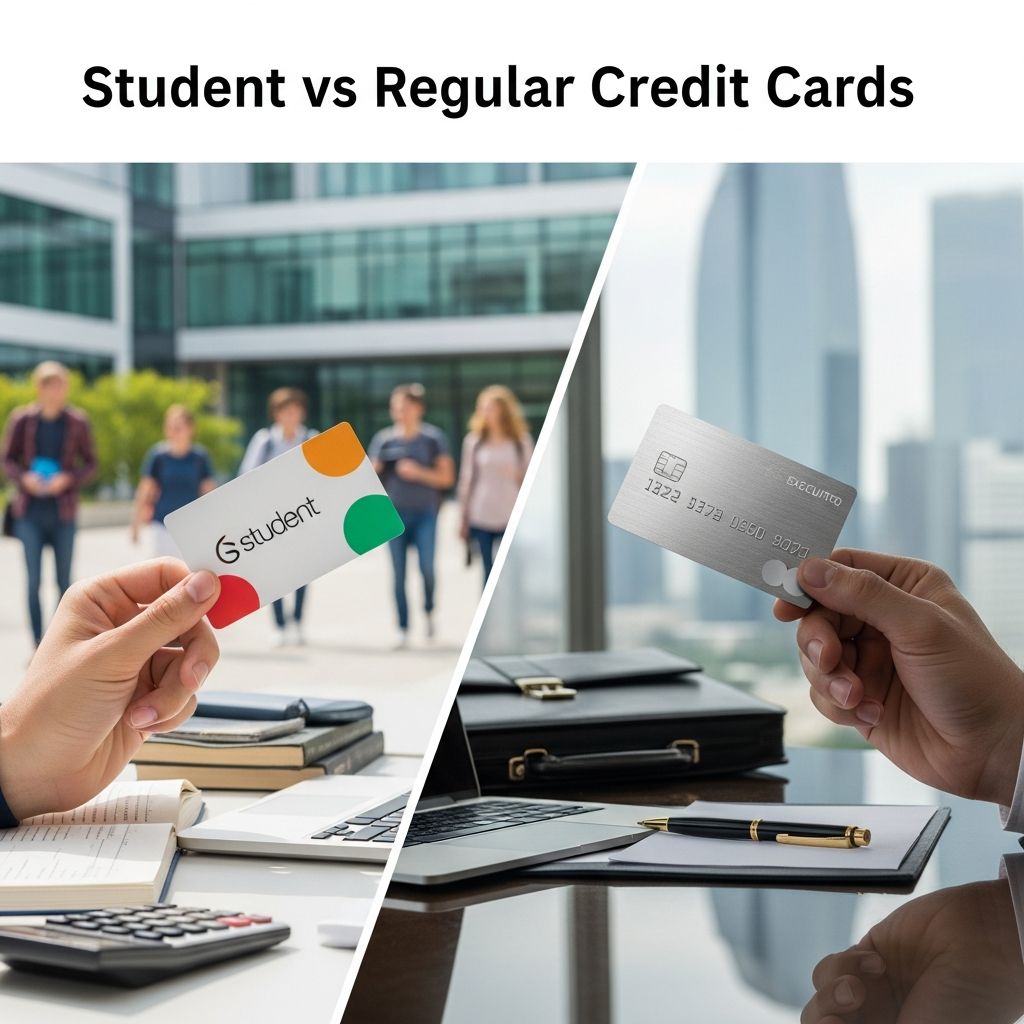
Student credit cards provide young adults, particularly college enrollees, with an accessible entry into credit management, featuring relaxed approval standards and tailored benefits that differ markedly from standard credit cards designed for established users.
Understanding the Core Purpose of Each Card Type
Student credit cards target individuals typically aged 18 and above who are pursuing higher education, often lacking substantial credit history or independent income. These cards prioritize credit building through lenient qualification criteria, such as proof of enrollment in a qualifying academic program rather than a robust credit score. In contrast, regular credit cards cater to consumers with proven financial track records, demanding higher income levels and favorable credit profiles for approval.
This distinction stems from legislative protections like the CARD Act of 2009, which safeguards young borrowers by imposing stricter rules on issuers targeting those under 21. For students, cards serve as educational tools for fostering responsible habits, while regular cards emphasize maximizing rewards and higher spending power for experienced users.
Eligibility Requirements: Who Qualifies and Why It Matters
Securing a student credit card generally requires being at least 18 years old, possessing a Social Security number, a U.S. address, and verification of student status in a two-year or longer program. Many issuers, like Discover, forgo credit history checks, focusing instead on age, basic income from part-time jobs or allowances, and enrollment proof. Capital One, for instance, waives minimum income thresholds but verifies sufficient funds for payments.
Regular credit cards, however, scrutinize FICO scores, debt-to-income ratios, and annual earnings, often excluding newcomers. Under 21-year-olds without independent income must secure a co-signer for either type, but student cards offer more flexibility. This leniency helps bridge the gap for 18-24-year-olds, with data showing over 40% of undergraduates using credit cards to manage expenses.
| Criteria | Student Cards | Regular Cards |
|---|---|---|
| Minimum Age | 18+ | 18+ (co-signer if under 21, no income) |
| Credit History | Often not required | Good score typically needed |
| Income Proof | Minimal or none | Substantial required |
| Enrollment Proof | Yes, for most | No |
Credit Limits: Starting Small to Build Big
Student cards launch with modest limits, commonly $500 to $1,000, to mitigate risk for inexperienced users. This encourages disciplined spending, preventing overwhelming debt. As on-time payments accumulate, issuers like Chase or Bank of America may increase limits automatically, rewarding reliability.
Regular cards offer higher starting limits—often $5,000 or more—reflecting trust in the borrower’s history. While appealing for larger purchases, this can tempt overspending. For students, low limits act as a safeguard, aligning with average college expenses like books ($1,200/year) and groceries.
Fees and Costs: Lower Barriers for Beginners
A hallmark of student cards is reduced fees: many waive annual charges, foreign transaction fees, and even introductory APR periods at 0% for 6-15 months. Chase highlights no maintenance fees on select student products, easing entry. Late fees exist but are capped lower under regulations.
Standard cards may impose annual fees ($95+ for premium ones), higher APRs (15-25%), and foreign fees (3%). Student options prioritize affordability, with Sallie Mae noting 0% intro offers to habituate full monthly payments.
Rewards and Perks: Tailored Incentives for Campus Life
Student cards shine with rewards suited to student lifestyles. Discover’s it Student Cash Back offers 5% on rotating categories (groceries, restaurants) up to $1,500/quarter, plus 1% elsewhere. Bank of America’s Customized Cash Rewards for Students provides 6% in a chosen category (e.g., streaming, dining) for the first year, then 3%, alongside 2% at groceries. Capital One Quicksilver Student delivers flat 1.5% unlimited cash back, no foreign fees.
Unique perks include GPA-based bonuses or study-abroad fee waivers. Regular cards boast richer rewards (e.g., 3-5% travel, lounge access) but require higher spending for value. Students benefit from cash back on essentials, offsetting costs like laptops or travel.
- Cash Back Examples: Gas/restaurants (2-5%), groceries (3-6% first year), all purchases (1-1.5%).
- Student Exclusives: No foreign fees for abroad programs, emergency fund access.
- Regular Perks: Travel points, insurance, higher multipliers.
Interest Rates and APR: Managing the Cost of Borrowing
Both types carry variable APRs (15-28%), but student cards often feature 0% intro periods, allowing interest-free purchases initially. Post-intro, rates align with regular cards, underscoring the need for full payments. Regular cards rarely offer such grace for new purchases, prioritizing established users.
Building Credit: Long-Term Advantages
Responsible use—paying on time, low utilization (<30%)—builds credit equally on both, reported to bureaus like Experian. Student cards excel for starters, with 6-12 months yielding scores in the 670+ range. Bank of America notes utility for rentals/jobs.
Risks and Best Practices for Safe Usage
Common pitfalls include high utilization eroding scores or accruing debt. Strategies:
- Pay balances fully monthly.
- Track spending via apps.
- Avoid cash advances (high fees).
- Upgrade post-graduation.
Authorized user status on family cards offers an alternative, building history sans liability.
Top Student Card Recommendations
| Card | Key Reward | Fees | Best For |
|---|---|---|---|
| Discover it Student Cash Back | 5% rotating, 1% other | No annual/foreign | Category shoppers |
| BofA Customized Cash Rewards Student | 6% choice (yr1), 3% after | No annual | Custom categories |
| Capital One Quicksilver Student | 1.5% all purchases | No fees | Simplicity |
Transitioning from Student to Regular Cards
Post-graduation, many issuers auto-upgrade, preserving history. Apply independently if limits suffice, leveraging 1-2 years’ positive activity.
Frequently Asked Questions
Can non-students get student cards?
Typically no; enrollment proof required, though some assess limited credit broadly.
What’s the average student card limit?
$500-$1,000 initially, growing with use.
Do student cards report to credit bureaus?
Yes, aiding score development.
Are there penalties for students under 21?
Co-signer needed without income.
Can I get a student card with bad credit?
Possible if enrolled; focuses on potential.
References
- Student Credit Card Benefits: What to Know — Chase Bank. 2023. https://www.chase.com/personal/credit-cards/education/build-credit/student-credit-card-benefits
- Discover® Student Credit Card Requirements — Discover. 2024. https://www.discover.com/credit-cards/card-smarts/are-student-credit-cards-only-for-students/
- Credit Cards for College Students from Bank of America — Bank of America. 2024. https://www.bankofamerica.com/credit-cards/student-credit-cards/
- What is a Student Credit Card—And How to Apply for One — Sallie Mae. 2023. https://www.salliemae.com/blog/what-is-a-student-credit-card/
- Student Credit Cards — Mastercard. 2024. https://www.mastercard.com/us/en/personal/find-a-card/credit-card/categories/students.html
- Student Credit Cards 101: Everything You Need to Know — NerdWallet. 2024. https://www.nerdwallet.com/credit-cards/learn/student-credit-cards-101
- Compare Student Credit Cards — Capital One. 2024. https://www.capitalone.com/credit-cards/students/
Similar Articles








Read full bio of medha deb