Student Loan Terms Guide: What You Need To Know
Master essential student loan terminology to make informed borrowing decisions and manage repayment effectively for long-term financial health.

Navigating student loans requires understanding a range of specialized terms that define how much you can borrow, what you’ll pay, and your repayment obligations. This guide breaks down critical concepts from federal and private lending programs, empowering borrowers to choose wisely and minimize debt burdens.
Understanding Federal Student Loans
Federal student loans, issued through the U.S. Department of Education, form the foundation of most education financing due to their standardized terms and borrower protections. These loans prioritize accessibility over credit history, making them ideal for undergraduates and graduates alike.
Direct Subsidized Loans
These loans target undergraduate students showing financial need, as determined by the Free Application for Federal Student Aid (FAFSA). A key benefit is that the government covers interest during enrollment, the six-month grace period post-graduation, and qualified deferment periods, preventing balance growth.
- Annual limits: $3,500 for first-year students, $4,500 for second-year, $5,500 for third-year and beyond.
- Lifetime cap: $23,000.
- 2025-2026 interest rate: 6.39% fixed.
Direct Unsubsidized Loans
Available to both undergraduates and graduates without a financial need requirement, these loans accrue interest from disbursement. Borrowers can pay interest while in school to avoid capitalization, where unpaid interest adds to the principal.
| Year | Dependent Students | Independent Students |
|---|---|---|
| First-year undergraduate | $5,500 | $9,500 |
| Second-year undergraduate | $6,500 | $10,500 |
| Third-year and beyond | $7,500 | $12,500 |
| Graduate/professional | N/A | $20,500 |
Aggregate limits reach $31,000 for dependent undergrads, $57,500 for independent undergrads, and $138,500 for graduates.
Direct PLUS Loans
Designed for parents of dependent undergrads (Parent PLUS) or graduate/professional students (Grad PLUS), these loans cover costs beyond other aid, up to the school’s total attendance cost. They require a credit check but no adverse history.
- Interest rate (2025-2026): 8.94% fixed.
- Repayment: Starts immediately unless deferred; terms up to 30 years.
- Origination fee: Higher than other Direct Loans.
Private Student Loans Explained
Private loans from banks, credit unions, or specialized lenders fill gaps after exhausting federal options. They demand credit checks, often yielding variable or fixed rates based on creditworthiness, with fewer protections.
Key Features of Private Lending
Unlike federal loans, private terms vary widely. Lenders like Sallie Mae offer specialized products for MBAs, law, medical, or residency programs, with amounts up to full cost of attendance.
| Lender | Best For | Loan Amount | Terms |
|---|---|---|---|
| Sallie Mae | Specialized programs | $1,000 to 100% COA | 10-20 years |
| Abe | Payment relief | $1,000 to COA (up to $225K aggregate) | 5-20 years |
| SoFi | Member perks | $1,000-$100,000 | 5-15 years |
| Nelnet Bank | Competitive rates | $1,000-$500,000 | 5-15 years |
Rates range from 2.69% to 17.99% APR fixed or variable as of February 2026, often lower for excellent credit with cosigners.
Interest Rates and Fees
Federal loans feature fixed rates set annually, lower than most private averages. For 2025-2026, undergrad unsubsidized matches subsidized at 6.39%, grad at 7.94%, and PLUS at 8.94%.
Private rates fluctuate with market conditions and borrower profiles. Origination fees on federal loans (about 1.057%) add to costs, while private fees vary from 0% to 5%.
Repayment Strategies
Federal loans offer flexible plans: standard (10 years), extended (25 years), or income-driven repayment (IDR) capping payments at 10-20% of discretionary income, with forgiveness after 20-25 years.
- Grace period: 6 months post-enrollment for most Direct Loans.
- Forbearance/deferment: Pauses payments for hardship.
- Forgiveness: Public Service Loan Forgiveness (PSLF) after 120 qualifying payments.
Private repayment mirrors consumer loans: fixed terms (5-20 years), with limited IDR-like options. Some provide in-school deferment or cosigner release after 12-24 months.
Borrowing Limits and Eligibility
Federal aggregate limits protect against overborrowing: $31,000-$138,500 depending on status. Private loans have no caps beyond lender policies or school certification, but require FAFSA exhaustion first.
Eligibility hinges on enrollment at least half-time in eligible programs, satisfactory academic progress, and for PLUS, no credit defaults.
Cost of Attendance (COA) and Aid Packaging
COA encompasses tuition, fees, room, board, books, transport, and personal expenses. Loans cannot exceed COA minus grants/scholarships, preventing excess debt.
Forgiveness and Relief Programs
Beyond IDR, federal options include Teacher Loan Forgiveness ($17,500 max) and PSLF for public/nonprofit workers. Private loans rarely forgive; relief is lender-specific.
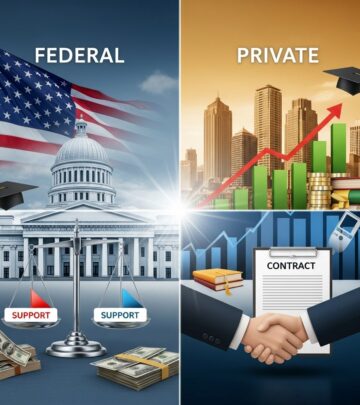
Comparing Federal vs. Private Options
| Feature | Federal | Private |
|---|---|---|
| Credit Check | No (except PLUS) | Yes |
| Interest Rates | Fixed, lower average | Fixed/variable, credit-based |
| Repayment Flexibility | High (IDR, forgiveness) | Low (lender-dependent) |
| Borrow Limits | Capped | Higher potential |
Experts recommend maxing federal aid before private to leverage protections.
FAQs
What is the difference between subsidized and unsubsidized loans?
Subsidized loans don’t accrue interest while in school for need-based undergrads; unsubsidized do for all eligible students.
Can parents borrow for their child’s education?
Yes, via Parent PLUS (federal) or private parent loans, often requiring credit approval.
Are variable rates safe for student loans?
They can rise, increasing costs; fixed federal rates provide stability.
How do I qualify for loan forgiveness?
Work in public service or teaching, make 120-240 qualifying payments under eligible plans.
Should I get a cosigner for private loans?
Yes, it improves approval odds and rates for those with limited credit.
Steps to Borrow Responsibly
- Complete FAFSA annually for federal eligibility.
- Compare COA vs. aid package.
- Exhaust grants/scholarships first.
- Use federal loans next.
- Shop private rates with prequalification.
- Borrow only what you need.
By mastering these terms, students and families can align borrowing with future earning potential, typically aiming for debt under one year’s expected salary post-graduation.
References
- Types of Student Loans: Federal vs. Private Loans Explained — Experian. 2025-08-11. https://www.experian.com/blogs/ask-experian/what-are-the-different-types-of-student-loans/
- Types Of Student Loans & How To Choose One — Bankrate. Accessed 2026. https://www.bankrate.com/loans/student-loans/types-of-student-loans/
- Compare Private Student Loans and Interest Rates for February 2026 — Credible. 2026-02. https://www.credible.com/student-loans
- BestColleges’ Guide to Student Loans — BestColleges. Accessed 2026. https://www.bestcolleges.com/resources/college-loans/
- Subsidized and Unsubsidized Loans — Federal Student Aid (studentaid.gov). Accessed 2026. https://studentaid.gov/understand-aid/types/loans/subsidized-unsubsidized
- Loans | Federal Student Aid — Federal Student Aid (studentaid.gov). Accessed 2026. https://studentaid.gov/understand-aid/types/loans
Similar Articles








Read full bio of Sneha Tete