Student Loan Refinancing vs. Consolidation
Understand when to refinance, when to consolidate, and how each option can change your interest, payments, and protections.
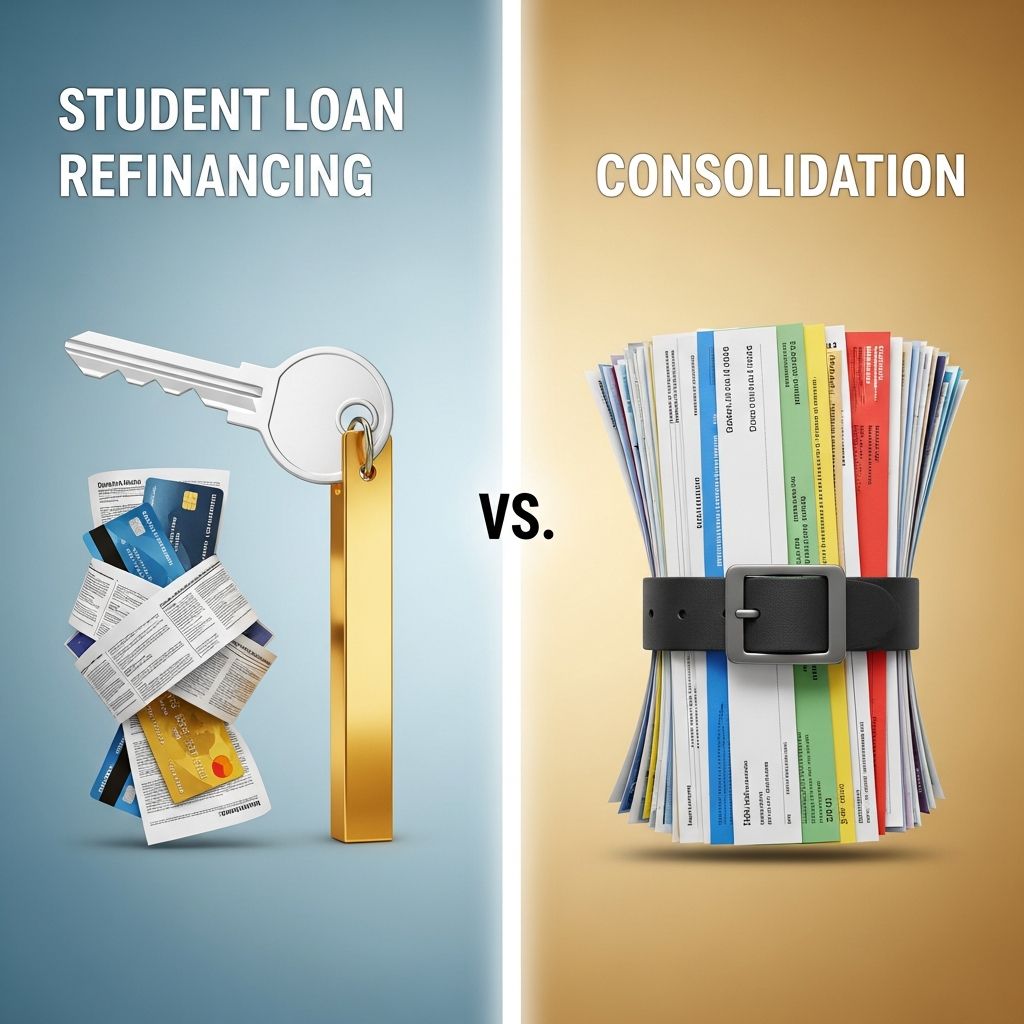
Student loan repayment can feel complicated when you juggle multiple loans, interest rates, and servicers. Two common strategies to simplify repayment are student loan refinancing and student loan consolidation. While these terms are often used interchangeably, they are not the same and can affect your interest rate, monthly payment, and federal protections in very different ways.
This guide explains how each option works, highlights the advantages and disadvantages, and helps you decide whether refinancing, consolidating, or keeping your current loans is the better move for you.
Refinancing vs. Consolidation: At a Glance
Both refinancing and consolidation involve replacing or combining existing loans with a new loan, but they do so in different ways and under different rules.
| Feature | Refinancing | Consolidation |
|---|---|---|
| Who offers it? | Private banks, credit unions, online lenders | U.S. Department of Education for federal Direct Consolidation Loans; private lenders for private consolidation |
| Eligible loan types | Federal and/or private loans, depending on lender | Federal loans (via Direct Consolidation); federal + private if using a private consolidation loan |
| Interest rate basis | Based on your credit, income, and debt profile | Federal consolidation: weighted average of existing rates, rounded up to nearest 1/8%; not credit-based |
| Can you lower your interest rate? | Yes, if you qualify for a lower rate | Federal consolidation typically does not lower your rate; it usually keeps it about the same overall |
| Federal benefits preserved? | No, if you refinance federal loans with a private lender, you lose federal protections | Yes, if you consolidate through the federal Direct Consolidation program; no if you use a private lender |
| Main goal | Save money through a lower rate or different term; simplify payments | Simplify payments and maintain access to federal repayment plans and forgiveness; may adjust term |
What Is Student Loan Consolidation?
Student loan consolidation means combining multiple loans into a single new loan with one servicer and one monthly payment. When people refer to consolidation, they usually mean a federal Direct Consolidation Loan through the U.S. Department of Education.
How Federal Direct Consolidation Works
With a Direct Consolidation Loan, most types of federal student loans can be combined into one new federal loan.
- Your new interest rate is the weighted average of the interest rates on the loans you consolidate, rounded up to the nearest one-eighth of a percent.
- You do not undergo a credit check for a Direct Consolidation Loan; approval is not based on credit scores.
- Your repayment term can be extended, sometimes up to 30 years depending on your balance, which usually reduces your monthly payment but can increase total interest paid over time.
Because the interest rate is an average of your existing rates, consolidation usually does not reduce the overall interest rate; its main benefit is simplified repayment and continued access to federal protections.
Federal Benefits You Keep With Direct Consolidation
When you consolidate federal loans through the government, your new loan remains a federal Direct Loan. That means you typically preserve important protections and benefits such as:
- Income-driven repayment (IDR) plans, which adjust payments based on your income and family size.
- Deferment and forbearance options during financial hardship, school enrollment, or qualifying circumstances.
- Borrower defense and other discharge options in specific situations.
- Eligibility for forgiveness programs like Public Service Loan Forgiveness (PSLF), as long as you meet program requirements.
Pros of Federal Student Loan Consolidation
- One monthly payment instead of multiple payments to different servicers.
- Access to additional repayment plans if some older federal loans are not currently eligible until they are consolidated into a Direct Loan.
- Preserves federal protections such as IDR and forgiveness if you consolidate through the Department of Education.
- Fixed rate if you had older variable-rate federal loans; consolidation can convert them to a fixed rate.
- Can help manage cash flow by extending the repayment term and lowering monthly payments (though at a cost of more interest over time).
Cons of Federal Student Loan Consolidation
- Little to no interest rate savings because the rate is a weighted average of existing loans, rounded up.
- Potentially higher total cost if you extend your repayment term, since interest accrues over more years.
- Loss of certain loan-specific benefits tied to your original loans, such as special borrower benefits or certain types of deferment, depending on the loan type.
- Capitalization of unpaid interest in some cases, which may slightly increase your principal balance at the time of consolidation.
What Is Student Loan Refinancing?
Student loan refinancing is when a private lender issues a new loan with new terms to pay off one or more existing student loans. The new loan replaces the old loans, and you then make payments to the new lender.
How Refinancing Works
Refinancing is available only through private lenders such as banks, credit unions, or online lenders. When you refinance, the lender evaluates your financial profile and offers terms based on the perceived risk.
- Interest rate is set by the private lender and is typically based on your credit score, income, debt-to-income ratio, and sometimes the presence of a cosigner.
- Loan types can include federal loans, private loans, or both, depending on the lender’s policies.
- Terms can be shorter or longer than your current repayment term, often ranging from about 5 to 20 years.
- You may choose between fixed and variable interest rates, depending on lender offerings.
Borrowers typically refinance to secure a lower interest rate, change their repayment term, or simplify multiple loans into one payment.
What Happens When You Refinance Federal Loans?
If you choose to refinance federal student loans with a private lender, your new loan becomes a private loan. This has important consequences:
- You permanently lose federal protections such as IDR plans, federal forbearance and deferment options, and eligibility for federal forgiveness programs like PSLF.
- Future federal relief measures (such as broad-based cancellation or temporary interest waivers, if enacted) will generally not apply to refinanced private loans.
- Your loan will be subject to the lender’s private policies for forbearance, hardship relief, and loan modification, which may be more limited than federal options.
Pros of Student Loan Refinancing
- Potential for lower interest rates, especially if market rates are favorable and you have strong credit and income.
- Interest savings over the life of the loan if you secure a lower rate and keep a similar or shorter term.
- Option to shorten the term and pay off loans faster, potentially reducing total interest costs.
- Flexible term choices that allow you to balance monthly payment size and total interest paid.
- One monthly payment and one servicer if you refinance multiple loans into a single new loan.
- Ability to remove a cosigner from existing private loans in some refinance programs, or to shift parent PLUS loan responsibility to the student borrower through refinancing.
Cons of Student Loan Refinancing
- Loss of federal protections when refinancing federal loans into a private loan, including IDR, PSLF eligibility, and certain deferment or forbearance benefits.
- Qualification requirements; you typically need good credit, stable income, and a reasonable debt-to-income ratio to obtain the best rates.
- Variable-rate risk if you choose a variable interest rate, your payments could rise if market rates increase.
- Longer terms may increase total cost even if your rate is lower, because interest accrues over more years.
Refinancing vs. Consolidation: Which Is Better for You?
There is no single right answer; the better option depends on your goals, loan types, and financial situation. Consider your primary objective:
If Your Goal Is to Simplify Payments
Both refinancing and consolidation can help.
- Direct Consolidation is often preferable if you have multiple federal loans and want to keep federal protections while reducing the number of monthly payments.
- Refinancing can also combine multiple federal and private loans into a single payment, but you must be comfortable giving up federal benefits on any federal loans you refinance.
If Your Goal Is to Lower Interest Costs
- Refinancing is generally the better option for lowering your interest rate and potentially saving money over time, provided you qualify for a more favorable rate.
- Federal consolidation usually will not reduce your rate because it uses a weighted average of existing rates.
Because of this, financial regulators emphasize that private refinancing may be appropriate primarily when you do not need federal benefits and can significantly improve your rate.
If Your Goal Is to Maintain or Gain Federal Protections
- Choose federal consolidation (Direct Consolidation) if you want one payment but also need access to income-driven repayment, PSLF, or other federal benefits.
- Avoid refinancing federal loans if you rely on or may need IDR, federal forbearance, or forgiveness programs. Once refinanced, federal protections cannot be restored.
If Your Goal Is to Reduce Monthly Payments
Lower monthly payments can make your budget more manageable, but may increase the total amount you pay.
- Direct Consolidation can lower payments by extending the repayment term, though this usually increases total interest.
- Refinancing can reduce payments by:
- Securing a lower interest rate, and/or
- Choosing a longer repayment term (with the trade-off of more interest overall).
If your income is limited or unstable and you have federal loans, consider whether an income-driven repayment plan might be more appropriate than refinancing, because IDR ties payments to your income and offers forgiveness after a set period.
Key Questions to Ask Before You Decide
Before choosing refinancing or consolidation, ask yourself:
- Are my loans federal, private, or a mix? The type of loan strongly influences your options and the impact of each choice.
- Do I need access to federal protections? If yes, be cautious about refinancing federal loans.
- Is my main goal to save money, simplify, or lower my payments? Your answer will point toward refinancing, consolidation, or staying put.
- What interest rate could I realistically qualify for? Get prequalified estimates from reputable lenders before deciding to refinance.
- Am I comfortable with potential trade-offs? Especially giving up federal benefits in exchange for a lower rate.
Frequently Asked Questions (FAQs)
Q: Can I consolidate private student loans with a federal Direct Consolidation Loan?
No. The federal Direct Consolidation program can only consolidate eligible federal student loans. Private loans cannot be added to a Direct Consolidation Loan. To combine private loans (and possibly federal loans) into one new private loan, you would need to use a private consolidation or refinancing lender.
Q: Will federal consolidation lower my interest rate?
Generally, no. With federal Direct Consolidation, your new interest rate is the weighted average of your existing federal loan rates, rounded up to the nearest one-eighth of a percent. This means your rate is unlikely to be significantly lower and may be slightly higher due to rounding.
Q: When does it make sense to refinance federal student loans?
Refinancing federal loans may make sense if you have strong credit, stable income, do not need federal protections such as income-driven repayment or forgiveness, and can substantially reduce your interest rate and total cost. Consumer regulators advise weighing the permanent loss of federal benefits carefully before refinancing.
Q: Can I refinance more than once?
Yes. Many private lenders allow borrowers to refinance multiple times. Some borrowers refinance again to take advantage of improved credit, higher income, or lower market interest rates. However, each refinancing should be evaluated on its own merits, including any fees and the impact on your repayment timeline.
Q: Does consolidating or refinancing affect my credit score?
Applying for refinancing typically involves a hard credit inquiry, which may have a small, temporary impact on your credit score. Consolidation through the federal government does not involve a traditional credit approval process, but any new loan, whether federal or private, can affect credit factors such as the age of your accounts and payment history over time. Consistent on-time payments after consolidation or refinancing can help build or maintain good credit.
References
- Student loan refinancing vs. consolidation — Citizens Bank. 2024-01-10. https://www.citizensbank.com/learning/student-loan-consolidation-vs-refinancing.aspx
- Student Loan Consolidation vs. Refinancing: What’s the Difference? — Nelnet Bank. 2023-09-15. https://www.nelnetbank.com/learning-center/consolidation-vs-refinancing/
- Student loan refinancing vs. consolidation — Consumer Financial Protection Bureau. 2023-08-28. https://www.consumerfinance.gov/ask-cfpb/should-i-consolidate-refinance-student-loans-en-561/
- Student Loan Consolidation vs. Refinancing — NerdWallet. 2024-02-05. https://www.nerdwallet.com/student-loans/learn/student-loan-consolidation-myths
- Student loans: Refinancing or Consolidating — Is There a Difference? — Laurel Road. 2023-06-20. https://www.laurelroad.com/refinance-student-loans/refinance-or-consolidate-student-loans-is-there-a-difference/
Similar Articles








Read full bio of medha deb