Student Loan Forbearance: Relief Options Explained
Understand how forbearance can provide temporary payment relief and its long-term financial implications.

Managing student loan debt can feel overwhelming, especially when unexpected financial challenges arise. One option available to borrowers facing temporary hardship is student loan forbearance, a program that temporarily pauses or reduces your monthly loan payments. While forbearance can provide critical breathing room during difficult times, it’s essential to understand how it works, what it costs you in the long run, and whether it’s the right choice for your situation.
Defining Forbearance and How It Works
Student loan forbearance is a temporary arrangement that allows borrowers to pause or reduce their monthly loan payments due to qualifying financial difficulties or other circumstances. Unlike loan cancellation or forgiveness programs, forbearance doesn’t eliminate your debt—it simply postpones your obligation to pay for a set period. This temporary relief can help you avoid delinquency and default while you work through financial challenges.
When you enter forbearance, your loan servicer (the organization that manages your loan) officially approves a pause or reduction in your required payments. The forbearance period has a defined start and end date, after which your regular payment obligations resume. Understanding the mechanics of forbearance is crucial because the way it affects your loan balance differs significantly depending on your loan type and terms.
Two Primary Categories of Forbearance
Forbearance comes in two distinct varieties, each with different approval processes and eligibility requirements.
General (Discretionary) Forbearance
General forbearance, also called discretionary forbearance, is granted at the discretion of your loan servicer. Your servicer has the authority to decide whether to approve your request based on the circumstances you present. This type of forbearance is available when you’re experiencing temporary financial challenges that make it difficult to maintain regular payments.
Common reasons for requesting general forbearance include:
- Loss of employment or reduced income
- Unexpected medical expenses or health issues
- Natural disasters or emergency situations
- Difficulty adjusting to the repayment phase
- Recent job transition or career change
Since general forbearance is discretionary, your servicer evaluates each application individually. This means approval is not guaranteed, and you may need to provide documentation supporting your claim of financial hardship.
Mandatory Forbearance
Mandatory forbearance operates differently because your loan servicer is legally required to grant it if you meet specific eligibility criteria. You don’t need to convince your servicer of your hardship; instead, you simply need to demonstrate that you qualify under one of the mandatory forbearance categories.
Mandatory forbearance eligibility typically includes:
- Active military service or national service programs
- Participation in medical or dental internships
- Enrolled in fellowship programs
- Teaching in low-income schools or serving in AmeriCorps
- Participation in Peace Corps service
Mandatory forbearance is often more straightforward to obtain because it doesn’t rely on your servicer’s judgment regarding financial hardship.
Duration and Frequency Limitations
Understanding how long forbearance lasts and how often you can use it is vital for long-term financial planning.
For federal loans, a single forbearance period typically extends up to 12 months. However, federal loans have a cumulative lifetime limit of three years (36 months) of general forbearance. This means that while you can request multiple forbearance periods, the total time you can spend in forbearance over the life of your loan is capped at three years.
Mandatory forbearance follows a similar timeline—it can be granted for up to 12 months at a time and may be renewed if you continue to meet eligibility requirements. However, mandatory forbearance may not be subject to the same cumulative limits as general forbearance.
If you have private student loans, the rules differ considerably. Private lenders establish their own forbearance policies, which can range from 12 to 24 months total. You should contact your specific lender to understand their particular forbearance limitations.
The Hidden Cost: Interest Accrual During Forbearance
One of the most important aspects of forbearance that borrowers must understand is what happens to interest during the forbearance period. In most cases, interest continues to accrue on your loans even though you’re not making payments.
This creates an important choice when your forbearance period ends:
- Pay accrued interest immediately: You can pay the interest that accumulated during forbearance as a lump sum when the forbearance period ends.
- Allow interest to capitalize: Alternatively, you can let the unpaid interest be added to your principal loan balance. While this means you don’t owe it immediately, you’ll pay interest on that interest for the remainder of your loan term, significantly increasing your total repayment cost.
For example, if you have $50,000 in federal loans and take a 12-month forbearance period, interest continues accruing the entire time. Depending on your interest rate, this could mean an additional $1,500 to $3,000 in interest charges. If this interest capitalizes, you’re now repaying a larger principal balance plus additional interest on top of that.
Navigating the Forbearance Application Process
Applying for forbearance involves several steps, though the specific requirements vary depending on whether you’re seeking general or mandatory forbearance.
Basic Application Steps
- Contact your loan servicer through their website, phone line, or mail to express your interest in forbearance
- Complete the appropriate forbearance request form (available online or by mail from your servicer)
- For general forbearance, provide documentation of your financial hardship if requested
- For mandatory forbearance, submit specific documentation proving your eligibility (such as military service records or internship verification)
- Wait for your servicer to review and approve your request
- Receive written confirmation of your forbearance approval, including the start and end dates
An important consideration: you should continue making loan payments while your forbearance request is being processed. If your servicer hasn’t officially approved your forbearance, missed payments could result in delinquency charges and credit reporting issues.
Comparing Forbearance to Alternative Relief Options
Forbearance isn’t your only option for managing student loan payments during financial hardship. Understanding how it compares to other relief strategies helps you make an informed decision.
| Feature | Forbearance | Deferment | Income-Driven Repayment Plans |
|---|---|---|---|
| Interest Accrual | Interest accrues on most loans; you must pay it or let it capitalize | Interest may not accrue on subsidized federal loans; accrues on unsubsidized loans | Interest accrues, but some plans cover unpaid interest under specific conditions |
| Approval Process | Discretionary (general) or automatic (mandatory) based on circumstances | Based on specific eligibility (enrollment, unemployment, economic hardship) | Based on income and family size; must recertify annually |
| Duration | Up to 12 months per period; 3-year lifetime limit for federal loans | As long as you remain eligible; may extend indefinitely | Can continue indefinitely as long as you recertify; payments based on income |
| Cost Implications | Higher total repayment due to interest accrual and capitalization | Lower cost if on subsidized loans (interest may not accrue) | Variable; payments may be lower but forgiveness programs available (Public Service Loan Forgiveness) |
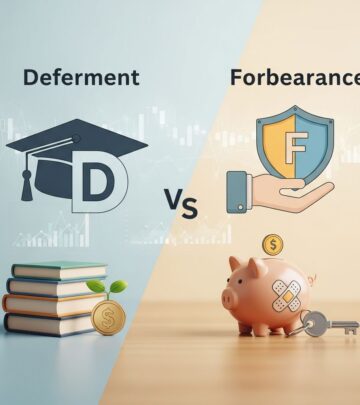
Deferment is particularly attractive if you have subsidized federal loans, as interest may not accrue on these loans during the deferment period. However, deferment is only available during specific life circumstances (such as returning to school or qualifying unemployment), making it inaccessible to many borrowers.
Income-Driven Repayment (IDR) plans offer a longer-term solution by adjusting your monthly payment based on your income rather than a fixed forbearance period. Unlike forbearance’s time limits, IDR plans can provide relief indefinitely as long as you recertify your income annually. Some newer plans, such as SAVE, even include provisions where the government covers unpaid interest when you make your required payments.
Advantages and Disadvantages of Forbearance
Forbearance provides specific benefits but comes with substantial tradeoffs you should carefully consider.
Advantages
- Immediate payment relief: You can stop or reduce monthly payments quickly during financial emergencies
- Prevents delinquency: Forbearance helps you avoid missed payments, late fees, and damage to your credit report
- Simple application: The process is generally straightforward compared to other relief options
- Maintains loan status: Your loans remain in good standing during forbearance
- Works for various circumstances: Both general and mandatory forbearance accommodate different situations
Disadvantages
- Interest continues accruing: You’ll owe more money at the end of forbearance, even though you weren’t making payments
- Higher total repayment cost: Interest capitalization significantly increases your long-term debt burden
- Limited duration: Federal loans have a 3-year lifetime limit, making forbearance unsuitable for long-term financial challenges
- Not a permanent solution: Forbearance is designed for temporary hardship, not ongoing financial difficulties
- May not count toward forgiveness: Time in forbearance typically doesn’t count toward Public Service Loan Forgiveness or other forgiveness programs (with limited exceptions)
Who Should Consider Forbearance?
Forbearance works best for borrowers experiencing temporary financial hardship—situations you expect to resolve within 12 months. It’s particularly useful if you:
- Recently lost your job and expect to find new employment within several months
- Experienced an unexpected medical emergency with temporary financial impact
- Need breathing room while transitioning between jobs or careers
- Faced a natural disaster or emergency that temporarily disrupted your finances
- Are in the early stages of financial hardship before exploring longer-term solutions
Forbearance is less suitable if you’re experiencing chronic financial difficulties, face ongoing reduced income, or need relief for more than a year or two.
Frequently Asked Questions About Forbearance
Can I request forbearance multiple times?
Yes, you can request forbearance multiple times, but federal loans have a cumulative 3-year limit of general forbearance over the life of the loan. Mandatory forbearance may be renewed annually if you continue to qualify. Private lenders set their own policies regarding multiple forbearance requests.
What happens to my credit score during forbearance?
If your forbearance is approved before you miss any payments, your credit score typically won’t be negatively affected. However, if you miss payments before approval, those may be reported to credit bureaus. Forbearance itself doesn’t improve your credit—it simply prevents further damage from missed payments.
Can forbearance help me qualify for loan forgiveness programs?
Generally, time spent in forbearance does not count toward Public Service Loan Forgiveness or other income-driven repayment forgiveness programs. However, there are limited exceptions, such as certain PSLF buyback provisions.
Do I have to pay interest while in forbearance?
Interest continues to accrue during forbearance on most loans. You have the choice of paying it immediately or allowing it to capitalize (be added to your principal). You’re not required to pay it during forbearance, but you’ll owe it eventually.
Is forbearance available for private student loans?
Yes, forbearance is available for both federal and private student loans, though private lenders have their own specific policies and requirements. Contact your private loan servicer to understand their forbearance terms.
Making Your Decision: Is Forbearance Right for You?
Forbearance serves as a financial safety net for borrowers facing temporary hardship, but it’s not a long-term solution to student loan debt. Before requesting forbearance, consider whether your financial challenges are truly temporary and whether alternatives might better serve your situation.
If you’re experiencing ongoing financial difficulties, exploring income-driven repayment plans might provide more lasting relief without the interest capitalization concerns. If you’re facing a genuine emergency requiring immediate payment relief and expect to recover financially within a year, forbearance can provide valuable breathing room.
Ultimately, forbearance is a tool designed to help borrowers bridge short-term financial gaps while protecting their credit and loan status. Understanding its costs and benefits ensures you use it strategically as part of a broader student loan management plan.
References
- Understanding Student Loan Forbearance — Western & Southern Financial Group. https://www.westernsouthern.com/personal-finance/student-loan-forbearance
- What is Student Loan Forbearance? — Citizens Bank. https://www.citizensbank.com/learning/student-loan-forbearance.aspx
- What Student Loan Forbearance Means — Ascent Funding. https://www.ascentfunding.com/blog/what-is-student-loan-forbearance/
- Forbearance on Student Loans: What You Need to Know — HESCO Loans. https://www.hescloans.com/blog/forbearance-on-student-loans
- What is student loan forbearance? — Consumer Financial Protection Bureau. https://www.consumerfinance.gov/ask-cfpb/what-is-student-loan-forbearance-en-631/
- 34 CFR 682.211 — Forbearance — Electronic Code of Federal Regulations. https://www.ecfr.gov/current/title-34/subtitle-B/chapter-VI/part-682/subpart-B/section-682.211
- Get Temporary Relief: Deferment and Forbearance — Federal Student Aid (U.S. Department of Education). https://studentaid.gov/manage-loans/lower-payments/get-temporary-relief
Similar Articles








Read full bio of medha deb