Deferment vs Forbearance: Student Loan Relief Options
Understand the key differences between student loan deferment and forbearance to choose the best temporary relief option for your financial situation.
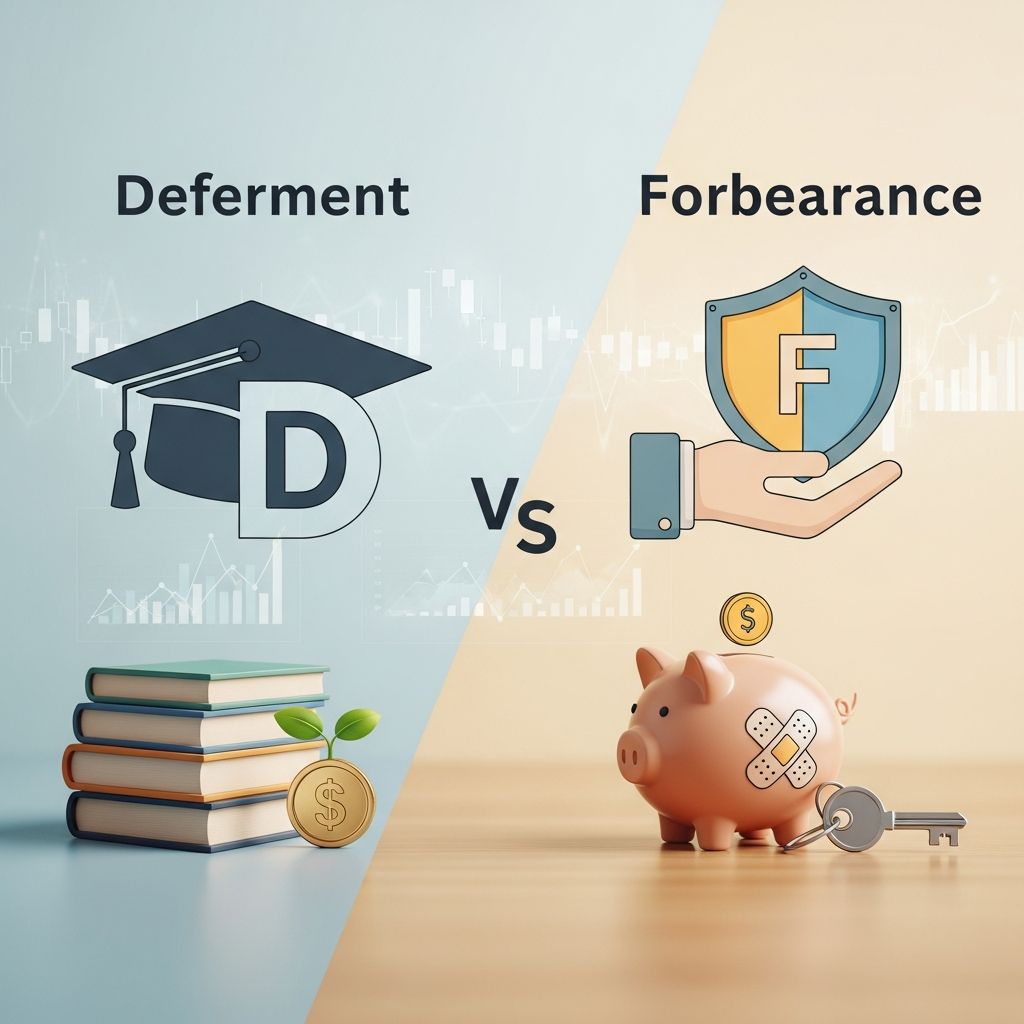
Student loan borrowers facing temporary financial difficulties often turn to deferment or forbearance to pause or reduce payments. These federal programs provide essential breathing room, but they differ significantly in eligibility requirements, interest handling, duration limits, and overall financial impact. Choosing the right option depends on your specific circumstances, loan type, and long-term repayment goals.
Core Concepts of Loan Payment Pauses
Both deferment and forbearance allow qualified borrowers to temporarily halt principal and interest payments on eligible federal student loans. Deferment is typically linked to specific life events like returning to school or military service, while forbearance offers more flexibility for general hardships. Understanding these mechanisms is crucial for avoiding default and managing debt effectively.
Federal Direct Loans, FFEL Program loans, and Perkins Loans qualify for both options, though private loans may offer similar but less standardized relief through individual lenders. Always contact your loan servicer to confirm availability and requirements.
Eligibility Criteria Breakdown
Deferment eligibility is narrower and tied to defined qualifying events. Common scenarios include:
- Enrollment in school at least half-time (undergraduate: 6 credits per term; graduate: 3 credits per term).
- Participation in an approved graduate fellowship program.
- Engagement in rehabilitation training for disabled borrowers.
- Active military duty or service in the National Guard.
- Receiving means-tested federal benefits or full-time Peace Corps service under economic hardship provisions.
- Cancer treatment or parental deferment for PLUS loans while the student is enrolled half-time.
Forbearance provides broader access, especially through general forbearance, which servicers can grant at their discretion for reasons like:
- Financial difficulties, job loss, or excessive debt relative to income.
- High medical or dental expenses.
- Changes in employment status or internships/residencies.
- AmeriCorps service or Department of Defense repayment programs.
- Eligibility for Teacher Loan Forgiveness or other mandatory conditions.
Mandatory forbearance applies when specific criteria are met, such as monthly payments exceeding 20% of discretionary income or National Guard duty on active orders. Unlike deferment, forbearance does not require proof of a precise event, making it easier to obtain in urgent situations.
Duration and Renewal Rules
| Aspect | Deferment | Forbearance |
|---|---|---|
| Typical Period | Up to 3 years cumulative, varies by type (e.g., in-school lasts as long as qualified) | 12 months at a time |
| Cumulative Limit | 3 years for most; no limit for some ongoing events | 3 years total for general (new rules post-2027: 9 months in 24) |
| Renewal | Automatic for qualifying events; reapply as needed | Reapply every 12 months; servicer approval required |
Deferment durations align closely with the triggering event—for instance, military deferment extends through active service plus 180 days. Forbearance increments are shorter to encourage quicker return to repayment, with Perkins Loans facing stricter caps.
Interest Accrual and Capitalization Explained
The most critical distinction lies in interest handling, which can dramatically affect total repayment costs.
- Deferment: No interest on subsidized federal loans, Perkins Loans, or certain primary loans—government covers it. Unsubsidized loans accrue interest, capitalized (added to principal) upon exit, increasing future interest calculations.
- Forbearance: Interest accrues on all loans daily, regardless of type. Borrowers must pay it monthly to prevent growth, but it’s not capitalized in federal programs, preserving the original principal.
For subsidized loans, deferment preserves affordability by avoiding interest buildup. In forbearance, expect your balance to grow by the full interest rate (typically 5-8%) during the pause. Example: A $30,000 loan at 6% in 12-month forbearance adds about $1,800 in interest.
Application Process Step-by-Step
Applying for either requires contacting your federal loan servicer via their online portal, phone, or mail. Key steps include:
- Log into StudentAid.gov or your servicer’s site to check eligibility.
- Download the appropriate form: Deferment forms vary (e.g., In-School Deferment Form); forbearance uses a single general form or phone request.
- Submit documentation like enrollment verification, income proof, or military orders.
- Await approval—mandatory cases are automatic; general forbearance is discretionary.
Processing takes 1-4 weeks. Track status online and make payments until confirmed to avoid delinquency.
Financial Impacts and Credit Effects
Neither option negatively affects credit reports when properly granted—both appear positively, showing good standing. However, interest dynamics alter costs:
- Deferment saves money on subsidized loans, ideal for long pauses.
- Forbearance increases debt via accruing interest, better for short-term needs.
Post-pause, explore Income-Driven Repayment (IDR) plans to cap payments at 10-20% of discretionary income. Avoid default by acting before payments are 270 days late.
When to Choose Deferment Over Forbearance
Opt for deferment if:
- You hold subsidized federal loans and qualify via school, military, or hardship status—zero interest accrual maximizes savings.
- Your situation matches strict criteria, ensuring guaranteed approval.
- You anticipate an extended pause (e.g., full degree program).
Ideal Scenarios for Forbearance
Select forbearance when:
- Deferment eligibility is unavailable, but cash flow is tight (e.g., medical bills, job transition).
- You need quick, flexible relief without extensive paperwork.
- Short-term bridge to stability, accepting interest costs over alternatives like high-interest personal loans.
Private Student Loans: Limited Parallels
Private lenders may offer deferment for in-school or residency periods and forbearance for hardships, but terms vary widely. Interest always accrues, and approvals are not federally mandated. Review your promissory note or contact the lender directly.
Alternatives to Deferment and Forbearance
Consider these if neither fits:
- IDR Plans: Recalculate payments based on income/family size; forgiveness after 20-25 years.
- Extended/Graduated Repayment: Stretch terms to lower monthly amounts.
- Loan Rehabilitation: Cure default with 9 affordable payments.
Public Service Loan Forgiveness (PSLF) pairs well with pauses for qualifying nonprofit/government workers.
Frequently Asked Questions (FAQs)
Does interest capitalize during forbearance?
No, federal forbearance interest accrues but is not added to principal unless unpaid upon exit to certain repayment plans.
Can I get both deferment and forbearance on the same loan?
Yes, sequentially if limits allow, but time in one counts toward cumulative caps.
How does COVID-19 relief compare?
Past emergency forbearances paused payments/interest; current options revert to standard rules post-2023.
Will using these affect future borrowing?
No direct impact on credit scores; responsible use demonstrates management skills.
What’s the difference for Perkins Loans?
Stricter forbearance limits (3 years max); school/perkins servicer handles.
Strategic Tips for Borrowers
Proactively monitor loans via StudentAid.gov. Pay accruing interest voluntarily to curb growth. Consult nonprofit counselors like NFCC.org before deciding. Recent changes (e.g., 2027 forbearance caps) underscore planning ahead.
References
- Federal Student Aid – Deferment and Forbearance — U.S. Department of Education. 2024-01-15. https://studentaid.gov/help-center/answers/article/difference-between-deferment-and-forbearance
- AmeriCorps Trust – Forbearance vs Deferment — Corporation for National and Community Service. 2023-06-01. https://my.americorps.gov/trust/help/member_portal/what_is_the_difference_between__forbearance__and__deferment_.htm
- Student Loan Deferment vs. Forbearance — Experian. 2024-05-20. https://www.experian.com/blogs/ask-experian/student-loan-deferment-vs-forbearance/
- Deferment vs. Forbearance for Student Loans — NerdWallet. 2024-03-12. https://www.nerdwallet.com/student-loans/learn/student-loan-deferment-forbearance
- What is the Difference Between Deferment and Forbearance? — Excelsior University. 2023-11-08. https://www.excelsior.edu/article/difference-between-deferment-and-forbearance/
Similar Articles








Read full bio of Sneha Tete