Student Loan Credit Reporting by Enrollment
Understand how your enrollment status shapes student loan reporting to credit bureaus and impacts your financial future.
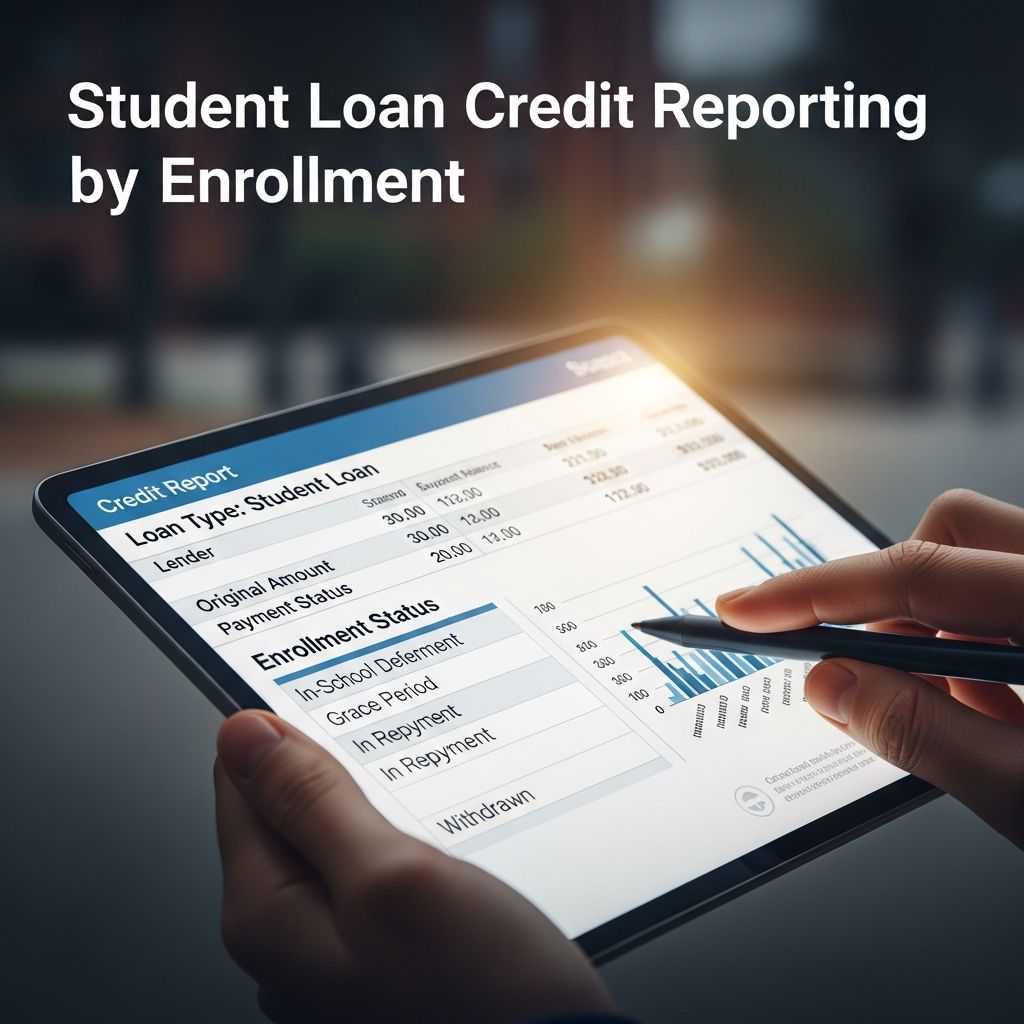
Student loans appear on credit reports based on disbursement timelines and enrollment statuses, with federal loans typically reporting within weeks of funding and private ones after initial payments. This process links directly to how schools report enrollment to systems like NSLDS, influencing loan statuses during school terms, grace periods, and beyond.
Fundamentals of Student Loan Credit Visibility
Credit bureaus receive updates on student loans from servicers, reflecting balances, payment histories, and statuses tied to your academic progress. Federal loans enter reports shortly after funds disburse to your school, often 2-4 weeks later, as servicers log the new account and current repayment status. Private lenders delay reporting until after the first payment, usually 30-90 days post-funding, allowing time for account verification.
Enrollment plays a pivotal role: schools must submit data to the National Student Loan Data System (NSLDS) every 60 days, capturing full-time, half-time, withdrawn, or graduated statuses. This feeds into loan servicers, who then update credit reports monthly, based on the last day of each month.
Federal Student Loans: Quick Post-Disburstment Reporting
Federal loans, managed by the Department of Education, hit credit files rapidly. Once funds transfer from the school, servicers report the loan balance and ‘in-school’ or deferred status within about 30 days. Even during a six-month grace period after dropping below half-time enrollment, the loan remains visible but marked as current, avoiding negative impacts if managed properly.[10]
Key factors include:
- Disbursement timing: Reports follow the first payout, regardless of multiple disbursements per enrollment period.
- Monthly updates: Status reflects enrollment as of month-end, excluding finalized loans like paid-off accounts.
- Grace triggers: Repayment starts six months post-enrollment drop, with credit reports updating accordingly.[10]
For clock-hour or non-term programs, the minimum loan period matches the lesser of the academic year, program length, or remaining year portion, ensuring precise reporting alignment.
Private Student Loans: Delayed Entry After Payments
Unlike federal options, private loans from banks or lenders appear after processing the initial payment, spanning 30-90 days from disbursement. This window verifies borrower details before bureau submission. Cosigned loans mirror the primary borrower’s timeline.
| Loan Type | Reporting Trigger | Typical Timeline |
|---|---|---|
| Federal | First disbursement | 2-4 weeks |
| Private | First payment | 30-90 days |
| Cosigned | Matches primary | Same as above |
Refinancing creates a new account, resetting the reporting clock and replacing prior records.
Enrollment Reporting: The NSLDS Connection
Schools report to NSLDS at least every 60 days, using effective dates for status changes like graduation or withdrawal. For a student shifting from full-time fall to half-time spring, reports use the exact change date, even if submitted later, maintaining compliance.
Non-required terms like summer require nuance: active students expected to return aren’t marked withdrawn, preserving deferments. However, campus-level withdrawals (e.g., via R2T4 calculations) must report accurately to trigger grace or repayment properly.
This system protects benefits like Direct Subsidized Loan interest subsidies under the 150% limit, recalculating based on reported graduation before excess borrowing.
Grace Periods, Deferments, and Credit Impacts
During grace, the loan shows on reports with a zero or current balance, updating monthly without payment history until repayment. Deferments or forbearances similarly reflect paused status, beneficial if no delinquencies occur.
Delinquency reports start at 90+ days past due, monthly thereafter. Enrollment errors can trigger premature repayment demands; proactive servicer notifications help when leaving school early or reenrolling.
Loan Periods and Disbursement Schedules
Loan periods define enrollment spans for certification. Term-based schools can certify per semester, while non-term programs use the shortest of academic year, program, or remainder. Maximum periods cap at the school’s year or 12 months.
Example: A school with fall-spring as its year certifies loans accordingly, even if summer exists but isn’t standard.
Practical Strategies for Monitoring and Managing
Regularly check NSLDS for enrollment accuracy and credit reports for loan entries. Notify servicers of status changes to preempt issues. The Student Clearinghouse handles reporting for federal/private aid, sharing with NSLDS and servicers.
- Track disbursements to anticipate reports.
- Verify school reports every 60 days via NSLDS.
- Address discrepancies promptly to safeguard credit.
Common Pitfalls in Enrollment-Linked Reporting
Errors like unreported withdrawals during summer can prematurely end grace, leading to unwanted payments or interest accrual. Late NSLDS updates might delay subsidy protections.
Private loan delays mean no initial credit impact, but missed first payments risk early negatives.
FAQs on Student Loan Credit and Enrollment
Q: When do federal student loans first appear on my credit report?
A: Typically 2-4 weeks after the first disbursement, showing the balance and in-school status.
Q: How often do loan servicers update credit bureaus?
A: Monthly, reflecting the status as of the month’s last day.
Q: What if my school reports my enrollment wrong?
A: It can trigger incorrect repayment starts; contact your servicer directly.
Q: Do summer terms affect loan reporting?
A: Only if withdrawn; otherwise, continuous enrollment assumes return for fall.
Q: Can refinancing change my credit reporting timeline?
A: Yes, it creates a new account with fresh reporting.
Long-Term Credit Health Tips
Maintain on-time payments post-grace to build positive history. Use enrollment reporting to qualify for deferments during returns to school. Monitor via AnnualCreditReport.com alongside NSLDS for holistic oversight.
Understanding these interconnections empowers better financial navigation through education funding.
References
- When Are Student Loans Reported to Credit Bureaus? — The Credit People. 2023. https://www.thecreditpeople.com/bureaus/when-are-student-loans-reported-to-credit-bureaus
- NSLDS Enrollment Reporting – Submission Dates. — Federal Student Aid Partners. 2017-04-20. https://fsapartners.ed.gov/knowledge-center/library/electronic-announcements/2017-04-20/general-subject-nslds-enrollment-reporting-submission-dates-effective-dates-and-certification-dates
- Enrollment Reporting for Summer & Other Non-Required Terms. — National Student Clearinghouse. 2025-09-10. https://help.studentclearinghouse.org/compliancecentral/knowledge-base/enrollment-reporting-for-summer-and-other-non-required-terms/
- Determining the Loan Period and Amounts. — Federal Student Aid. 2021-03. https://fsapartners.ed.gov/sites/default/files/2021-03/0304Vol8Ch3Loanperiodamounts.pdf
- Credit Reporting – StudentAid.gov. — Federal Student Aid. Accessed 2026. https://staging-usds.mohela.studentaid.gov/DL/resourceCenter/understandingCredit.aspx
Similar Articles








Read full bio of medha deb