Student Loan Calculator: Estimate Payments & Compare Rates
Calculate your monthly student loan payments and compare rates to find the best borrowing option.

Understanding the Student Loan Calculator
A student loan calculator is an essential financial tool that helps borrowers make informed decisions about education financing. Whether you’re considering taking out your first student loan or refinancing existing debt, understanding how to use a student loan calculator can save you thousands of dollars over the life of your loan. These calculators provide transparent estimates of monthly payments, total interest costs, and various repayment scenarios, empowering you to choose the borrowing option that best fits your financial situation.
How to Use the Student Loan Calculator
Using a student loan calculator is straightforward and requires only basic information about your proposed or existing loan. The process involves three main steps that will give you a comprehensive overview of your loan obligations.
Step 1: Input Your Loan Information
Begin by entering the following essential details into the calculator:
– Loan Amount: The total principal you plan to borrow or currently owe- Repayment Term: The length of time (typically measured in years) you have to repay the loan- Interest Rate: The annual percentage rate (APR) charged by the lender
Gathering this information beforehand ensures accuracy in your calculations. If you’re evaluating an existing loan, you can find these details on your loan documents, your lender’s website, or by logging into StudentAid.gov.
Step 2: Review Your Estimated Results
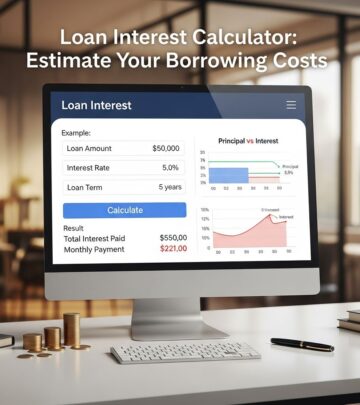
Once you input your information and click “Calculate,” the calculator instantly provides:
– Estimated Monthly Payment: The amount you’ll need to pay each month- Total Interest Paid: The cumulative interest over the entire loan term- Total Amount Repaid: The combined principal and interest you’ll pay back
Step 3: Explore Additional Features
Most comprehensive student loan calculators offer additional functionality to help you make better financial decisions:
– Compare Loan Rates: View rates and terms offered by multiple lenders to identify competitive options- Amortization Schedule: Access a detailed breakdown showing how each monthly payment applies to principal and interest throughout your loan term- Extra Payment Options: Model the impact of making additional payments toward principal reduction
Making the Most of Your Calculator Results
Simply running the calculator once is just the beginning. To truly optimize your student loan strategy, you should apply the results strategically to your unique financial situation.
Compare Lenders and Interest Rates
Interest rates vary significantly between lenders, and even a small difference in rate can result in substantial savings over a 10-year repayment period. Use the “Compare Loan Rates” feature to evaluate what different lenders offer. This comparison shopping is crucial before committing to any loan. Run the calculator multiple times using different rates and terms to see the full spectrum of options available to you.
Test Different Repayment Terms
One of the most valuable uses of a student loan calculator is testing various repayment timeframes. Many borrowers face a critical trade-off: while longer repayment terms result in lower monthly payments, they significantly increase the total interest paid over the loan’s lifetime. For example, a $10,000 loan at 6% interest might have a monthly payment of approximately $111 over 10 years, but extending to 20 years could reduce the monthly payment to around $66 while nearly doubling the total interest paid. Input different term options until you find the monthly payment that best fits your budget while keeping total interest costs manageable.
Develop a Repayment Strategy
The calculator can help you determine whether making extra payments toward principal is feasible within your budget. Many borrowers find that allocating even $25-50 extra per month toward principal can shorten the repayment timeline significantly and reduce total interest costs. Experiment with different extra payment amounts to see how they impact your payoff date and total interest expense.
Understanding Student Loan Interest Calculation
To fully appreciate what your calculator is computing, it’s helpful to understand the mechanics of student loan interest. Most federal student loans use a simple interest formula rather than compound interest.
The Three-Step Interest Calculation Process
Step 1: Calculate Your Daily Interest Rate
Divide your annual interest rate by 365 (the number of days in a year). For a 6% loan: 0.06 ÷ 365 = 0.000164, or approximately 0.016% daily.
Step 2: Determine Daily Interest Accrual
Multiply your daily interest rate by your outstanding loan balance. Using a $10,000 loan: 0.000164 × $10,000 = $1.64 in daily interest charges.
Step 3: Calculate Monthly Interest Payment
Multiply your daily interest by the number of days in your billing cycle (typically 30 days): $1.64 × 30 = $49.20 in monthly interest.
Factors Affecting Your Interest Charges
Several key factors influence how much interest you’ll ultimately pay:
– Interest Rate: Even marginal differences in APR compound significantly over time- Loan Principal: The larger your initial borrowing, the more interest accrues- Repayment Term: Extended timelines allow more interest accumulation- Payment Schedule: Making extra payments reduces the principal balance faster, lowering total interest
Comparing Student Loan Calculators and Tools
While the Bankrate student loan calculator is comprehensive, borrowers should understand the complete ecosystem of available tools for different situations:
| Calculator Type | Best For | Key Features |
|---|---|---|
| Standard Student Loan Calculator | New borrowers evaluating initial loans | Monthly payment estimates, total interest calculations, amortization schedules |
| Student Loan Refinance Calculator | Existing borrowers considering consolidation | Compares current vs. refinanced terms, calculates monthly savings, weighted average rates |
| Student Budget Calculator | Planning overall education financing | Calculates total education costs minus savings and other income sources |
| Loan Repayment Calculator | Any loan type evaluation | Flexible term options, extra payment modeling |
Advanced Calculator Features Explained
Amortization Schedule
An amortization schedule is a detailed table showing exactly how your monthly payments are applied throughout your loan’s life. Early payments typically allocate more to interest, with gradually increasing portions going toward principal reduction. This schedule helps you understand the true impact of making extra payments and seeing how principal balance decreases over time.
Extra Payment Impact Modeling
Most calculators allow you to input additional monthly or lump-sum payments. This feature is invaluable for demonstrating how even modest extra contributions accelerate payoff timelines. For instance, adding just $50 monthly to a standard $10,000 loan payment could reduce your repayment period by several years and save thousands in interest.
Rate Comparison Tools
The integrated rate comparison feature lets you evaluate offerings from multiple lenders simultaneously. After clicking “Compare Loan Rates,” you’ll see the current market rates and terms, helping you identify which lenders offer the most competitive options for your credit profile and financial situation.
Practical Application Examples
Example 1: Evaluating Your First Loan
Sarah is considering borrowing $25,000 for her undergraduate degree. She enters this amount, selects a 10-year term, and tests rates ranging from 4.5% to 6.5%. The calculator shows that a 1% rate difference results in approximately $2,500 in additional interest over the loan term. Armed with this information, Sarah shops around with multiple lenders to secure the lowest possible rate before committing.
Example 2: Refinancing Strategy Assessment
Marcus currently has $45,000 in student loans at an average 5.8% interest rate with 15 years remaining on his repayment plan. His current monthly payment is $360. Using the refinance calculator, he discovers that refinancing to a 10-year term at 4.2% would increase his monthly payment to $435 but save him over $8,000 in total interest. He decides this trade-off aligns with his financial goals.
Key Considerations When Using the Calculator
Income and Employment Stability
Remember that the calculator provides estimates based on the financial inputs you provide. Your actual ability to maintain monthly payments depends on income stability and employment circumstances. Always choose a loan term that fits comfortably within your realistic budget, even accounting for potential income fluctuations.
Tax Deduction Opportunities
Federal student loan interest may be tax-deductible up to $2,500 annually, which effectively reduces your borrowing costs. While the calculator focuses on the raw numbers, remember to factor in potential tax benefits when evaluating the true cost of your loan.
The Long-Term Impact of Term Length
The calculator clearly demonstrates why term length matters significantly. While longer repayment periods lower monthly payments—making loans more accessible—they substantially increase total interest costs. Most financial advisors recommend the shortest repayment term your budget comfortably supports.
Frequently Asked Questions About Student Loan Calculators
Q: How accurate are student loan calculator estimates?
A: Calculators provide highly accurate estimates when you input correct information. However, actual payments may vary slightly depending on factors like variable interest rates, payment application methods, and whether your loans have origination fees or other charges.
Q: Can I use the calculator for federal and private loans?
A: Yes, most calculators work for both loan types. However, federal loans may have specific repayment options and protections that the calculator might not fully capture. Consult your loan servicer or StudentAid.gov for federal-specific scenarios.
Q: What if my financial situation changes after I take out a loan?
A: If circumstances change—such as income loss or unexpected expenses—federal loans offer income-driven repayment plans that can temporarily lower your monthly obligation. The calculator can help you model these alternative scenarios.
Q: How often should I recalculate my loan projections?
A: Recalculate whenever your financial situation changes, when considering refinancing, or annually to track progress. Regular recalculation keeps you informed about your payoff trajectory and helps identify optimization opportunities.
Q: Is it better to use a calculator from my lender or a third-party calculator?
A: Third-party calculators like Bankrate’s offer unbiased comparisons across multiple lenders, while lender-specific calculators provide precise information about their products. Using both provides comprehensive perspective.
Taking Action After Using the Calculator
Once you’ve thoroughly explored the calculator and identified your optimal loan scenario, the next steps involve comparing actual lender offers. Most major lenders provide rate quotes without hard credit inquiries, allowing you to compare multiple options. Take advantage of these prequalification processes to confirm that the calculator estimates align with real-world offerings.
Consider setting up a spreadsheet comparing lenders on several dimensions: interest rate, origination fees, repayment term flexibility, income-driven repayment options (for federal loans), and borrower benefits like interest rate reductions for automatic payments. This comprehensive comparison ensures you select the lender and loan terms that truly maximize your financial outcome.
Conclusion: Empowering Your Borrowing Decision
Student loan calculators democratize financial planning by putting sophisticated financial analysis tools directly in borrowers’ hands. By understanding how to use these calculators effectively—inputting accurate information, testing multiple scenarios, and applying results strategically—you gain the knowledge necessary to make confident borrowing decisions. Whether you’re evaluating your first student loan or refinancing existing debt, the calculator serves as your financial compass, helping you navigate toward the most favorable terms and lowest total costs. Taking time to thoroughly explore calculator scenarios before committing to any loan is one of the most valuable investments you can make in your financial future.
References
- How to calculate and pay less student loan interest — Bankrate. 2025-11-29. https://www.bankrate.com/loans/student-loans/how-to-calculate-student-loan-interest/
- Student Loan Calculator — Bankrate. 2025-09-05. https://www.bankrate.com/loans/student-loans/student-loan-calculator/
- Student Loan Information for Consumers — Commonwealth of Massachusetts. 2025-11-29. https://www.mass.gov/info-details/student-loan-information-for-consumers
- Financial Literacy: Managing Debt — Purdue University Libraries. 2025-11-29. https://guides.lib.purdue.edu/c.php?g=1171310&p=8556132
Similar Articles








Read full bio of medha deb