Structured CDs: 5 Advantages And 7 Risks To Consider
Understand the advantages and disadvantages of structured CDs for your investment portfolio.
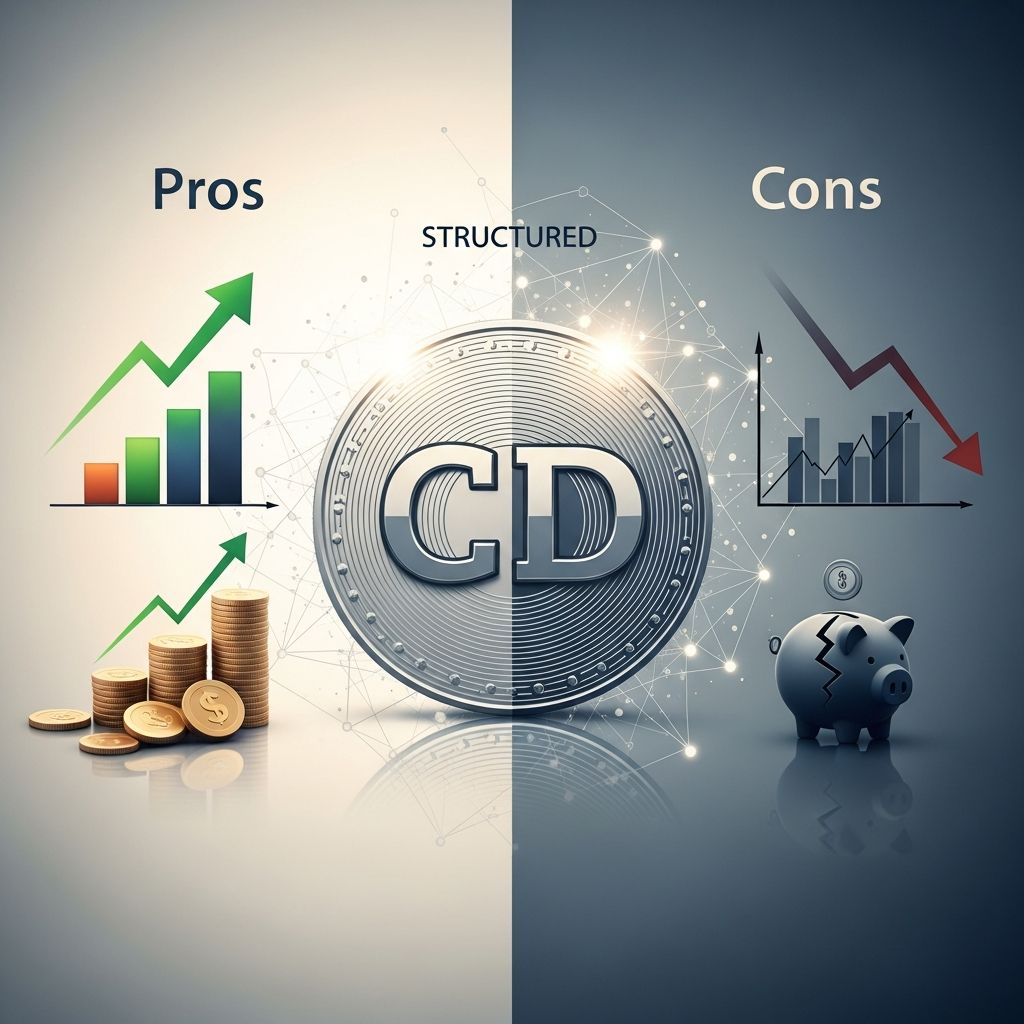
Understanding Structured Certificates of Deposit
A structured certificate of deposit (structured CD) is a specialized investment product that combines the safety features of traditional certificates of deposit with market-linked return potential. Unlike conventional CDs that offer fixed interest rates, structured CDs provide returns based on the performance of an underlying asset such as a stock index, commodity, or basket of securities. These products are designed to give investors the opportunity to earn higher returns while maintaining some level of principal protection, making them an intriguing option for those seeking to balance safety with growth potential.
Structured CDs represent a hybrid between traditional fixed-income investments and derivative products. They offer predetermined maturity dates and are typically FDIC-insured up to the standard coverage limits, providing a safety net that appeals to conservative investors. However, the complexity of these products requires careful evaluation before investing.
Key Features of Structured CDs
Principal Protection Guarantee
One of the most distinctive features of structured CDs is their principal protection component. Most structured CDs guarantee that a portion or all of your initial investment will be returned at maturity, regardless of how the underlying asset performs. This protection applies even if the reference asset declines significantly during the investment period, offering peace of mind similar to traditional CDs but with additional market exposure.
Underlying Asset Performance
Structured CDs are linked to various underlying assets, which could include equity indices like the S&P 500, commodity prices, foreign currency baskets, or volatility indices. The return you receive depends on how these reference assets perform during the investment term. This linkage creates the opportunity for enhanced returns compared to standard CDs, though with accompanying complexities.
Participation Rates and Return Caps
Structured CDs typically include participation rates, which determine what percentage of the underlying asset’s gains you receive. For example, an 80% participation rate means you capture 80% of the index gains. Additionally, many structured CDs include caps on maximum returns, limiting your upside even if the underlying asset performs exceptionally well. A CD with a 12% cap, for instance, will pay no more than 12% regardless of superior index performance.
The Advantages of Structured CDs
Enhanced Return Potential
Unlike traditional CDs or bonds that offer fixed rates of return, structured CDs provide the potential for significantly higher returns if the underlying asset performs favorably. This appeal attracts investors seeking to enhance their portfolio yield without necessarily taking on the full risk associated with direct equity investments. During strong market periods, structured CDs can substantially outperform conventional fixed-income alternatives.
Portfolio Diversification Benefits
Structured CDs offer diversification advantages by providing exposure to different asset classes, market sectors, or geographic regions through their underlying assets. This exposure can help reduce overall portfolio risk and potentially smooth out returns across market cycles. An investor heavily weighted toward domestic stocks, for example, could use a structured CD linked to international indices to add geographic diversification.
Capital Preservation
The principal protection feature provides a significant psychological and financial benefit. Knowing that your initial investment is protected at maturity, regardless of market conditions, allows investors to participate in market upside with defined downside risk. This characteristic makes structured CDs particularly appealing during periods of market uncertainty or for those nearing retirement who cannot afford significant losses.
Customization Options
Structured CDs are customized instruments that provide access to numerous investment strategies and market exposures. Investors can select from various underlying assets, participation rates, and term lengths to align with their specific investment objectives and time horizons. This flexibility allows tailored solutions for different investment scenarios.
Liquidity Opportunities
While structured CDs are typically designed to be held until maturity, some issuers allow early redemption or secondary market trading, providing a degree of liquidity if unexpected financial needs arise. This feature distinguishes them from traditional CDs and adds flexibility for investors.
The Disadvantages of Structured CDs
Capped Return Potential
Despite offering higher return potential than traditional CDs, structured CDs typically have limited upside through return caps and participation rate restrictions. Even if the underlying asset performs exceptionally well, your returns may be constrained by these terms. For example, if an index gains 25% but your structured CD has a 12% cap with an 80% participation rate, you would only earn 10% rather than the full 20% you would receive with direct index investment.
Complex Terms and Conditions
Structured CDs are significantly more complex than traditional CDs, with numerous terms, conditions, and features that require careful analysis. Understanding participation rates, caps, floors, knock-in provisions, and other features demands investor sophistication. Many investors struggle to fully comprehend these products, which can lead to poor investment decisions or unexpected outcomes.
High Fees and Commissions
Hidden fees represent a major drawback of structured CDs. Advisers selling these products can receive commissions up to 3% of the CD’s value, with banks covering FDIC insurance premiums by reducing participation rates or return caps. These costs significantly diminish potential returns and often tilt the risk-return profile heavily in favor of the issuing bank.
Disappointing Historical Performance
Research reveals concerning performance records for structured CDs. Analysis of 118 structured CDs issued at least three years prior showed that only one-quarter posted returns better than average five-year conventional CDs, while roughly one-quarter produced no returns at all. Similarly, market-linked CDs revealed that 62% produced lower returns than standard five-year CDs, with almost 25% paying no return whatsoever.
Limited Compounding and No Interest Accrual
Unlike traditional CDs where interest compounds over time, structured CDs typically pay returns only at maturity, preventing the benefit of compounding growth. This feature further reduces effective returns compared to conventional fixed-income investments.
Credit Risk Exposure
While structured CDs are FDIC-insured, the insurance covers only the original deposit amount at standard limits ($250,000 per depositor per bank). If purchased at a premium in the secondary market, that premium portion lacks FDIC protection. Additionally, investors retain direct credit risk exposure to the issuing bank for amounts exceeding FDIC coverage limits.
Mandatory Redemption at Maturity
Structured CDs typically must be redeemed at maturity without flexibility to extend or modify terms. This inflexibility can be problematic if market conditions are unfavorable or if investors’ financial situations have changed.
Structured CDs vs. Traditional CDs: A Comparison
| Feature | Traditional CD | Structured CD |
|---|---|---|
| Principal Protection | 100% guaranteed | Partial or full, depending on terms |
| Return Potential | Fixed rate of return | Linked to underlying asset performance |
| Risk Level | Low risk with limited upside | Higher risk due to market exposure |
| Liquidity | Limited before maturity | Limited, some with early redemption options |
| Complexity | Simple and straightforward | Complex with multiple terms and conditions |
| Tax Treatment | Interest taxed annually | Potential tax deferral on gains until maturity |
| Fees | Minimal or none | Often significant hidden fees |
Real-World Examples of Structured CD Performance
Example 1: Equity Index Participation
John invested $50,000 in a five-year structured CD offering 100% principal protection with an 80% participation rate and a 12% cap on the underlying stock index. Over the investment period, the index gained 25%. Because of the 12% cap, the maximum return was limited to 12%, and with the 80% participation rate, John earned 9.6% on his investment, or approximately $4,800 in gains. His principal was fully protected, but the return significantly underperformed the actual index performance.
Example 2: Volatility Index Strategy
Tom invested $100,000 in a two-year structured CD linked to a volatility index with specific performance conditions. During the investment period, market conditions stabilized and volatility declined significantly. Due to the structure’s design for hedging purposes, Tom earned a 24% return, helping offset potential losses elsewhere in his portfolio. This example demonstrates how structured CDs can serve specific portfolio strategies under favorable conditions.
Structured CDs as Alternative Investments
Structured CDs occupy a unique position as bond alternatives for investors seeking enhanced returns with some capital protection. They differ from pure equities in that they’re not designed to replicate long-term growth potential of stocks. Instead, they offer shorter investment horizons with defined upside and downside parameters. This positioning makes them potentially suitable for investors with specific time horizons and return objectives, but unsuitable for those with long-term growth requirements.
Considerations for Potential Investors
Transparency and Disclosure
Before investing in structured CDs, insist on completely transparent cost disclosures and clear, understandable performance reports. Request detailed explanations of all fees, commissions, participation rates, caps, and other terms. If the product cannot be explained simply, it likely contains expensive tricks and traps.
Compare to Alternatives
Always compare structured CD terms to conventional CDs, bonds, and direct investment in the underlying asset. Calculate potential returns under various scenarios and compare them to what you could achieve through simpler alternatives. Often, structured CDs underperform their simpler counterparts.
Evaluate Your Time Horizon
Ensure the structured CD’s maturity date aligns with your financial needs and time horizon. Avoid purchasing structured CDs if you might need the funds before maturity, as early redemption typically involves penalties or unfavorable pricing.
Understand the Underlying Asset
Thoroughly research the underlying asset driving returns. Understand its historical performance, volatility, and future prospects. If you don’t understand how the reference asset behaves, you cannot make an informed investment decision.
Frequently Asked Questions About Structured CDs
Q: Are structured CDs FDIC-insured?
A: Yes, structured CDs issued by FDIC-insured banks are covered up to $250,000 per depositor per bank. However, if purchased at a premium in the secondary market, that premium amount lacks FDIC protection.
Q: Can I withdraw my money early from a structured CD?
A: Most structured CDs don’t allow early withdrawal without penalties. Some issuers may offer early redemption options, but these typically come at unfavorable prices.
Q: How are structured CD returns taxed?
A: Tax treatment varies. Some structured CDs defer taxes until maturity, while others may have annual tax consequences. Consult a tax professional regarding your specific product.
Q: What happens if the underlying asset performs poorly?
A: If your structured CD includes principal protection, you’ll receive your original investment back at maturity regardless of underlying asset performance. However, you’ll earn little or no return.
Q: How do participation rates and caps affect my returns?
A: Participation rates determine what percentage of gains you receive (e.g., 80% of index gains), while caps limit maximum returns. Both features reduce potential upside compared to direct investment.
Q: Should I invest in structured CDs if I need growth?
A: Structured CDs are not suitable for long-term growth strategies. They’re better suited for intermediate-term investors seeking modest returns with capital protection rather than significant wealth accumulation.
Making Your Decision: Is a Structured CD Right for You?
Structured CDs can serve specific investment purposes for certain investors, but they’re not appropriate for everyone. They work best for investors who have a specific time horizon, can afford to lock up capital until maturity, understand the underlying asset, and seek modest enhancement over traditional CDs while accepting higher complexity and fees. Conversely, if you prioritize simplicity, transparency, and straightforward returns, traditional CDs, bonds, or direct index investing may better serve your needs.
Before committing to any structured CD, work with a financial advisor to evaluate whether the product aligns with your overall financial plan, risk tolerance, and investment objectives. Remember that attractive-sounding returns often come with hidden costs and limitations that can significantly reduce actual gains.
References
- Safety and Market Upside with Structured CDs — Inspire Financial Planning. 2025. https://www.inspirefp.net/blog/structured-cds
- Structured CDs: Buyer Beware — Finley Wealth Advisors. 2025. https://mywealthadvisor.com/structured-cds/
- What’s the Deal: Structured CDs — Mayer Brown LLP. May 2022. https://www.mayerbrown.com/-/media/files/perspectives-events/publications/2022/05/whats-the-deal–structured-cds.pdf
- Federal Deposit Insurance Corporation Coverage — FDIC. 2025. https://www.fdic.gov/
- Understanding Structured Notes With Principal Protection — FINRA. 2025. https://www.finra.org/investors/insights/structured-notes-principal-protection
Similar Articles








Read full bio of medha deb