Structural Inequality: Facts, Types, Causes & Solutions
Understanding structural inequality: definitions, manifestations, root causes, and evidence-based solutions for equitable societies.
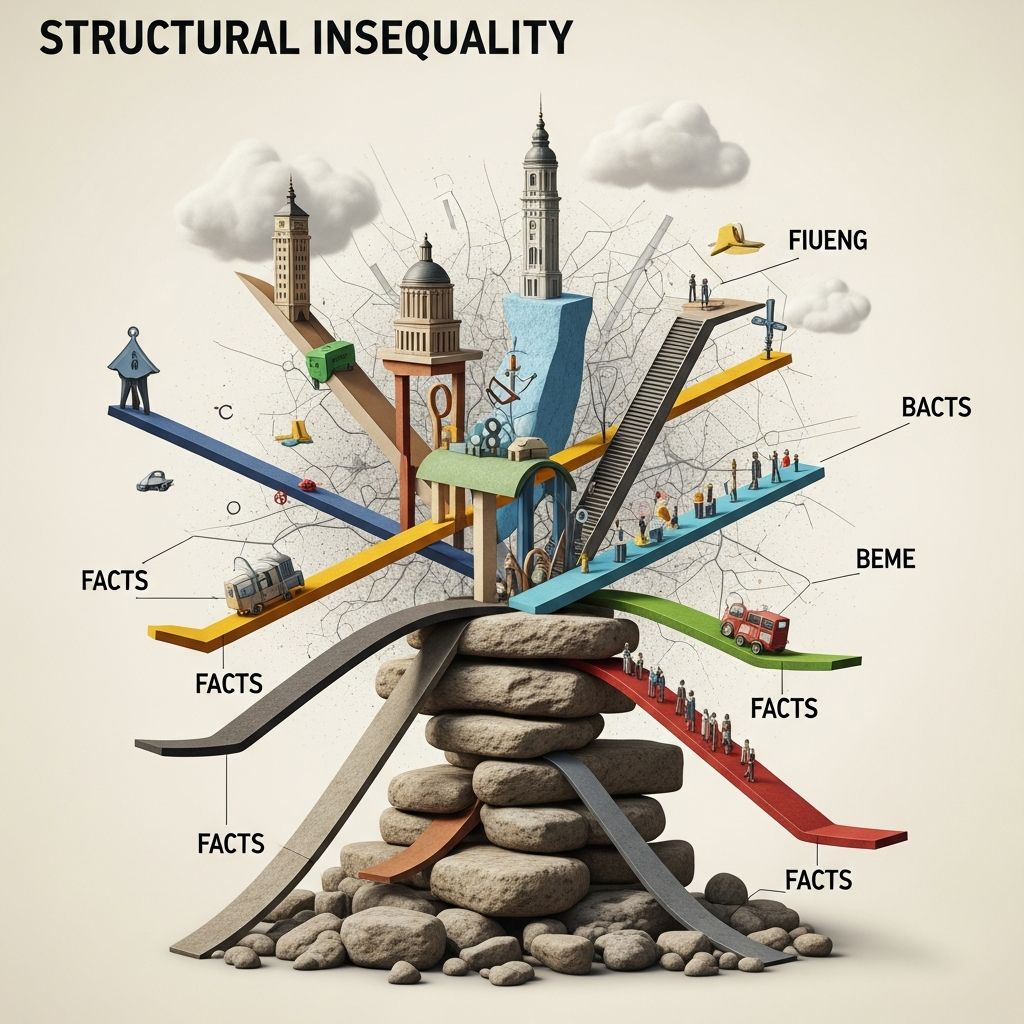
Understanding Structural Inequality: Facts, Types, Causes, and Solutions
Structural inequality represents one of the most persistent challenges facing modern societies. Unlike individual acts of discrimination, structural inequality is embedded within the normal operations of social, economic, and political institutions, creating systematic disadvantages for certain groups while providing advantages to others. This comprehensive guide explores what structural inequality is, how it manifests, why it exists, and what solutions can help address it.
What Is Structural Inequality?
Structural inequality refers to a system where prevailing social institutions offer an unfair or prejudicial distinction between different segments of a population in a specific society. Such unfair distinctions are rooted in social practices, laws, regulations, government policies, and politics, which eventually cause consequences in terms of access to equal or fair opportunity in socio-political and economic atmospheres.
The fundamental characteristic of structural inequality is that it occurs within the normal operations of dominant social institutions. This means that discrimination is not necessarily the result of individual prejudice or intentional bias, but rather emerges from the way institutions are organized and operated. The systemic nature of structural inequality makes it particularly challenging to identify and address, as it is woven into the fabric of society itself.
Who Is Affected by Structural Inequality?
Structural inequality affects specific groups of people who are systematically disadvantaged or attributed an unequal status compared to other groups with which they coexist. These are minority or subordinated groups that experience persistent social disadvantage. Groups persistently affected by structural inequality include Indigenous Peoples, persons of color, racial and ethnic minorities, women, and the economically poor.
These groups lack the power, control, resources, and opportunities to improve their conditions compared to majority or dominant groups in society. The disadvantage experienced by these populations is not random but systematic, meaning it occurs consistently and predictably across multiple sectors of society.
Types and Forms of Structural Inequality
Structural inequality manifests in multiple forms across different social, economic, and political domains. Understanding these distinct types helps illuminate how systemic disadvantage operates throughout society.
Employment Discrimination
Employment represents one of the most visible domains where structural inequality occurs. Barriers in hiring, promotion, pay equity, and job quality create significant disparities in economic opportunity. Unequal structures in employment can be identified by recognizing significant gaps in access to quality positions, career advancement opportunities, and compensation between different demographic groups.
Educational Discrimination
Educational systems perpetuate structural inequality through unequal access to quality education, disparities in funding between schools serving different populations, and differences in educational outcomes. These barriers limit future economic opportunities and reinforce cycles of disadvantage across generations.
Healthcare Disparities
Healthcare systems reflect and reinforce structural inequality through differential access to quality care, geographic disparities in service availability, and health outcome gaps between demographic groups. These disparities are rooted in systemic factors including wealth inequality, residential segregation, and institutional practices.
Housing and Residential Segregation
Spatial and residential segregation creates structural inequality by limiting access to neighborhoods with quality schools, employment opportunities, and services. Residential location often determines educational and economic outcomes, making housing discrimination a critical factor in perpetuating systemic disadvantage.
Gender-Based Structural Inequality
Gender-based structural inequality refers to the embedding of gender inequalities in social structures based on institutionalized conceptions of gender differences. This includes sexual harassment, pregnancy discrimination, unequal pay, and unequal opportunities to earn livelihood. Gender inequality is deeply rooted in the normal operations of dominant social institutions such as employment and education.
Racial and Ethnic Inequality
Structural racism operates through mutually reinforcing systems of housing, education, employment, earnings, benefits, credit, media, health care, and criminal justice. These interconnected systems create compounding disadvantages that are difficult for individuals to overcome through personal effort alone.
Root Causes of Structural Inequality
Understanding the causes of structural inequality requires examining how institutions, policies, and practices create and maintain systemic disadvantage.
Institutional Design and Operations
Structural inequality is caused by systemic and structural arrangements rooted in an imbalance of political and economic power. When institutions are designed or operated in ways that advantage certain groups while disadvantaging others, these patterns become embedded in normal institutional functioning and difficult to change.
Historical Legacies
The global history of slavery, serfdom, indentured servitude, and other forms of coerced labor and economic exploitation that marginalized individuals are key factors defining structural inequality. These historical injustices created wealth gaps, restricted access to resources, and established patterns of institutional discrimination that persist today.
Laws and Policies
Laws and government policies can potentially construct structural forms of inequality. Policies regarding zoning, education funding, lending practices, and criminal justice directly shape opportunities and outcomes for different groups.
Geographic and Economic Factors
Access to bodies of water, long-distance trade routes, and ports has historically influenced community development and wealth accumulation. Discrepancies between growth in communities near these resources and those further away have created spatial inequality that persists today.
Why Identifying and Addressing Structural Inequality Matters
The consequences of structural inequality extend far beyond individual hardship. When significant populations are systematically disadvantaged, entire societies suffer reduced development potential and increased social instability. Structural inequalities prevent many countries and societal groups from realizing their full potential and undermine the effectiveness of social policy. They may also undermine sustainable development outcomes, with enormous costs in terms of regressed development, declined social and cultural environments, and increased risk of social instability and conflict.
Addressing structural inequality is therefore not merely a matter of fairness but of societal wellbeing and economic efficiency. Deconstruction of structural inequality can potentially improve the social, cultural, natural, economic, legal, political, and institutional environment for sustainable social development.
Solutions for Reducing Structural Inequality
Addressing structural inequality requires comprehensive, systemic approaches that go beyond treating symptoms. Solutions must target the underlying institutional arrangements that create and perpetuate disadvantage.
Policy Reform and Legal Changes
Governments must review and reform policies that create or perpetuate inequality in education, housing, employment, and criminal justice. This includes examining zoning laws, school funding mechanisms, lending practices, and hiring standards to ensure they do not systematically disadvantage particular groups.
Institutional Accountability and Transparency
Organizations must establish mechanisms to identify and measure inequality within their operations. Regular audits of hiring practices, promotion patterns, compensation, and service delivery can reveal structural inequalities and guide reforms.
Investment in Affected Communities
Addressing structural inequality requires targeted investment in communities that have historically been disadvantaged. This includes funding for education, infrastructure, healthcare, and economic development in underserved areas.
Diversity, Equity, and Inclusion Initiatives
Organizations across sectors must implement comprehensive diversity, equity, and inclusion programs that go beyond hiring quotas to examine and reform institutional practices, culture, and decision-making processes.
Education and Awareness
Understanding the systemic nature of structural inequality is essential for addressing it. Education programs must help people recognize how institutional practices create disadvantage and understand that individual solutions alone cannot overcome systemic barriers.
Coalition Building and Advocacy
Addressing structural inequality requires collaboration among affected communities, civil society organizations, businesses, and government. Coalition building amplifies voices demanding change and creates political will for reform.
Frequently Asked Questions About Structural Inequality
Q: How is structural inequality different from individual discrimination?
A: Individual discrimination involves prejudicial actions by specific people, while structural inequality is embedded in institutions and normal practices. Structural inequality can exist and perpetuate itself without requiring individual acts of discrimination, making it more systemic and difficult to address.
Q: Can structural inequality exist in progressive societies?
A: Yes. Structural inequality is believed to be an embedded part of all known cultural groups. Even societies with strong commitments to equality can maintain structural inequalities through policies, institutional practices, and historical legacies.
Q: How do we measure structural inequality?
A: Structural inequality can be identified by recognizing significant gaps in outcomes between groups in employment, social integration, education, health, and access to resources. Statistical analysis of disparities in income, employment rates, education levels, and other indicators reveals structural patterns.
Q: What is the relationship between structural inequality and poverty?
A: Structural inequality often traps people in poverty by limiting access to quality education, employment opportunities, and wealth-building resources. Poverty is not simply an individual outcome but often reflects systemic disadvantage created by structural inequality.
Q: How long does it take to address structural inequality?
A: Addressing structural inequality is a long-term process because it is deeply embedded in institutions and practices. Change requires sustained effort, policy reform, cultural shifts, and generational commitment to equity.
Q: What role do corporations play in perpetuating structural inequality?
A: Corporations perpetuate structural inequality through hiring practices, promotion policies, compensation structures, and location decisions. They also influence broader systems through lobbying and can either resist or support policy changes affecting inequality.
Q: Can structural inequality be completely eliminated?
A: While complete elimination may be difficult, significant reduction is possible through systematic institutional reform, policy changes, and sustained commitment to equity. Progress requires addressing root causes rather than symptoms and maintaining accountability for outcomes.
Conclusion
Structural inequality represents a fundamental challenge to equitable societies. By understanding its definition, recognizing its multiple forms, identifying its root causes, and implementing comprehensive solutions, societies can move toward greater equity. The key insight is that structural inequality is not inevitable but rather the product of human choices embedded in institutions—and therefore can be addressed through deliberate institutional reform and policy change. Creating more equitable societies requires recognizing that individual effort alone cannot overcome systemic barriers and that solutions must target the structures themselves, not just individual outcomes. Through sustained commitment to identifying and deconstructing inequality-producing structures, societies can create more just and prosperous futures for all.
References
- Toolkit for Structural Inequality — Arctic Centre. 2021. https://www.arcticcentre.org/EN/structuralinequality/toolkit
- Structural Inequality — Wikipedia. 2024. https://en.wikipedia.org/wiki/Structural_inequality
- What is Structural Inequality? — Nordic Information on Gender (NIKK). 2021. https://nikk.no/wp-content/uploads/2021/05/APB6C61.pdf
- Structural Inequality — Fiveable (Intro to Anthropology). 2024. https://fiveable.me/key-terms/intro-anthropology/structural-inequality
- Structural Inequalities — Vulnerability Knowledge and Practice Platform (VKPP). 2024. https://www.vkpp.org.uk/vkpp-work/vkpp-research/structural-inequalities/structural-inequalities/
- Addressing Structural Inequalities, Structural Racism, and Social Determinants of Health — PMC, National Center for Biotechnology Information (NCBI). 2024-02-15. https://pmc.ncbi.nlm.nih.gov/articles/PMC10897090/
- Structural Inequalities — UN Terminology Database (UNTERM). 2024. https://unterm.un.org/unterm2/en/view/fca377d0-cead-41ee-bb49-d408799e416b
Similar Articles








Read full bio of Sneha Tete