Strategic Timing For Selling Stocks: A Practical Guide
Master the art of knowing exactly when to sell stocks to optimize returns, manage risks, and align with your financial goals effectively.

Determining the right moment to sell stocks remains one of the most challenging aspects of investing. While buying decisions often stem from excitement about potential growth, selling requires discipline to lock in gains or cut losses without letting emotions dictate actions. This guide delves into practical strategies drawn from established investment principles, helping you navigate market fluctuations with confidence.
Establishing Clear Investment Theses Before Purchase
The foundation of smart selling begins at the point of entry. Every stock acquisition should rest on a specific thesis—such as anticipated earnings expansion, undervaluation relative to peers, or exposure to emerging trends. Documenting this rationale creates an objective benchmark for future evaluation. If the core assumptions underpinning your purchase erode, it signals time for reconsideration, regardless of short-term price movements.
For instance, investors frequently cite shifts in company fundamentals as primary selling triggers. Strong initial earnings momentum that fades, competitive pressures intensifying, or management missteps can invalidate the original investment case. Regularly reviewing quarterly reports and industry developments ensures alignment with your thesis.
Implementing Profit-Taking Mechanisms
Capturing gains systematically prevents the greed trap where investors hold winners too long, exposing them to reversals. Set predefined price targets based on valuation metrics like forward P/E ratios or discounted cash flow models. A common approach involves partial sales: liquidate 20-50% of a position upon reaching a milestone, allowing the remainder to compound further.
Trailing stop-loss orders serve as automated safeguards. These adjust upward with rising prices, typically triggering sales at 10-20% below recent highs. Research indicates such tools enhance returns in momentum-driven environments by preserving upside while curbing drawdowns. However, in stable markets, they may underperform buy-and-hold tactics, underscoring the need for strategy alignment.
| Profit-Taking Method | Description | Best For |
|---|---|---|
| Fixed Target | Sell at predetermined price or multiple | Value investors with clear valuations |
| Trailing Stop | Dynamic sell point trailing peaks | Momentum or volatile stocks |
| Partial Scaling | Sell in tranches at milestones | Balancing risk and reward |
Maintaining Portfolio Equilibrium Through Rebalancing
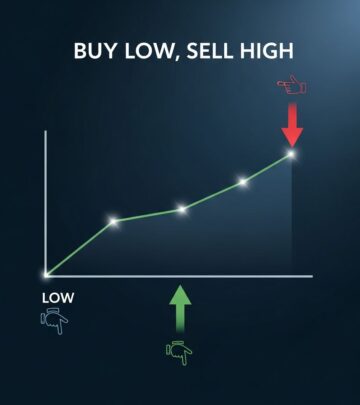
Over time, market movements distort asset allocations. A stock surging from 10% to 25% of your portfolio introduces undue concentration risk. Quarterly or annual rebalancing restores target weights—selling outperformers to fund underperformers—enforcing the discipline of ‘sell high, buy low.’
This tactic not only mitigates volatility but also capitalizes on mean reversion. For example, trimming gold miners after rallies while adding to depressed energy stocks leverages relative opportunity shifts. Institutional strategies like Ray Dalio’s All-Weather portfolio exemplify this, delivering consistent results across cycles.
- Frequency: Review allocations quarterly or after 5-10% drifts.
- Thresholds: Act when any asset exceeds ±5% from targets.
- Tax Efficiency: Harvest losses from laggards to offset gains.
Evaluating Risk-Reward Evolution
Market prices reflect collective sentiment, often diverging from intrinsic value. As stocks appreciate, potential returns diminish while downside risks mount due to elevated valuations. Conversely, sharp declines can enhance appeal if business quality remains intact, as seen in Berkshire Hathaway’s 40% drops that preceded superior recoveries.
Quantify this by recalculating expected returns: compare projected cash flows against current prices. John Templeton’s rule offers a heuristic—replace holdings only if an alternative promises 50% superior upside, calculated as (Price A – Price B) / Price B. This framework prioritizes capital redeployment to higher-conviction opportunities.
Addressing Deteriorating Fundamentals in Underperformers
Persistent losers demand scrutiny. The ‘break-even fallacy’ tempts holders to wait for recovery to purchase price, yet prolonged stagnation erodes opportunity costs. Sell if:
- Earnings growth stalls or reverses.
- Debt burdens escalate unsustainably.
- Market share erodes amid competition.
Charles Schwab emphasizes divesting when investments misalign with strategy, using realized losses to offset taxes on winners. Fidelity advocates natural selection: exit before stop-losses as conditions worsen.
Aligning Sales with Broader Financial Objectives
Life events and goals influence timing. Approaching retirement may prompt shifting from growth stocks to income generators. Need for liquidity—college funding or home purchases—necessitates sales irrespective of market levels. Merrill Lynch notes rebalancing to target allocations, like trimming equities from 70% back to 60%, maintains risk parity.
Short-term traders differ from long-haul holders. Define your horizon upfront: short-term aims might target 20-30% gains, while buy-and-hold favors multi-year compounding unless theses break.
Navigating Tax and Transaction Realities
Selling incurs capital gains taxes—short-term rates mirror income brackets, long-term offer preferential treatment after one year. Time sales in low-income years or pair with loss harvesting for offsets. Transaction costs, though minimal today, accumulate in frequent trading; prioritize high-conviction moves.
Psychological Pitfalls and Mitigation Tactics
Emotions sabotage decisions: anchoring to buy prices, recency bias favoring recent trends, or overconfidence in rebounds. Counter with written rules: ‘Sell if earnings miss twice consecutively’ or ‘Rebalance annually.’ Journaling trades fosters pattern recognition and accountability.
Pre-commitment works wonders—outline exit criteria pre-purchase. Reframe gains as ‘house money’ post-appreciation to ease sales. Professional oversight via advisors enforces discipline for retail investors.
Advanced Tactics for Sophisticated Investors
Options overlays like covered calls generate income on held stocks, providing sell signals via premium decay. Pairs trading sells overvalued legs against undervalued counterparts. Algorithmic rules, backtested on historical data, systematize processes.
In momentum regimes, Kaminski and Lo’s analysis validates stop-losses; value regimes favor patience. Hybrid approaches blend fundamentals with technicals for robustness.
Common Mistakes to Avoid
- Holding Forever: No stock is immortal; businesses evolve.
- Chasing Momentum Blindly: Fundamentals anchor sustainability.
- Ignoring Opportunity Costs: Idle capital misses alternatives.
- Tax Neglect: Uncle Sam claims a share—plan accordingly.
FAQs
When should I sell a stock that’s gone up a lot?
Consider profit targets, rebalancing needs, or if better opportunities arise. Trailing stops protect gains without fully exiting.
Is it better to sell losers or let them recover?
Sell if the thesis is broken; holding ties up capital. Use losses for tax benefits.
How often should I rebalance my portfolio?
Quarterly or on 5-10% deviations from targets to control risk.
Do stop-losses always work?
Effective in momentum markets, less so in ranging ones per academic studies.
What’s John Templeton’s selling rule?
Replace if another stock offers 50% more upside potential.
Building Your Personalized Selling Framework
Synthesize these elements into a bespoke ruleset. Assign weights: 30% thesis validity, 25% risk-reward shift, 20% rebalancing, 15% targets, 10% life goals. Backtest against history, refine iteratively. Consistency trumps perfection—systematic selling outperforms intuition long-term.
Ultimately, selling sharpens investing edges. It frees capital for superior bets, tempers overexposure, and honors original intents. Master these dynamics to elevate performance amid uncertainty.
References
- When To Sell A Stock – 7 Strategies — Sven Carlin. 2023. https://svencarlin.com/when-to-sell-a-stock-7-strategies-on-my-20-portfolio-stock-sale-example/
- Exactly when to sell your stocks — YouTube (Video Transcript). 2023. https://www.youtube.com/watch?v=jGabQmZmjlg
- 4 Reasons to Sell Your Losers — Charles Schwab. 2024-01-15. https://www.schwab.com/learn/story/4-reasons-to-sell-your-losers
- When to Sell Stocks & Investing Strategies — Menninger & Associates. 2023. https://maaplanning.com/tricks-of-the-trade/when-to-sell-stocks-and-investing-strategies
- 6 reasons to sell an investment — and 2 to hold — Merrill Lynch. 2024. https://www.ml.com/articles/when-to-sell-investments.html
- Techniques for Managing Positions — Fidelity Investments. 2024-02-01. https://www.fidelity.com/learning-center/trading-investing/trading/managing-positions
Similar Articles








Read full bio of Sneha Tete