Stocks vs Bonds: Key Differences
Discover how stocks and bonds differ in risk, returns, and role in your portfolio for smarter investing decisions.
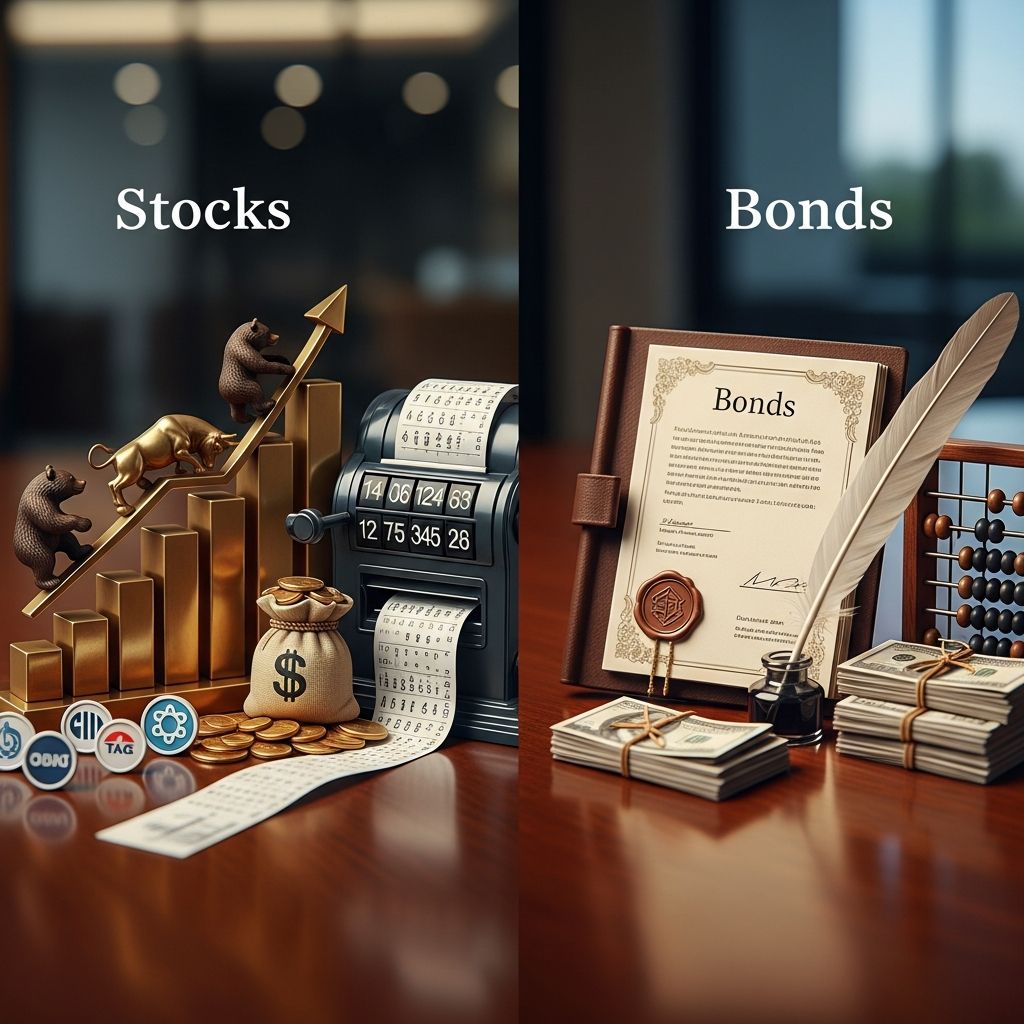
Stocks and bonds represent two cornerstone asset classes in investment portfolios, each offering distinct risk-reward profiles that can complement one another for long-term financial growth. Stocks provide ownership stakes with higher potential returns but greater volatility, while bonds deliver fixed income through debt obligations with more predictable payouts.
Understanding the Basics of Equity and Debt Investments
At their core, stocks embody equity financing, granting investors partial ownership in a company. This means shareholders benefit from profits via dividends or capital appreciation when share prices rise, but they also bear losses if the company underperforms. In contrast, bonds function as debt instruments where investors lend money to issuers—governments or corporations—in exchange for periodic interest payments and principal repayment at maturity.
This fundamental distinction shapes investor expectations. Equity holders rank last in bankruptcy proceedings, after bondholders claim their dues, underscoring bonds’ senior position in capital structures. Over time, this dynamic influences performance: stocks have historically outperformed bonds during economic expansions due to earnings growth, while bonds shine in downturns as safe havens.
Historical Performance: A Long-Term Perspective
Examining decades of data reveals stocks’ superior long-term returns. The S&P 500, a benchmark for U.S. equities, has consistently outpaced bond indices when measured by total return ratios. Periods of rising stock-bond ratios signal equity dominance, often tied to robust economic growth, whereas falling ratios highlight bonds’ resilience amid recessions.
For instance, rolling correlations between stocks and bonds fluctuate with macroeconomic cycles. Positive correlations emerge during expansions, but negative ones prevail in recessions as investors flock to bonds and central banks cut rates. In early 2022, aggressive rate hikes drove both assets lower, pushing correlations near +1, a rare alignment.
| Period | Stock Performance (S&P 500) | Bond Performance (Total Return Index) | Key Driver |
|---|---|---|---|
| Expansions | Outperforms | Stable | Growth optimism |
| Recessions | Declines | Rallies | Flight to safety |
| 2022 Rate Hikes | Declines | Declines | Inflation pressure |
This table summarizes performance patterns, highlighting diversification benefits.
Risk Profiles: Volatility vs Predictability
Stocks carry higher risk due to market sensitivity. Their prices swing with company earnings, sector trends, and broader sentiment, amplifying both upsides and downsides. Bonds, deemed fixed-income assets, offer more stability through contractual interest, though values fluctuate inversely with interest rates and inflation.
- Stock Risks: Business failure, market crashes, economic slowdowns.
- Bond Risks: Interest rate changes, credit defaults (especially corporates), inflation erosion.
Corporate bonds add yield premiums over governments but introduce default risk, particularly if growth falters and spreads widen from historic lows.
Income Generation: Dividends Meet Interest
Bonds guarantee interest payments, appealing to income-focused investors, unlike variable stock dividends. Yet, stocks’ growth potential often yields higher total returns over time. In 2026 outlooks, bonds’ elevated yields post-rate normalization position them for positive portfolio contributions, especially with moderating inflation restoring negative stock-bond correlations.
Market Dynamics in 2026: Evolving Outlook
Looking to 2026, bonds may rally early as central banks pivot, with U.S. 10-year Treasury yields dipping before stabilizing near 4%. Stocks, led by S&P 500 targets of 7,800 (a 14% gain), eye outperformance amid growth.
Factors like fiscal spending, geopolitics, and term premiums will shape trajectories. Bonds benefit from inflation control, enhancing diversification, while corporate bonds could edge governments if growth persists.
Building a Balanced Portfolio
Diversification harnesses stocks’ growth and bonds’ ballast. Historical inverse relationships cushion downturns, though exceptions like high inflation test this. Active management within bonds can optimize yields and stability.
Consider allocations by age or risk tolerance:
- Young investors: 80% stocks, 20% bonds for growth.
- Pre-retirees: 60/40 split for balance.
- Retirees: 40% stocks, 60% bonds for income.
Factors Influencing Prices and Returns
Stock prices hinge on earnings forecasts, while bonds react to rates and inflation. Rising rates hurt both short-term but favor longer bonds if curves steepen.
Tax and Liquidity Considerations
Stocks offer tax advantages on long-term gains; bonds’ interest is taxed as ordinary income. Liquidity favors stocks via exchanges, though bonds trade over-the-counter.
Investment Vehicles: ETFs, Mutual Funds, and Direct
Access both via low-cost ETFs tracking indices like S&P 500 or Bloomberg Aggregate. Direct bonds suit laddering strategies for steady income.
Common Myths Debunked
- Myth: Bonds are always safe. Reality: Rate and credit risks apply.
- Myth: Stocks only for the young. Reality: All ages benefit from equity exposure.
Frequently Asked Questions
What are stocks and bonds?
Stocks are ownership shares; bonds are loans to issuers.
Which is better for beginners?
A mix provides balance; start with index funds.
How do interest rates affect them?
Higher rates lower bond prices; stocks vary by sector.
Can bonds outperform stocks?
Yes, in downturns or low-growth periods.
What’s the ideal allocation?
Depends on goals; 60/40 is classic.
Strategies for 2026 and Beyond
Overweight bonds early 2026 for yield declines, pivot to stocks on growth signals. Monitor inflation and Fed moves for rebalancing.
In summary, blending stocks and bonds optimizes risk-adjusted returns. Stay informed on economic shifts to refine your approach.
References
- Stocks vs. Bonds – Updated Chart — LongtermTrends. 2026 (accessed). https://www.longtermtrends.com/stocks-vs-bonds/
- More ‘normal’ for bond markets in 2026 — J.P. Morgan. 2026. https://www.personalinvesting.jpmorgan.com/guides/our-investment-outlook/bond-markets
- Investment Outlook 2026: U.S. Stock Market to Guide Growth — Morgan Stanley. 2026. https://www.morganstanley.com/insights/articles/stock-market-investment-outlook-2026
- Bond market outlook 2026 — Fidelity. 2026. https://www.fidelity.com/learning-center/trading-investing/bond-market-outlook
- The Bond Market in 2026: What Could Go Wrong? — Charles Schwab. 2026. https://www.schwab.com/learn/story/bond-market-2026-what-could-go-wrong
Similar Articles








Read full bio of medha deb