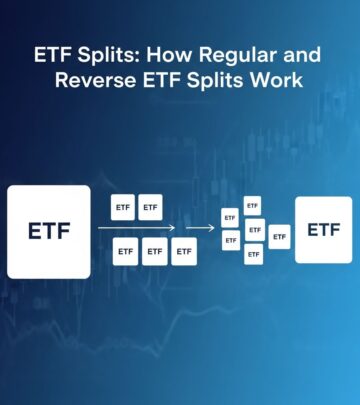
Stock Splits: How Companies Reshape Share Values
Learn how stock splits work and why companies use them to benefit investors

When a publicly traded company decides to restructure its equity, one of the most common actions it takes is a stock split. This corporate maneuver involves dividing existing shares into a greater number of shares, each with proportionally lower value. While the mechanics may sound complex, understanding stock splits is essential for any investor seeking to make informed decisions about their portfolio.
Defining the Stock Split Concept
A stock split is a corporate action where a company increases the total number of outstanding shares by dividing existing shares according to a predetermined ratio. The most fundamental characteristic of a stock split is that it preserves the overall market value of the company while changing how that value is distributed across a greater number of share units.
When a company executes a stock split, each existing shareholder receives additional shares proportional to their original holdings. For instance, in a 2-for-1 split, an investor who owned 100 shares would receive 200 shares after the split. However, the price per share would be adjusted downward accordingly, so the total investment value remains constant.
The fundamental principle underlying all stock splits is simple: the total equity of the company does not change, even though shareholders now own more individual shares. This preservation of total value distinguishes stock splits from other corporate actions that might actually alter shareholder wealth.
The Mechanics Behind Share Restructuring
Understanding how stock splits work requires examining the mathematical relationship between share quantity and share price. When a company announces a stock split ratio—expressed as formats like 2:1, 3:1, or 3:2—it is establishing the formula by which existing shares will be converted.
Consider a practical example: suppose an investor owns 100 shares of a company trading at $300 per share, representing a total investment value of $30,000. If the company announces a 3-for-1 split, the investor would receive 300 shares, with each share adjusted to $100. The mathematical relationship preserves the investment’s total value: 300 shares × $100 = $30,000.
The impact on company market capitalization demonstrates this preservation principle clearly. If a company has 10 million shares outstanding at $50 per share, its market capitalization equals $500 million. Following a 2-for-1 split, the company would have 20 million shares outstanding at $25 per share, yet the market capitalization would remain $500 million.
Different companies employ different split ratios based on their specific circumstances. The most common splits are:
- 2-for-1 splits, where shareholders receive two shares for every one held
- 3-for-1 splits, where shareholders receive three shares for every one held
- 3-for-2 splits, where shareholders receive three shares for every two held
Some companies have even executed more aggressive splits. Each ratio represents a different approach to achieving the company’s objectives, whether improving share accessibility or signaling market confidence.
Why Companies Choose to Split Shares
Companies typically pursue stock splits when they believe their share price has become too elevated relative to comparable companies in their industry. This perception of excessive pricing relative to peer companies drives the decision-making process.
The primary motivation behind most stock splits centers on improving market accessibility. When a company’s stock trades at an extremely high price per share—say $500 or $1,000—retail investors with modest investment capital may feel discouraged from purchasing shares. By reducing the per-share price through a split, the company makes its equity more attainable for smaller investors.
Enhanced liquidity represents another significant advantage companies seek through stock splits. Greater liquidity means more buyers and sellers actively trading the stock, which can reduce the bid-ask spread and enable transactions to execute more efficiently. When high trading volume occurs in a liquid stock, the individual transactions are less likely to cause dramatic price movements.
From an operational perspective, stock splits can benefit companies executing share buyback programs. Improved liquidity during these initiatives can reduce trading slippage—the difference between expected and actual execution prices—thereby lowering the company’s transaction costs.
Additionally, some market observers suggest that stock splits may signal management confidence in the company’s future prospects. A decision to split shares could indicate that executives believe the stock price will continue rising, making it beneficial to make shares more accessible now.
Understanding the Different Split Varieties
While the standard stock split dominates corporate practice, companies may employ alternative split structures in specific situations.
Traditional Forward Splits
Forward splits—the conventional type discussed above—increase the number of outstanding shares while reducing per-share value. These splits address concerns about elevated share prices and improve share affordability.
Reverse Stock Splits
A reverse stock split operates in the opposite direction, combining multiple existing shares into fewer shares with proportionally higher value. In a reverse 1-for-2 split, an investor holding 200 shares would receive 100 shares, each worth twice as much. While the investment’s total value remains unchanged, the per-share price increases.
Companies typically employ reverse splits when their stock price has fallen to undesirably low levels. Maintaining a minimum share price can be important for exchange listing requirements or market perception.
Combination Split Strategies
Some companies execute reverse-forward splits, combining a reverse split followed by a forward split. This strategy can serve multiple purposes, including reducing the total shareholder count by forcing smaller investors to cash out during the reverse phase, thereby lowering administrative communication costs.
Critical Timeline Considerations for Investors
Stock splits involve three key dates that investors should understand, as these dates determine eligibility for receiving new shares and the actual implementation timing:
Announcement Date: The company’s board of directors officially declares the split, including the specific ratio and all relevant details.
Record Date: Investors must own the stock on this specific date to be eligible for receiving additional shares created by the split. This date is crucial because it establishes who qualifies for the split benefits.
Effective Date: The actual split occurs on this date, with new shares appearing in investor accounts and adjusted share prices taking effect.
Understanding these dates helps investors plan their purchase or sale timing around the split event.
Examining Real-World Implications
Stock splits create noteworthy effects on investor behavior and market dynamics, though not always in predictable ways.
From an ownership perspective, existing shareholders maintain their exact proportional stake in the company. If a shareholder owned 1% of the company before a split, they would still own 1% afterward, despite having more individual shares. This mathematical reality means splits do not dilute existing ownership positions.
However, splits frequently trigger increased demand for the stock. The lower per-share price may attract investors who previously could not afford the shares, potentially driving up the stock’s value. Yet this outcome is not guaranteed. When Tesla executed a 3-for-1 split in August 2022, shares initially traded at $288 but declined nearly 18% by the end of the following trading day, illustrating that short-term price movements are unpredictable.
The psychological impact of stock splits deserves consideration. Some investors perceive a stock split as a positive signal about the company’s future growth prospects, while others view it as merely administrative restructuring with no material significance. This perception divergence can influence trading behavior in the period surrounding the split announcement and execution.
Calculating Stock Split Effects
Investors can easily calculate how a stock split will affect their holdings using straightforward mathematical operations:
New Number of Shares: Multiply your current share count by the split ratio.
New Per-Share Price: Divide the original share price by the split ratio.
For example, a 3-for-1 split affecting 100 shares worth $30 each would result in 300 shares worth $10 each. The investment’s total value—$3,000—remains constant.
Market Capitalization Preservation
A crucial concept for understanding stock splits is that company market capitalization—the total market value of all outstanding shares—never changes due to a split. This principle holds true regardless of the split ratio employed.
The formula demonstrates this preservation:
| Factor | Before Split | After 2-for-1 Split |
|---|---|---|
| Outstanding Shares | 100 million | 200 million |
| Share Price | $50 | $25 |
| Market Capitalization | $5 billion | $5 billion |
As the table illustrates, the doubling of share count is precisely offset by the halving of share price, resulting in identical market capitalization.
Strategic Considerations for Investors
When a company announces an impending stock split, investors should recognize several important considerations:
- Stock splits themselves create no wealth or eliminate no wealth for existing shareholders
- Your percentage ownership in the company remains unchanged following a split
- The decision to buy, hold, or sell should be based on the company’s fundamental business performance and your financial goals, not the split announcement itself
- Monitor the announcement, record, and effective dates to understand your eligibility and timing
- Anticipate potential price volatility in the period surrounding the split announcement as market sentiment shifts
Final Perspectives on Share Restructuring
Stock splits represent a fundamental corporate restructuring tool that companies use to achieve specific strategic objectives. By increasing the number of outstanding shares while proportionally reducing per-share price, companies make their equity more accessible to a broader investor base while maintaining the overall company valuation.
While stock splits can enhance market liquidity and potentially signal management confidence, they do not inherently change the economic value of an investor’s holdings. Shareholders should approach stock split announcements with a clear understanding of the mechanics involved and a focus on the company’s underlying business fundamentals rather than the technical restructuring itself.
For investors seeking to align stock splits with their financial planning, consulting with a qualified financial advisor who understands your specific circumstances and goals remains a prudent approach.
Frequently Asked Questions
Does a stock split change my investment value?
No. A stock split preserves your total investment value while increasing your share count. You own more shares, but each is worth proportionally less.
Why would a company split its stock if it doesn’t create value?
Stock splits improve market liquidity, make shares more affordable for smaller investors, and may signal management confidence in future growth.
What happens to my shares if I don’t own stock on the record date?
If you purchase shares after the record date, you receive the post-split share quantity at the adjusted price. You do not receive additional shares from the split itself.
Are reverse splits bad for investors?
Reverse splits are neutral from a value perspective but may indicate the company is struggling with a depressed stock price. They serve an operational purpose rather than creating or destroying wealth.
References
- What Is a Stock Split? — Chase Bank/J.P. Morgan Wealth Management. 2025-11-12. https://www.chase.com/personal/investments/learning-and-insights/article/what-is-a-stock-split
- Stock Splits — Financial Industry Regulatory Authority (FINRA). https://www.finra.org/investors/investing/investment-products/stocks/stock-splits
- Stock split — Wikipedia. https://en.wikipedia.org/wiki/Stock_split
- Understanding Stock Splits: Benefits & How It Works — Western & Southern Financial Group. https://www.westernsouthern.com/investments/what-is-a-stock-split
- What is a Stock Split? Definition, examples & impact — Zerodha Support. https://support.zerodha.com/category/console/corporate-actions/stock-splits/articles/stock-split
- What is a Stock Split and How Does it Work? — Vision Retirement. https://www.visionretirement.com/articles/investing/how-stock-splits-work
Similar Articles








Read full bio of medha deb