Stock Exchanges: Gateways to Global Investing
Discover how stock exchanges power economies by enabling trading, capital raising, and investor confidence worldwide.

Stock exchanges serve as the heartbeat of modern financial systems, providing organized platforms where securities like stocks, bonds, and derivatives change hands efficiently. These marketplaces connect companies seeking growth capital with investors looking for opportunities, ensuring smooth transactions under regulated conditions.
The Fundamental Purpose of Stock Exchanges
At their core, stock exchanges act as intermediaries in capital formation, channeling savings from individuals and institutions into productive business ventures. By offering a centralized venue for listing and trading, they enable firms to access vast pools of funds while allowing investors to buy, sell, or hold assets with relative ease.
This dual role supports broader economic stability. Companies use exchanges to fund expansions, innovations, or acquisitions, while investors benefit from liquidity—the ability to convert holdings into cash quickly without significant loss in value.
Key Mechanisms Driving Exchange Operations
Stock exchanges operate through distinct yet interconnected processes that ensure efficiency and fairness.
- Primary Market Activities: New securities are issued here, allowing companies to raise fresh capital directly from investors via initial public offerings (IPOs) or bond issuances.
- Secondary Market Trading: Existing securities trade among investors, determining ongoing market prices based on supply and demand dynamics.
- Clearing and Settlement: Post-trade processes verify transactions, transfer ownership, and manage payments, minimizing risks.
These mechanisms collectively foster a vibrant ecosystem where prices reflect real-time information, influencing corporate decisions and investment strategies.
Core Functions That Define Stock Exchanges
Enabling Capital Mobilization
One primary function involves bridging savers and borrowers of capital. Public companies list shares on exchanges, inviting participation from retail investors, pension funds, and sovereign wealth entities. This democratizes access to investment, directing funds toward high-potential enterprises and fueling industrial growth.
For instance, a tech startup can go public to finance research and development, transforming idle savings into tangible innovations that benefit society.
Delivering Market Liquidity
Liquidity remains a cornerstone benefit, as exchanges provide continuous trading opportunities. Investors can enter or exit positions swiftly, often within seconds, thanks to electronic systems that match buy and sell orders instantaneously.
This feature reduces the ‘illiquidity premium’—the extra return demanded for hard-to-sell assets—and boosts participation by lowering perceived risks.
Facilitating Transparent Price Discovery
Through competitive bidding, exchanges reveal the fair value of securities. Prices adjust rapidly to news, earnings reports, or macroeconomic shifts, serving as a real-time gauge of company health and market sentiment.
High trading volumes amplify accuracy, preventing distortions from low activity and enabling informed decision-making.
Upholding Investor Safeguards
Regulatory frameworks enforced by bodies like the U.S. Securities and Exchange Commission (SEC) or India’s SEBI ensure compliance. Exchanges mandate disclosures, audit financials, and monitor for manipulations like insider trading.
Standardized contracts and clearinghouses further mitigate counterparty defaults, building trust essential for sustained market activity.
Acting as Economic Indicators
Broad indices like the S&P 500 or Nifty 50 compiled from exchange data mirror national economic vitality. Rising values signal optimism and growth, while declines may highlight recessions or sector woes.
Policymakers and analysts rely on these metrics to calibrate interest rates, fiscal policies, or interventions.
Major Stock Exchanges Around the World
Global exchanges vary in scale, specialization, and history, yet share common operational principles.
| Exchange | Location | Key Index | Daily Volume (Avg.) | Notable Features |
|---|---|---|---|---|
| New York Stock Exchange (NYSE) | USA | Dow Jones | $200B+ | Oldest major exchange; hybrid floor-electronic trading. |
| NASDAQ | USA | NASDAQ Composite | $150B+ | Fully electronic; tech-heavy listings. |
| London Stock Exchange (LSE) | UK | FTSE 100 | $10B+ | International listings; strong in mining/energy. |
| Bombay Stock Exchange (BSE) | India | Sensex | $5B+ | Asia’s oldest; diverse sectors. |
| National Stock Exchange (NSE) | India | Nifty 50 | $15B+ | Electronic pioneer; high-speed trading. |
Data approximated from recent reports; volumes fluctuate with market conditions.
Evolution from Physical Floors to Digital Platforms
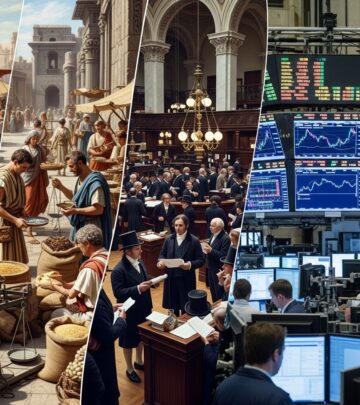
Historically, exchanges buzzed with open-outcry pits where traders shouted orders. Today, algorithms and high-frequency systems dominate, processing millions of trades per second with minimal human intervention.
This shift enhances speed, cuts costs, and extends access via online brokers, though it introduces challenges like flash crashes, addressed through circuit breakers and oversight.
Risks and Regulatory Responses in Stock Exchanges
Despite safeguards, exchanges face volatility from geopolitical events, algorithmic glitches, or fraud. Regulators impose trading halts, position limits, and surveillance tech to curb excesses.
Investors mitigate personal risks via diversification, stop-loss orders, and long-term horizons, recognizing exchanges as tools rather than guarantees.
Innovations Expanding Exchange Capabilities
Modern exchanges list diverse products beyond stocks: ETFs for broad exposure, derivatives for hedging, and REITs for real estate. Blockchain pilots promise faster settlements, while sustainable indices cater to ESG-focused capital.
These developments attract new demographics, from millennials trading via apps to institutions pursuing thematic investments.
Building a Portfolio Through Exchange-Traded Assets
For investors, exchanges offer entry points to global opportunities. Start with index funds mirroring major benchmarks for instant diversification, then allocate to sectors or regions based on research.
- Assess risk tolerance and goals before trading.
- Use limit orders to control execution prices.
- Monitor fees from brokers and exchanges.
- Stay informed via official data feeds.
Frequently Asked Questions (FAQs)
What distinguishes a stock exchange from other markets?
Stock exchanges focus on listed securities with strict listing criteria, real-time pricing, and regulatory supervision, unlike over-the-counter markets.
How do stock exchanges contribute to economic development?
They mobilize savings for business investment, promote efficient capital allocation, and signal growth trends, spurring job creation and innovation.
Are stock exchanges accessible to retail investors?
Yes, through brokerage accounts, with low barriers via apps and fractional shares, though education and caution are vital.
What role do indices play on stock exchanges?
Indices aggregate stock performance to benchmark markets, aiding valuation and strategy formulation.
How are trades executed on modern exchanges?
Electronically via matching engines that pair orders by price and time priority, with clearing firms handling backend processes.
References
- Functions of Stock Exchange: Top 5 Key Roles You Should Know — Kotak Neo. 2025-12-18. https://www.kotakneo.com/investing-guide/share-market/top-5-functions-of-stock-exchange/
- What is Stock Exchange? — BYJU’S. N/A. https://byjus.com/commerce/what-is-stock-exchange/
- What is a stock exchange? Meaning, how they work & features — Zerodha Support. N/A. https://support.zerodha.com/category/account-opening/glossary/stock-markets/articles/what-is-a-stock-exchange
- Stock exchange | Definition, Meaning, History, & Facts — Britannica. N/A. https://www.britannica.com/money/stock-exchange-finance
- What are stock exchanges for? And why should we care? — New Financial. N/A. https://www.newfinancial.org/reports/what-are-stock-exchanges-for%3F-and-why-should-we-care%3F
- Stock exchange – Wikipedia — Wikipedia. N/A. https://en.wikipedia.org/wiki/Stock_exchange
- What is a Stock Exchange? Definition and Examples — IG UK. N/A. https://www.ig.com/uk/investing-need-to-knows/what-is-a-stock-exchange
Similar Articles








Read full bio of medha deb