Stock Exchange History: From Ancient Markets to Modern Trading
Discover how stock exchanges evolved from medieval trading posts to today's digital powerhouses.
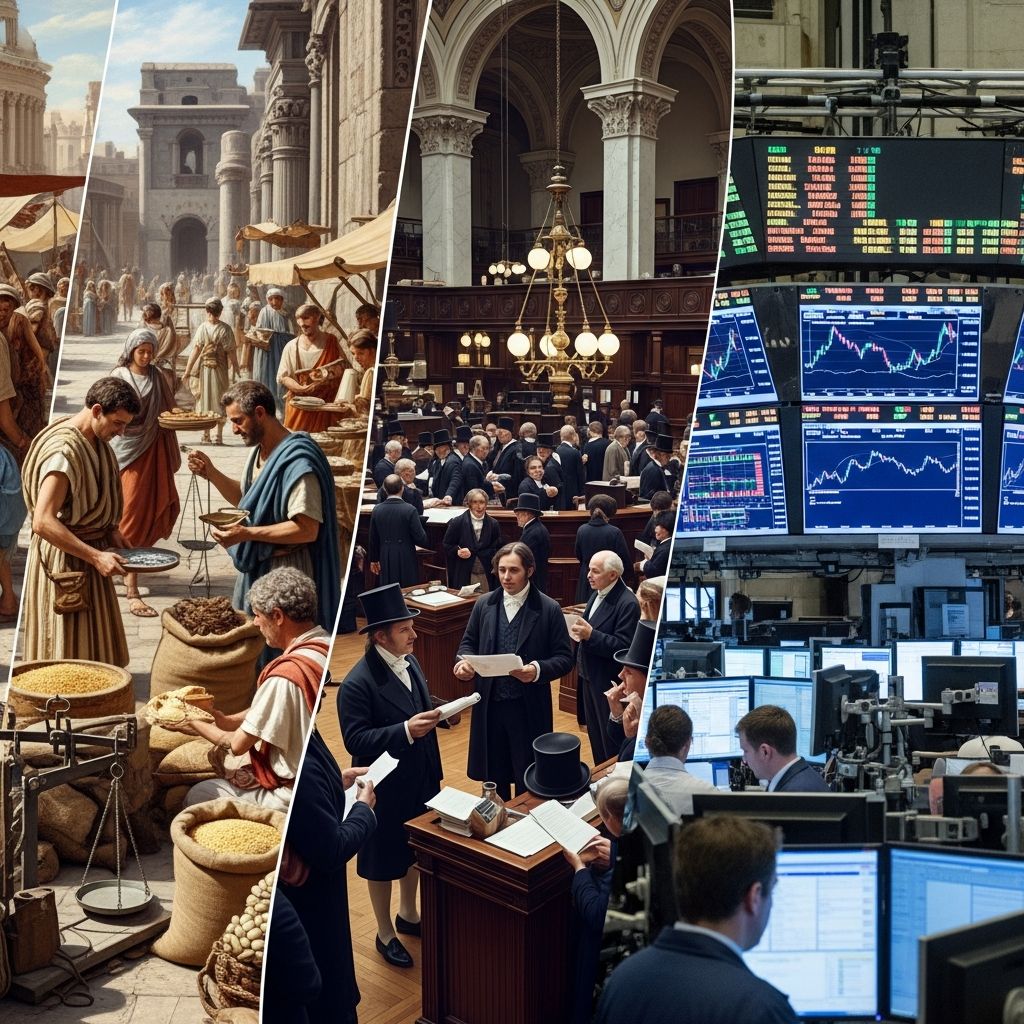
The stock exchange represents one of humanity’s most significant financial innovations, fundamentally transforming how capital is raised and distributed across economies. Understanding the history of stock exchanges provides valuable insight into how modern markets function and the economic forces that shaped our financial system. What began as informal trading in medieval town squares has evolved into sophisticated, electronically-connected systems that facilitate trillions of dollars in transactions daily.
The Origins of Stock Trading
The concept of stock exchanges did not emerge overnight but rather developed gradually over centuries as commerce and trade expanded across Europe. Before formal exchanges existed, merchants conducted business in open-air markets and town squares, negotiating prices directly with one another. These informal trading arrangements were limited by geography, as buyers and sellers had to be physically present to conduct transactions.
The earliest forms of organized trading occurred in medieval Europe, particularly in cities that served as major commercial hubs. Bruges, Antwerp, and Venice became prominent centers of trade during the Middle Ages, where merchants gathered to exchange goods, letters of credit, and eventually financial instruments. These informal gathering places represented the precursors to modern stock exchanges, establishing the fundamental principle that organized, centralized marketplaces facilitate more efficient commerce.
The transition from informal trading to more structured exchanges accelerated during the Renaissance, when European trade expanded dramatically. As merchant fleets traveled to distant lands, bringing exotic goods and wealth back to Europe, the need for sophisticated financial instruments became apparent. Merchants required ways to fund these expensive expeditions and distribute the risks associated with long-distance sea travel.
The Dutch Influence and Early Stock Markets
The Netherlands played a pivotal role in developing the first recognizable stock exchanges. During the Dutch Golden Age in the 17th century, the Dutch established themselves as maritime traders and merchants, controlling vast trading networks across Asia and the Americas. To finance their ambitious commercial ventures, Dutch companies created joint-stock arrangements that allowed multiple investors to share ownership and profits.
The Dutch East India Company, established in 1602, represented a watershed moment in financial history. This company issued shares that could be bought and sold, creating the first actively traded stock. Investors could now purchase ownership stakes in commercial enterprises without directly managing operations, revolutionizing how businesses were financed. The company’s shares were traded in Amsterdam, which quickly became Europe’s leading financial center.
The Amsterdam Stock Exchange, formally established in 1611, became the world’s first stock exchange. This marketplace provided a centralized location where investors could buy and sell shares in various companies, establishing many practices that modern exchanges still follow today. The exchange introduced price discovery mechanisms, where supply and demand determined share prices through open auction-style bidding.
The British Stock Market and Expansion
Following the Dutch example, other European nations developed their own stock markets. England, emerging as a major colonial power and maritime nation, established the London Stock Exchange in the late 17th century. What began as informal gatherings of brokers in London coffeehouses eventually evolved into a formal exchange with established rules and procedures.
The British government played a crucial role in stock market development by issuing government bonds to finance military campaigns and infrastructure projects. The need to trade these bonds created demand for an organized marketplace. By the 18th century, the London Stock Exchange had become the world’s dominant financial market, reflecting Britain’s economic and political power.
Britain’s industrial revolution in the 18th and 19th centuries further expanded the stock market’s importance. Factories, railroads, and canals required massive capital investments that individual entrepreneurs could not provide. Stock exchanges enabled these enterprises to raise funds from thousands of investors, transforming them from private ventures into public companies owned by multiple shareholders.
American Stock Markets and the New York Stock Exchange
The United States developed its stock markets following independence from Britain. Early American stock trading occurred informally, with brokers conducting business in open-air locations. The New York Stock Exchange (NYSE) was formally established in 1792 through the Buttonwood Agreement, named after the buttonwood tree where brokers gathered on Wall Street.
The establishment of the NYSE marked a significant moment in American financial history. The exchange provided a centralized marketplace for trading stocks and bonds, facilitating the capital formation necessary for America’s rapid industrialization and westward expansion. Throughout the 19th century, the NYSE grew to rival and eventually surpass the London Stock Exchange in volume and importance.
Key developments in American stock market history include:
- Railroad Era (1830s-1900s): Stock exchanges became essential for financing the vast railroad networks that connected America. Railroad stocks dominated trading volumes and attracted widespread investor participation.
- Industrial Revolution (1870s-1920s): Stocks of industrial companies, steel manufacturers, and utilities became primary trading instruments, reflecting America’s transformation into an industrial powerhouse.
- The Roaring Twenties (1920s): Stock market participation expanded dramatically as prosperity and optimism led millions of Americans to invest in equities, sometimes on borrowed money through margin trading.
- The Great Crash (1929): Speculation and excessive leverage led to a market collapse that triggered the Great Depression, exposing the need for market regulation and investor protection.
Regulation and Market Safeguards
The devastating market crash of 1929 and the subsequent Great Depression prompted governments to implement regulatory frameworks. In the United States, the Securities Act of 1933 and the Securities Exchange Act of 1934 established the Securities and Exchange Commission (SEC) to oversee markets and protect investors.
These regulations introduced several important features:
- Requirements for companies to disclose financial information to potential investors
- Prohibitions against insider trading and market manipulation
- Establishment of minimum capital requirements for exchanges and brokers
- Creation of investor protection mechanisms for failed brokerage firms
Similar regulatory frameworks were adopted by other countries, creating a global infrastructure for market oversight and investor protection. These regulations transformed stock markets from largely unregulated gambling halls into legitimate financial institutions integral to capital formation.
The Electronic Revolution
For most of stock exchange history, trading occurred through open outcry systems where brokers physically gathered to buy and sell securities. This process was labor-intensive, limited by geography, and prone to delays. The introduction of electronic trading revolutionized markets fundamentally.
The NASDAQ, launched in 1971 as the first electronic stock market, changed how securities could be traded. Rather than relying on physical trading floors, the NASDAQ used computers and telecommunications technology to connect buyers and sellers across the United States. This innovation increased market efficiency, reduced transaction costs, and enabled faster price discovery.
Electronic trading systems expanded throughout the 1980s and 1990s, as computer technology advanced and telecommunications networks improved. Today’s stock exchanges operate primarily through electronic systems, with millions of transactions executed per second by automated algorithms. Traditional open outcry trading has been largely abandoned in favor of electronic systems that provide greater efficiency, lower costs, and wider access to market participants.
Global Markets and International Integration
Stock exchanges have become increasingly integrated globally. The development of telecommunications and internet technology enabled 24-hour trading across multiple time zones and continents. Major exchanges in New York, London, Tokyo, and other financial centers now operate in coordinated fashion, with prices and information flowing instantly across borders.
This integration created both opportunities and challenges. Capital can flow instantaneously from one market to another, enabling efficient global capital allocation. However, it also means that problems in one market can quickly spread to others, as demonstrated during the 2008 financial crisis when losses on Wall Street rapidly affected stock exchanges worldwide.
The rise of emerging market stock exchanges, particularly in Asia and Latin America, reflects the growing importance of developing economies. These exchanges now provide capital formation opportunities for companies in rapidly growing regions and investment opportunities for global investors seeking geographic diversification.
Modern Stock Exchange Technology
Contemporary stock exchanges employ sophisticated technology far removed from the coffee houses and trading floors of earlier centuries. Key technological features include:
- Algorithmic Trading: Computer programs execute trades based on predetermined criteria, enabling high-frequency trading strategies
- Real-Time Data: Investors receive instant price quotes and market information through various platforms and devices
- Risk Management Systems: Automated safeguards halt trading if price movements exceed predetermined thresholds
- Clearing and Settlement: Sophisticated systems ensure accurate transfer of funds and securities between parties
- Regulatory Compliance: Advanced systems monitor trading for fraud, market manipulation, and insider trading
The Role of Stock Exchanges in the Modern Economy
Today’s stock exchanges serve several critical economic functions. They provide price discovery, determining fair values for securities through supply and demand. They facilitate liquidity, allowing investors to quickly buy or sell holdings. They enable capital formation, allowing companies to raise funds for expansion and innovation. They also provide economic indicators, as stock price movements often reflect investor sentiment about economic conditions.
The growth of passive investing through index funds and exchange-traded funds has transformed how most retail investors participate in stock markets. Rather than selecting individual stocks, many investors now buy funds tracking broad market indices, which has altered trading patterns and market dynamics compared to the active stock picking that dominated earlier periods.
Frequently Asked Questions
Q: When did stock exchanges first begin?
A: The world’s first formal stock exchange was the Amsterdam Stock Exchange, established in 1611, though informal trading in shares occurred earlier in the Dutch East India Company after 1602. However, organized trading in financial instruments existed in medieval European trading centers before true stock exchanges developed.
Q: What caused the development of stock markets?
A: Stock markets developed primarily to facilitate capital formation for large commercial enterprises. As trade expanded and businesses required more capital than individual merchants could provide, joint-stock arrangements and organized exchanges emerged to connect investors with businesses seeking funds.
Q: How did the 1929 market crash affect stock exchanges?
A: The 1929 crash led to comprehensive government regulation of stock markets. The Securities Act of 1933 and Securities Exchange Act of 1934 in the United States established regulatory oversight, disclosure requirements, and investor protections that fundamentally transformed how exchanges operated.
Q: When did electronic trading replace physical trading floors?
A: Electronic trading began expanding in the 1970s with the launch of the NASDAQ in 1971. Throughout the 1980s and 1990s, electronic systems gradually replaced open outcry trading. By the 21st century, most stock exchanges operated primarily through electronic systems, though some traditional exchanges retain physical trading floors for symbolic or limited purposes.
Q: How do modern stock exchanges differ from historical ones?
A: Modern exchanges operate electronically at high speeds, process vast transaction volumes, reach global participants instantly, employ sophisticated risk management systems, and maintain comprehensive regulatory oversight. Historical exchanges relied on physical gatherings, oral bids, manual record-keeping, and operated within limited geographic regions.
Q: Why are stock exchanges important to the economy?
A: Stock exchanges enable capital formation by allowing companies to raise funds through public ownership. They facilitate price discovery through supply and demand, provide liquidity for investors, serve as economic indicators through market indices, and allocate capital efficiently across the economy to productive investments.
References
- Securities and Exchange Commission (SEC) – The Investor’s Advocate — U.S. Securities and Exchange Commission. 2024. https://www.sec.gov/
- History of the New York Stock Exchange — New York Stock Exchange (NYSE). 2024. https://www.nyse.com/about/history
- The Dutch East India Company and the Origins of Modern Capitalism — Economic History Association. 2023. https://www.eh.net/
- Evolution of Stock Markets: From Amsterdam to Electronic Trading — International Organization of Securities Commissions (IOSCO). 2023. https://www.iosco.org/
- NASDAQ: Electronic Trading Revolution — NASDAQ Inc. 2024. https://www.nasdaq.com/about/history
- Global Financial Regulation and Market Structure — Bank for International Settlements (BIS). 2023. https://www.bis.org/
Similar Articles








Read full bio of Sneha Tete