State vs. Federal Income Tax: Key Differences
Understand how state and federal income taxes differ in rates, structures, and administration to optimize your tax planning effectively.

Federal income taxes support national programs through the IRS, while state income taxes fund local services via state agencies, creating distinct systems with varying rates and rules.
Core Distinctions in Administration and Purpose
The federal government collects income taxes nationwide via the Internal Revenue Service (IRS), directing funds to defense, Social Security, Medicare, and infrastructure. In contrast, each of the 41 states plus the District of Columbia with income taxes uses its own department, such as California’s Franchise Tax Board or New York’s Department of Taxation and Finance.
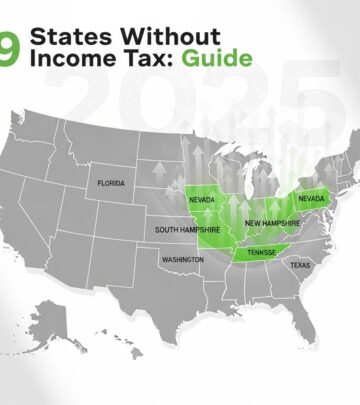
State taxes primarily cover education, roads, public safety, and healthcare at the regional level. Not all states impose income taxes: Alaska, Florida, Nevada, South Dakota, Tennessee, Texas, and Wyoming have none, relying instead on sales and property taxes. New Hampshire taxes only interest and dividends, phasing it out by 2027.
Federal Tax System: Progressive Brackets Explained
The U.S. federal income tax employs a progressive structure with seven brackets ranging from 10% to 37%, adjusted annually for inflation and based on filing status like single, married filing jointly, or head of household.
| Tax Rate | Single | Head of Household | Married Filing Jointly | Married Filing Separately |
|---|---|---|---|---|
| 10% | $0 – $11,000 | $0 – $15,700 | $0 – $22,000 | $0 – $11,000 |
| 12% | $11,001 – $44,725 | $15,701 – $59,850 | $22,001 – $89,450 | $11,001 – $44,725 |
| 22% | $44,726 – $95,375 | $59,851 – $95,350 | $89,451 – $190,750 | $44,726 – $95,375 |
| 24% | $95,376 – $182,100 | $95,351 – $182,100 | $190,751 – $364,200 | $95,376 – $182,100 |
| 32% | $182,101 – $231,250 | $182,101 – $231,250 | $364,201 – $462,500 | $182,101 – $231,250 |
| 35% | $231,251 – $578,125 | $231,251 – $578,100 | $462,501 – $693,750 | $231,251 – $346,875 |
| 37% | $578,126+ | $578,100+ | $693,751+ | $346,876+ |
These 2023 brackets illustrate marginal taxation: higher rates apply only to income exceeding each threshold. For a married couple with $112,000 taxable income, the first $22,000 is taxed at 10% ($2,200), the next $67,449 at 12% ($8,094), and the remaining $22,549 at 22% ($4,961), totaling $15,255.
State Tax Structures: Progressive, Flat, or None
Most states use progressive systems with fewer brackets and lower top rates than federal, starting from federal adjusted gross income (AGI) but adding state-specific adjustments. Top rates span 2.5% in Arizona to 13.3% in California, with eight states plus D.C. exceeding 8%.
Nine states apply flat rates to all income: Arizona, Colorado (4.4%), Georgia, Idaho, Illinois, Indiana, Kentucky, Louisiana, Mississippi, North Carolina, Pennsylvania, Utah, and others listed variably across sources. Colorado, for instance, taxes $112,000 at 4.4%, yielding $4,928 after adjustments.
- Progressive states like California tax higher earners more steeply, with 13.3% over $1 million.
- Flat-rate states simplify compliance with one rate.
- No-income-tax states offset with higher sales/property taxes.
Localities in Indiana, Iowa, Maryland, New York, and others add piggyback taxes on state returns.
Calculating Combined Tax Liability
Taxpayers often face both, with federal typically higher but states adding 0-13%. For the $112,000 couple in Colorado: federal $15,255 + state $4,928 = $20,183, or 18% effective rate. A Michigan single filer with $70,000 might pay $6,809 federal + $2,975 state, excluding payroll taxes.
States may not conform to all federal deductions; e.g., adding back state taxes deducted federally. Filing deadlines align, usually April 15.
Navigating Deductions and Credits Across Levels
31 states plus D.C. start from federal AGI, allowing subtractions for state-specific items like retirement contributions or child credits. Federal standard deduction ($13,850 single, $27,700 joint in recent years) may not fully apply statewide.
Key differences:
- Federal: Itemized deductions (mortgage interest, charity), child tax credit up to $2,000.
- State: Varies; some mirror federal, others offer property tax relief or earned income credits.
States Without Income Tax: Pros and Cons
Seven states skip personal income tax, attracting high earners but funding via sales (up to 10%+ combined) and property levies. Tennessee repealed its dividends tax in 2021. Residents save on income but face higher living costs elsewhere.
Filing Processes and Compliance Tips
Federal forms (1040) precede state returns, often pre-filled from IRS data. Software like TurboTax integrates both. Deadlines match, with extensions possible but payments due April 15.
Residents of multiple states prorate income; non-residents file where income sourced. Track state-specific rules via revenue departments.
Recent Trends and 2026 Outlook
Brackets adjust for inflation; top federal rate steady at 37%. States like Colorado maintain flat 4.4%; others index brackets. Phase-outs (e.g., New Hampshire) reflect no-tax shifts.
FAQ
Do all states have income tax?
No, 41 states plus D.C. do; nine don’t.
Is state tax progressive like federal?
Most yes, but nine use flat rates.
Who collects state taxes?
State agencies, e.g., Franchise Tax Board in CA.
Can state taxes be deducted federally?
Up to $10,000 SALT cap for itemizers.
When are taxes due?
April 15 for both, usually.
References
- What’s the Difference Between State and Federal Income Tax? — Experian. 2023. https://www.experian.com/blogs/ask-experian/difference-between-state-and-federal-income-tax/
- The Difference Between Federal vs State Taxes — Jackson Hewitt. 2023. https://www.jacksonhewitt.com/tax-help/tax-tips-topics/filing-your-taxes/difference-federal-state-taxes/
- How do state and local individual income taxes work? — Tax Policy Center. 2023. https://taxpolicycenter.org/briefing-book/how-do-state-and-local-individual-income-taxes-work
- State vs. Federal Taxes: What’s the Difference — Unison. 2023. https://www.unison.com/blog/state-vs-federal-taxes
- What Is Taxed and Why – Lesson 1: Federal/State/Local Taxes — IRS. 2023. https://apps.irs.gov/app/understandingTaxes/student/whys_thm04_les01.jsp
Similar Articles








Read full bio of medha deb