State Income Tax Rates: Highest vs Lowest in 2026
Discover which U.S. states impose the heaviest and lightest income tax burdens in 2026, and how recent reforms are reshaping your take-home pay.

U.S. state income taxes vary dramatically, with some states levying no tax at all while others impose top rates exceeding 12%. In 2026, nine states maintain zero income tax, offering significant advantages for residents, while graduated systems in places like California push marginal rates to 12.3% for high earners. Recent legislative changes, including rate reductions in over a dozen states, continue to influence financial planning nationwide.
Understanding State Income Tax Structures
State income taxes fall into three primary categories: no tax, flat rates, and graduated (progressive) brackets. No-tax states rely on sales, property, or other revenues, appealing to high earners seeking to maximize after-tax income. Flat rates apply uniformly regardless of income level, promoting simplicity. Graduated systems increase rates with income, often balancing revenue needs with equity concerns.
For 2026, flat-rate states like Colorado (4.25%) and Illinois (4.95%) exemplify straightforward taxation. Graduated structures, seen in 30+ states, feature multiple brackets; for instance, New Jersey spans 1.4% to 10.75%. These differences profoundly impact net pay, retirement planning, and relocation decisions.
States with No Income Tax: A Tax-Free Haven
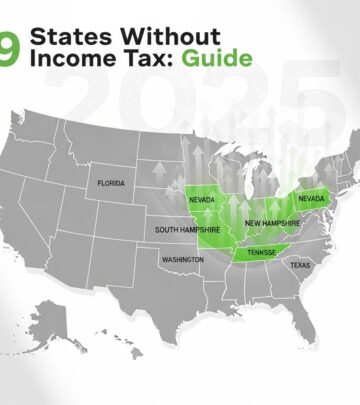
Nine states forgo personal income taxes entirely in 2026: Alaska, Florida, Nevada, New Hampshire, South Dakota, Tennessee, Texas, Washington, and Wyoming. This absence stems from robust alternative revenues—oil in Alaska, tourism in Florida, no-sales-tax policies in New Hampshire and Tennessee, and tech/property booms elsewhere.
- Alaska: Funds government via oil royalties; no state sales or income tax.
- Florida: Relies on tourism and property taxes; popular for retirees.
- Nevada: Gaming and sales taxes dominate; business-friendly.
- New Hampshire: Taxes interest/dividends only (phasing out by 2026); no broad income tax.
- South Dakota: Low regulations attract finance firms.
- Tennessee: Eliminated Hall tax; sales tax funds services.
- Texas: Oil, trade; high property taxes offset lack of income levy.
- Washington: Sales/property taxes; capital gains tax (7%) applies narrowly.
- Wyoming: Energy sector supports minimal taxation.
Residents save substantially; a $100,000 earner avoids thousands in taxes compared to high-rate states. However, overall tax burdens (e.g., property rates) must be evaluated holistically.
Highest Income Tax States: Progressive Burdens
States with the steepest top marginal rates target high incomes through graduated brackets. California leads at 12.3% (over $1 million), followed by New York (10.9%), New Jersey (10.75%), and Oregon (9.9%). These systems generate revenue for public services but can deter affluent residents.
| State | Top Rate | Applies To (Single Filer) | System |
|---|---|---|---|
| California | 12.3% | Over $1,000,000 | Graduated |
| New York | 10.9% | Over $25,000,000 | Graduated |
| New Jersey | 10.75% | Over $1,000,000 | Graduated |
| Oregon | 9.9% | Over $125,000 | Graduated |
| Minnesota | 9.85% | Over $193,000 | Graduated |
| Hawaii | 11% | Over $200,000 | Graduated |
These rates exclude local add-ons; California’s effective burden can exceed 13% with city taxes. High earners face ‘bracket creep’ as inflation pushes income upward.
Lowest Income Tax Rates: Affordable Options
Among taxing states, low flat or top rates provide relief. Pennsylvania (3.07%), Indiana (3%), and Louisiana (3%) anchor the bottom, ideal for middle-class families. Recent cuts amplify appeal.
| State | Rate | System | Notes |
|---|---|---|---|
| Pennsylvania | 3.07% | Flat | Due April 20 |
| Indiana | 3% | Flat | Simple structure |
| Louisiana | 3% | Flat | May 15 deadline |
| North Carolina | 3.99% | Flat | Down from 4.25% |
| Arkansas | 3.9% | Graduated | Top over $4,600 |
These states often pair low income taxes with moderate sales/property levies, enhancing affordability.
Recent Tax Rate Changes Shaping 2026
2025 legislation yielded cuts in 12 states, totaling billions in savings. Kentucky dropped to 3.5% flat (from 4%), saving $718 million annually. Ohio flattened to 2.75% (2026), Idaho to 5.3%, and Oklahoma simplified to three brackets (top 4.5%), with a path to zero if triggers met.
- Montana: 5.65% top (2026), 5.4% (2027).
- Nebraska: 4.55% top, falling to 3.99% by 2027.
- North Carolina: 3.99%, potential further drops.
- South Carolina: 6% top.
These reforms respond to economic pressures, aiming to retain residents and businesses.
Flat vs. Graduated: Pros, Cons, and Impacts
Flat taxes (e.g., Colorado 4.25%, Georgia 5.19%) simplify filing and reduce administrative costs but may burden low earners proportionally more. Graduated systems (e.g., Maryland 2%-5.75%) offer progressivity, taxing wealthier individuals higher, though complexity arises with brackets.
Middle-class families thrive in low-flat states like North Dakota (top 2.5%), per analyses. High earners favor no-tax or low-top states to minimize liability.
Factors Beyond Income Tax
Total tax burden includes sales (up to 10%+ in some), property (Texas averages high), and capital gains. Washington’s 7% capital gains tax affects investors despite no broad income tax. Retirees eye Social Security exemptions; many high-tax states exclude it.
Planning Tips for 2026 Filers
Key dates vary: most April 15, Louisiana May 15, Virginia May 1. Adjust withholdings, maximize deductions (e.g., Mississippi exempts first $10,000), and consider moves to low-tax states. Tools like tax calculators aid projections.
Frequently Asked Questions
Which states have no income tax in 2026?
Alaska, Florida, Nevada, New Hampshire, South Dakota, Tennessee, Texas, Washington, Wyoming.
What is the highest state income tax rate?
California’s 12.3% on income over $1 million (single).
Are there flat tax states?
Yes, including Arizona (2.5%), Colorado (4.25%), Illinois (4.95%), and others.
Did states cut taxes recently?
Yes, 12 states in 2025, e.g., Ohio to 2.75%, Kentucky to 3.5%.
How do I find my state’s brackets?
Check official revenue departments; rates apply post-deductions.
References
- 2026 State Income Tax Rates by State — Paycor. 2026. https://www.paycor.com/resource-center/articles/state-income-tax-rates/
- Income Tax by State: Which has the Highest and Lowest Taxes — TurboTax Intuit. 2026. https://turbotax.intuit.com/tax-tips/fun-facts/states-with-the-highest-and-lowest-taxes/L6HPAVqSF
- State Income Tax Brackets in 2026 — Polston Tax. 2026. https://polstontax.com/blog/state-income-tax-brackets-2026/
- Income Tax Map — Americans for Tax Reform. 2026. https://atr.org/taxmap/
- Best Low-Tax States for Middle-Class Families in 2026 — Kiplinger. 2026. https://www.kiplinger.com/taxes/most-tax-friendly-states-for-middle-class-families
- 2026 TOP STATE MARGINAL INCOME TAX RATES — Stifel. 2026-02-17. https://www.stifel.com/newsletters/adgraphics/PDF/WP/Top-State-Marginal-Income-Tax-Rates.pdf
Similar Articles








Read full bio of medha deb