Standard vs. Itemized Deductions Guide
Unlock tax savings: Compare standard and itemized deductions to choose the best option for your 2025 return and minimize your tax liability effectively.
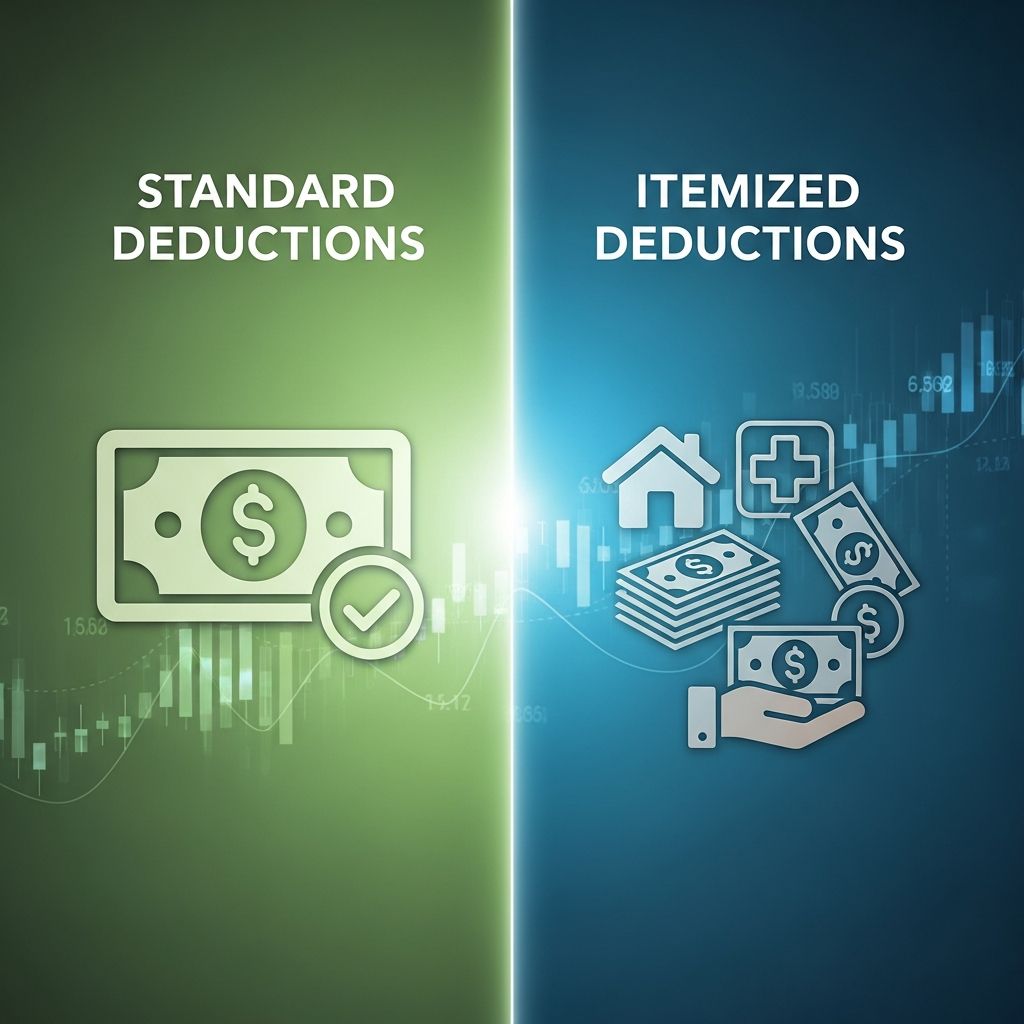
Taxpayers filing federal income taxes each year face a key decision: claim the
standard deduction
oritemize deductions
. The standard deduction offers a fixed amount that simplifies filing, while itemizing allows subtraction of specific eligible expenses if they exceed the standard amount. Choosing the larger deduction minimizes taxable income and reduces tax liability.Understanding the Standard Deduction
The standard deduction provides a straightforward way to lower taxable income without tracking individual expenses. The IRS sets this amount annually, adjusting for inflation, and it varies by filing status, age, and dependency status.
For the
2025 tax year
(returns filed in 2026), standard deduction amounts are:| Filing Status | Standard Deduction Amount |
|---|---|
| Single or Married Filing Separately | $15,750 |
| Married Filing Jointly or Qualifying Surviving Spouse | $31,500 |
| Head of Household | $23,625 |
Taxpayers aged 65 or older, or who are blind, qualify for additional amounts added to these base figures. Dependents may receive reduced standard deductions. Nearly 90% of filers opt for this method due to its simplicity—no receipts or logs required.
Exploring Itemized Deductions
Itemized deductions require listing qualified expenses on
Schedule A (Form 1040)
. Taxpayers must maintain records to substantiate claims during audits. This approach suits those with high deductible costs exceeding the standard deduction.Common categories include:
- Mortgage interest on primary or secondary homes, reported on Form 1098.
- State and local taxes (SALT), capped at $10,000 ($5,000 if married filing separately), covering property, income, and sales taxes.
- Charitable contributions to qualified organizations, up to 60% of AGI for cash gifts.
- Medical and dental expenses exceeding 7.5% of AGI.
- Casualty and theft losses from federally declared disasters.
Certain taxpayers must itemize, such as those married filing separately if their spouse itemizes, nonresident aliens, or estates/trusts.
Key Differences: Standard vs. Itemized at a Glance
| Aspect | Standard Deduction | Itemized Deductions |
|---|---|---|
| Ease of Use | Simple; no records needed | Requires tracking and documentation |
| Amount | Fixed by IRS, predictable | Variable based on expenses, subject to limits |
| Best For | Low-expense filers or those without records | High homeowners, donors, or medical costs |
| 2025 Example (Single) | $15,750 | Potentially higher if expenses qualify |
This comparison highlights why most choose standard, but itemizing can yield bigger savings for qualifying situations.
Step-by-Step: Deciding Which Deduction to Claim
To select optimally:
- Gather documents: Review Forms 1098 (mortgage), W-2 (SALT), receipts for charity/medical.
- Tally itemized totals: Use IRS worksheets or tax software to sum eligible amounts.
- Compare to standard: For 2025 single filer, if itemized > $15,750, itemize.
- Consider state returns: Some states allow itemizing even if federal uses standard.
- Automatically: Tax software picks the higher.
Run both scenarios—your return will use the greater deduction.
Practical Examples for 2025 Tax Year
Example 1: Single Renter with Minimal Expenses
AGI: $50,000. Itemized: $8,000 (charity + SALT). Standard: $15,750. Choice: Standard, reducing taxable income to $34,250.
Example 2: Married Homeowners Filing Jointly
AGI: $120,000. Itemized: $32,000 (mortgage $20,000 + SALT $10,000 + charity $2,000). Standard: $31,500. Choice: Itemize, saving ~$500 more in taxes (assuming 22% bracket).
Example 3: High Medical Costs (Head of Household)
AGI: $80,000. Medical: $12,000 (exceeds 7.5% AGI threshold of $6,000) + other $10,000 = $22,000 itemized. Standard: $23,625. Choice: Standard, unless additional expenses push over.
These illustrate math-driven decisions. Homeowners often benefit most from itemizing via mortgage interest.
Recent Changes and Inflation Adjustments
Post-2017 Tax Cuts and Jobs Act, standard deductions roughly doubled, reducing itemizers from ~30% to 10%. Inflation adjustments continue: 2024 single was $14,600, rising to $15,750 in 2025. SALT cap remains $10,000. Additional standard for seniors: +$1,600 single/$3,200 joint in 2025. Always check IRS updates for your filing year.
Special Situations and Limitations
- Married Filing Separately: Must match spouse’s choice.
- Dependents: Limited standard deduction.
- Phaseouts: High-income itemizers face reductions (Pease limitation suspended).
- Disaster Losses: Itemizable if federally declared.
Non-citizens or short-year filers may require itemizing.
Tools and Tips for Accurate Filing
Leverage IRS Free File, tax software for auto-comparisons, or consult professionals. Retain records 3-7 years. Track year-round via apps for charity/mileage.
Frequently Asked Questions (FAQs)
Can I claim both standard and itemized deductions?
No, choose one—the larger amount.
Who gets extra standard deduction?
Seniors 65+ and blind qualify for add-ons.
Is itemizing worth the effort?
Only if totals exceed standard; ~90% skip it.
How do state taxes factor in?
States may allow itemizing independently.
What if my spouse itemizes?
If married filing separately, you must too.
Maximize Your Deductions Strategically
Bunch expenses (e.g., prepay property taxes, accelerate charity) into one year to surpass standard. Homebuyers: Points and interest boost itemizing. Review annually—life changes like home purchase or medical events shift the balance.
References
- Standard Deduction vs Itemized: Key Tax Differences Explained — Edelman Financial Engines. 2025. https://www.edelmanfinancialengines.com/education/tax/standard-deduction-vs-itemized/
- Claiming the Standard vs Itemized Deduction — H&R Block. 2025. https://www.hrblock.com/tax-center/filing/adjustments-and-deductions/standard-vs-itemized-deductions/
- Deductions for individuals: the difference between standard and itemized deductions — Internal Revenue Service (IRS.gov). 2024-10-22. https://www.irs.gov/newsroom/deductions-for-individuals-the-difference-between-standard-and-itemized-deductions-and-what-they-mean
- Tax basics: Understanding the difference between standard and itemized deductions — Internal Revenue Service (IRS.gov). 2023-12-14. https://www.irs.gov/newsroom/tax-basics-understanding-the-difference-between-standard-and-itemized-deductions
- Standard Deduction vs. Itemized Deductions: Which Is Better? — TurboTax Intuit. 2025. https://turbotax.intuit.com/tax-tips/tax-deductions-and-credits/tax-deduction-wisdom-should-you-itemize/L8Ln7K0Gp
Similar Articles








Read full bio of Sneha Tete