Standard Deviation vs Variance: Key Differences
Understanding the crucial distinctions between standard deviation and variance in statistical analysis.
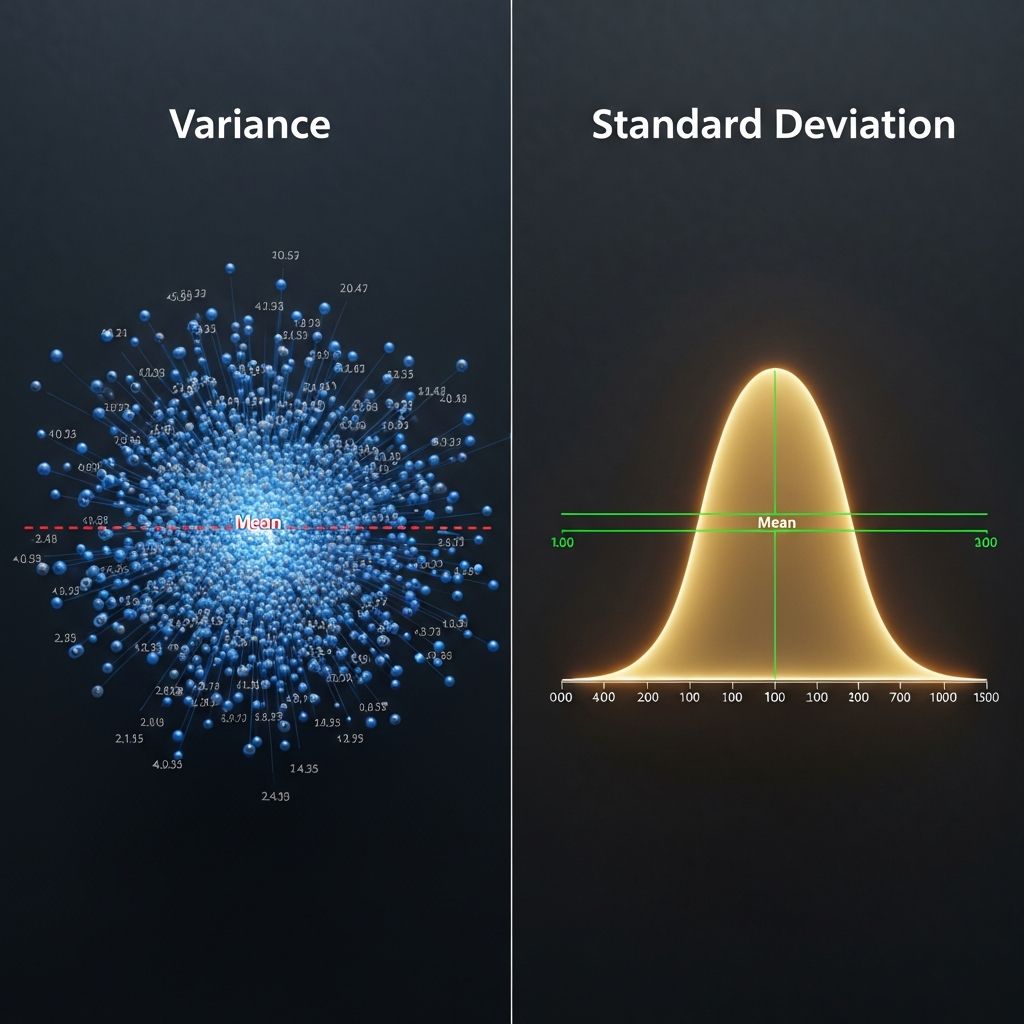
Understanding Standard Deviation and Variance
When analyzing data sets, investors and statisticians frequently encounter two closely related measures of dispersion: standard deviation and variance. While these metrics are mathematically linked and serve similar purposes in measuring how data points spread around a mean, they possess distinct characteristics that make each valuable for different analytical contexts. Understanding the nuances between standard deviation and variance is essential for anyone involved in financial analysis, risk assessment, or statistical research.
Both standard deviation and variance quantify the variability or dispersion within a data set, but they express this information in fundamentally different ways. The relationship between these two measures is direct and mathematical: standard deviation is simply the square root of variance. This mathematical connection means that if you know one measure, you can easily calculate the other. However, the practical applications and interpretability of each measure differ significantly, making it important to understand when and why to use each one.
What is Variance?
Variance represents the average of the squared differences from the mean. In simpler terms, it measures how far each data point in a set is from the average value, then squares those distances and averages the results. The squaring process is crucial because it emphasizes larger deviations from the mean while eliminating the problem of negative numbers canceling out positive ones.
The mathematical formula for variance in a population is:
σ² = Σ(x – μ)² / N
Where σ² represents variance, x represents each data point, μ represents the mean, and N represents the total number of data points. For a sample (rather than an entire population), the denominator uses (n-1) instead of n, applying what statisticians call Bessel’s correction.
Variance is expressed in squared units of the original data. For example, if you’re measuring heights in inches, variance would be expressed in square inches. This squared unit makes variance less intuitive for direct interpretation but mathematically elegant for statistical calculations.
What is Standard Deviation?
Standard deviation is the square root of variance, representing the average distance of data points from the mean. By taking the square root of variance, standard deviation returns the measure to the original units of the data, making it far more interpretable and practical for real-world applications.
The formula for standard deviation is:
σ = √[Σ(x – μ)² / N]
Where σ represents standard deviation. Like variance, the denominator changes for samples versus populations. Standard deviation is expressed in the same units as the original data, making it immediately understandable. If measuring heights in inches, standard deviation is also measured in inches, providing direct context for interpretation.
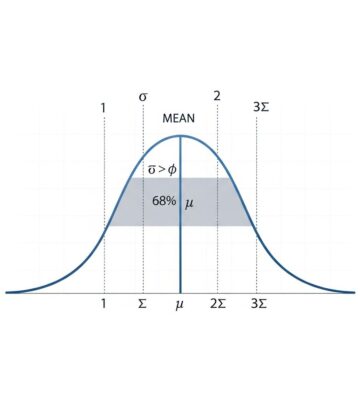
The normal distribution, one of the most important probability distributions in statistics, relies heavily on standard deviation. In a normal distribution, approximately 68% of data falls within one standard deviation of the mean, 95% falls within two standard deviations, and 99.7% falls within three standard deviations. This relationship makes standard deviation invaluable for probability calculations and risk assessment.
Key Differences Between Standard Deviation and Variance
While mathematically related, standard deviation and variance differ in several important ways:
Units of Measurement
The most immediately apparent difference is the units in which each measure is expressed. Variance uses squared units, making it difficult to interpret intuitively. Standard deviation, by returning to the original units through the square root operation, provides a measure that directly relates to the original data. This makes standard deviation far more practical for communicating findings to non-technical audiences and for making direct comparisons.
Interpretability
Standard deviation is significantly more interpretable than variance. Stating that a data set has a standard deviation of 5 inches immediately conveys meaning—the typical data point deviates from the mean by about 5 inches. Conversely, saying variance is 25 square inches is less intuitive and requires additional context or conversion to have practical meaning.
Mathematical Properties
Variance possesses superior mathematical properties that make it preferable for statistical calculations and theoretical work. Variances are additive for independent variables, a property that is not true for standard deviations. When combining independent data sets, their variances can be simply added together. This property makes variance essential for certain statistical operations and theoretical developments.
Sensitivity to Outliers
Both measures are sensitive to outliers, but variance amplifies this sensitivity through the squaring operation. Extreme values have an even more pronounced effect on variance than on standard deviation. For data sets potentially containing outliers, this distinction becomes particularly important when deciding which measure to report or analyze.
Calculating Standard Deviation and Variance: Step-by-Step Examples
Consider a simple data set of five values: 2, 4, 6, 8, and 10.
Step One: Calculate the Mean
Mean = (2 + 4 + 6 + 8 + 10) / 5 = 30 / 5 = 6
Step Two: Calculate Deviations from the Mean
For each data point, subtract the mean: (2-6) = -4, (4-6) = -2, (6-6) = 0, (8-6) = 2, (10-6) = 4
Step Three: Square Each Deviation
(-4)² = 16, (-2)² = 4, (0)² = 0, (2)² = 4, (4)² = 16
Step Four: Calculate Average of Squared Deviations (Variance)
Variance = (16 + 4 + 0 + 4 + 16) / 5 = 40 / 5 = 8
Step Five: Calculate Standard Deviation
Standard Deviation = √8 ≈ 2.83
This simple example demonstrates the direct mathematical relationship: the standard deviation is precisely the square root of the variance.
Applications in Finance and Investment Analysis
In financial contexts, both measures play crucial roles in different analytical frameworks.
Standard Deviation in Finance
Standard deviation is the primary measure of volatility in financial markets. Investors use standard deviation to assess investment risk, comparing the volatility of different securities or portfolios. A stock with high standard deviation experiences larger price swings, representing greater risk. Portfolio managers use standard deviation to optimize asset allocation and construct efficient portfolios. The measure’s interpretability makes it ideal for communicating risk to investors and for making investment decisions based on risk tolerance.
Variance in Finance
Variance appears extensively in theoretical finance and portfolio theory. The Capital Asset Pricing Model (CAPM) and Modern Portfolio Theory rely on variance in their mathematical frameworks. Variance’s mathematical properties make it essential for deriving optimal portfolio weights and understanding systematic risk relationships. Financial economists often work with variance in theoretical contexts, converting to standard deviation for practical applications and communication.
Why the Distinction Matters
Understanding the difference between standard deviation and variance is crucial for several reasons. First, it prevents analytical errors—using the wrong measure can lead to incorrect conclusions. Second, it facilitates better communication; using standard deviation when variance would be appropriate creates confusion, while doing the opposite undermines the mathematical elegance of variance for theoretical work. Third, it enhances understanding of financial concepts; many investment principles rely on one measure or the other, and confusion between them impedes comprehension of these frameworks.
Practical Considerations for Data Analysis
When conducting data analysis, consider several factors when choosing between standard deviation and variance. For descriptive statistics and communicating results to general audiences, standard deviation is almost always preferable. Its unit equivalence with the original data makes interpretation straightforward and intuitive. For theoretical work, statistical proofs, and mathematical derivations, variance often proves more elegant and useful. For comparison purposes across different variables or populations, standard deviation typically provides more meaningful comparisons since it accounts for different scales.
Common Misconceptions
Several misconceptions about standard deviation and variance persist in practice. Some believe they measure different aspects of data—they do not; they measure the same dispersion characteristic, just in different units. Others think variance has no practical use—it absolutely does, particularly in theoretical and advanced statistical work. Some assume standard deviation and variance are interchangeable—while mathematically related, they serve distinct purposes in different contexts.
Frequently Asked Questions
Q: Why is variance squared while standard deviation is not?
A: Variance uses squared deviations to eliminate negative values and emphasize larger deviations from the mean. Standard deviation applies the square root to return the measure to the original data units, making it more interpretable while retaining variance’s mathematical properties.
Q: Can variance be negative?
A: No, variance can never be negative because it’s the average of squared values. At minimum, variance equals zero when all data points are identical. Similarly, standard deviation cannot be negative.
Q: Which measure should I use for investment risk analysis?
A: Standard deviation is the preferred measure for investment risk analysis because it’s expressed in the same units as the underlying asset prices, making risk comparisons more intuitive. Variance is used more in theoretical portfolio optimization models.
Q: How do standard deviation and variance relate to the normal distribution?
A: In a normal distribution, standard deviation defines the probability of data falling within certain ranges (the 68-95-99.7 rule). Variance doesn’t have this direct probabilistic interpretation due to its squared units.
Q: Is standard deviation always the square root of variance?
A: Yes, by definition, standard deviation is always the square root of variance. This mathematical relationship holds true for any data set, whether population or sample data.
Q: Why would anyone use variance if standard deviation is more interpretable?
A: Variance possesses superior mathematical properties for statistical calculations and theoretical work. Variances of independent variables sum linearly, while standard deviations do not. This makes variance essential for deriving statistical formulas and theoretical models.
Conclusion
Standard deviation and variance are complementary statistical measures that quantify data dispersion in different but mathematically related ways. Variance, with its squared units and mathematical elegance, serves as the foundation for statistical theory and advanced analytical techniques. Standard deviation, as the square root of variance, provides an interpretable measure expressed in original data units, making it ideal for practical applications and communication. Understanding their differences enables analysts to choose the appropriate measure for their specific analytical context, whether conducting theoretical research, assessing investment risk, or communicating statistical findings to diverse audiences. Both measures remain indispensable tools in statistics, finance, and data analysis.
References
- Measures of Spread: Range, Variance & Standard Deviation — Khan Academy. https://www.khanacademy.org/math/statistics-probability/summarizing-quantitative-data/variance-standard-deviation-population/v/range-variance-and-standard-deviation-as-measures-of-dispersion
- Modern Portfolio Theory — CFA Institute. 2024. Official educational resource on portfolio risk measurement and variance in capital markets.
- The Capital Asset Pricing Model (CAPM) and Systematic Risk — U.S. Securities and Exchange Commission (SEC). Educational materials on investment risk metrics. https://www.sec.gov/investor
- Statistical Methods for Data Analysis — National Institute of Standards and Technology (NIST). 2024. https://www.nist.gov/
Similar Articles








Read full bio of medha deb