Standard Deviation: Definition, Formula, and Application
Understanding standard deviation: A comprehensive guide to measuring market volatility and investment risk.
What is Standard Deviation?
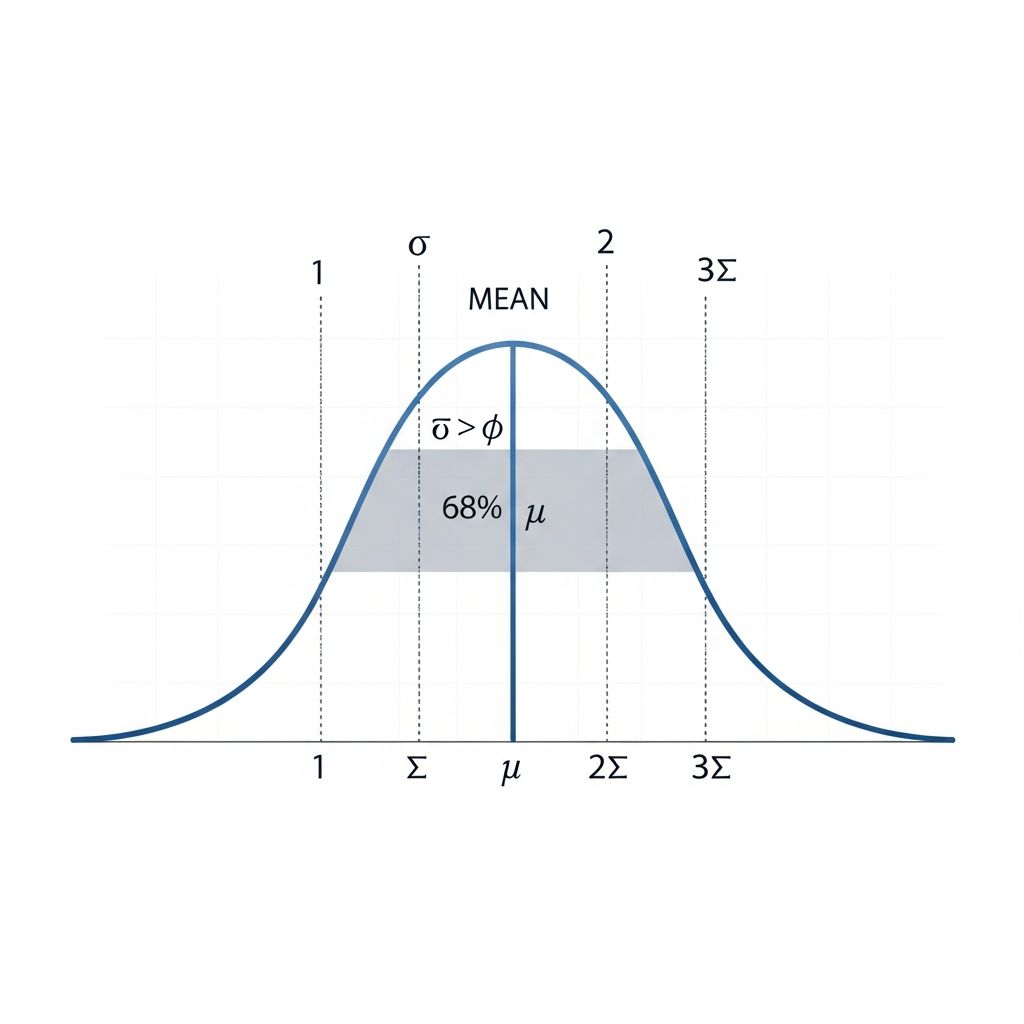
Standard deviation is a fundamental statistical measure used in finance and trading to quantify the degree of variation or dispersion of prices from their average value. In the context of financial markets, standard deviation represents how widely security prices fluctuate around their mean price over a specific period. When a security’s prices remain stable and clustered closely together, the standard deviation produces a low value, indicating minimal volatility. Conversely, when prices experience significant fluctuations and swing widely above and below the average, standard deviation generates a high value, signaling elevated volatility.
As a technical indicator, standard deviation serves as a critical tool for investors and traders seeking to understand market behavior and assess risk. The measure provides quantitative insight into price movement patterns, helping market participants make more informed decisions about entry points, exit strategies, and portfolio management. By translating price volatility into a single numerical value, standard deviation enables comparisons across different securities, timeframes, and market conditions.
Understanding Volatility Through Standard Deviation
Volatility represents the speed and magnitude of price changes in a security. Standard deviation directly correlates with volatility: as prices become more volatile and erratic, standard deviation increases proportionally. When market conditions stabilize and prices move within predictable ranges, standard deviation decreases accordingly. This inverse relationship between price stability and standard deviation makes it an invaluable indicator for assessing overall market conditions.
The interpretation of standard deviation varies depending on market context. Rising standard deviation suggests that prices are experiencing increased strength or weakness above historical averages. During bull markets characterized by rising prices, elevated standard deviation can indicate strong upward momentum driven by confident buyers. In bear markets, high standard deviation suggests intense selling pressure and significant downward price acceleration.
Market Tops and Bottoms: Volatility Signals
Identifying Market Peaks
Market tops often display distinctive volatility patterns that signal changing market conditions. When market tops occur with increased volatility over short time periods, this pattern typically indicates nervous and indecisive traders. The wild price swings reflect uncertainty about whether prices will continue climbing or reverse downward. This behavior characterizes local tops that may be followed by temporary pullbacks or trend reversals.
However, market tops accompanied by decreasing volatility over longer timeframes suggest different market psychology. These conditions often indicate a maturing bull market where traders have become more confident and settled into their positions. The reduced volatility reflects consensus among market participants about higher prices, creating a more stable trading environment even at elevated price levels.
Recognizing Market Bottoms
Market bottoms, like tops, exhibit characteristic volatility patterns. Market bottoms with decreased volatility over extended periods signal bored and disinterested traders. When prices remain depressed and trading volume drops, traders show minimal interest in the security. This apathy creates low volatility as participants disengage from active trading. Such conditions can persist for extended periods before catalysts spark renewed interest.
Conversely, market bottoms accompanied by increasing volatility over relatively short periods indicate panic sell-offs. These conditions reflect fear-driven trading as investors desperately exit positions at market bottoms. The intense selling pressure creates sharp price declines and elevated standard deviation, signaling capitulation and potential reversal opportunities as panic selling exhausts available sellers.
Calculating Standard Deviation
Understanding the calculation process helps traders appreciate what standard deviation measures and how to interpret its values. The calculation involves several mathematical steps that transform raw price data into a meaningful volatility metric.
Step-by-Step Calculation Process
Step 1: Calculate the Simple Moving Average (SMA)
Begin by determining the simple moving average for your chosen period (n). The SMA represents the average closing price over the specified number of periods, providing the reference point from which deviations are measured.
Step 2: Calculate Deviations and Square Them
For each of the past n periods, subtract the SMA value from the closing price. This calculation reveals how far each period’s price deviated from the average. Next, square each deviation to eliminate negative values and emphasize larger deviations. Squaring also weights outliers more heavily, making the measure sensitive to extreme price movements.
Step 3: Sum and Average the Squared Deviations
Add all the squared differences together, then divide by n. This step calculates the average squared deviation, known as variance. Variance measures average dispersion but is expressed in squared units, making it difficult to interpret directly.
Step 4: Calculate the Square Root
Taking the square root of the variance converts the measure back into the original price units, producing the standard deviation value. This final step makes the indicator directly comparable to price data.
The Standard Deviation Formula
The complete formula for standard deviation can be expressed as:
SD = √[(Σ((Close(n) – SMA(n))²)) / n]
Where SD represents standard deviation, Close(n) indicates the closing price for each of the past n periods, SMA(n) is the n-period simple moving average, and n is the number of periods in the calculation. This formula reveals that standard deviation measures how far individual closing prices deviate from their average value over the specified period.
Practical Application in Trading
Volatility Assessment
Traders use standard deviation to quickly assess whether current price volatility is elevated or subdued relative to historical norms. Comparing current standard deviation values to longer-term averages helps identify when volatility is expanding or contracting. Rising standard deviation suggests that price movements are becoming more pronounced, potentially creating trading opportunities for those comfortable with increased risk. Falling standard deviation indicates that price movements are normalizing and becoming more predictable.
Risk Management
Standard deviation serves as a quantitative risk measure, helping traders size positions appropriately and set stop-loss levels. Securities with higher standard deviation values carry greater price volatility risk and may require tighter stop-loss orders and smaller position sizes. Lower standard deviation securities allow for wider stops and potentially larger positions since price movements are expected to be more moderate.
Strategy Development
Different trading strategies benefit from different volatility environments. Mean reversion strategies typically perform better during periods of elevated standard deviation when prices deviate significantly from moving averages. Trend-following strategies may work better when standard deviation is rising, confirming directional momentum. By monitoring standard deviation, traders can adjust their strategies to match prevailing market conditions.
Standard Deviation and Investment Risk
In portfolio management, standard deviation represents a stock or portfolio’s risk measure. Historically, securities with higher standard deviations have exhibited greater price fluctuations and have been considered riskier investments. However, risk takes multiple forms, and standard deviation measures only volatility—the magnitude of price changes—not the direction or probability of losses.
Investors using the Sharpe Ratio or Sortino Ratio employ standard deviation to evaluate risk-adjusted returns. These metrics compare returns generated relative to the volatility undertaken, helping investors determine whether compensation exists for bearing higher risk. A high-volatility security generating strong returns may offer better risk-adjusted returns than a low-volatility security with modest returns.
Limitations and Considerations
While standard deviation provides valuable insights, traders should recognize its limitations. The measure treats upside and downside volatility equally, even though investors typically prefer upside moves and dislike downside moves. During bull markets with rising standard deviation, the increased volatility reflects positive price movements, which most investors welcome. During bear markets, high standard deviation reflects losses, which investors rightfully fear. Standard deviation alone cannot distinguish between these situations.
Additionally, standard deviation relies on historical data and assumes that past volatility patterns will continue into the future. Structural market changes, unexpected events, or shifts in trader behavior can cause volatility patterns to change abruptly, making historical standard deviation calculations less predictive during market regime changes.
Combining Standard Deviation with Other Indicators
Sophisticated traders combine standard deviation with other technical indicators to develop more robust trading strategies. Bollinger Bands, for example, use standard deviation to create dynamic support and resistance levels. These bands expand during high-volatility periods and contract during calm markets, automatically adapting to changing volatility conditions. Combining standard deviation with moving averages, momentum indicators, or volume analysis can provide more comprehensive market insight than any single indicator alone.
Frequently Asked Questions
Q: What does a high standard deviation value indicate?
A: A high standard deviation value indicates elevated volatility, meaning prices are fluctuating significantly from their average value. This suggests unpredictable price movements and potentially higher risk.
Q: How does standard deviation differ from variance?
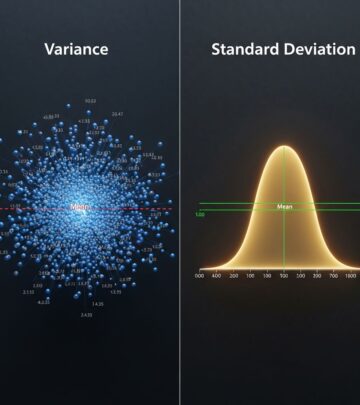
A: Variance and standard deviation measure the same concept, but standard deviation is the square root of variance. Standard deviation is expressed in the same units as the original data, making it more intuitive to interpret.
Q: Can standard deviation predict future price movements?
A: Standard deviation measures historical volatility but does not predict future price direction. It indicates how widely prices have varied historically, which may suggest future volatility levels but cannot forecast specific price movements.
Q: What time period should I use for standard deviation calculations?
A: The appropriate period depends on your trading timeframe. Short-term traders might use 10-20 periods, while swing traders may use 20-50 periods. Position traders and investors often use longer periods of 50-200 days.
Q: How does standard deviation relate to Bollinger Bands?
A: Bollinger Bands use standard deviation to create dynamic support and resistance levels around a moving average. The bands expand and contract as standard deviation changes, reflecting changing market volatility.
Q: Is lower standard deviation always better for investments?
A: Not necessarily. While lower volatility means fewer dramatic price swings, it may also mean lower returns. Investors must balance their risk tolerance with their return objectives, as higher-volatility investments can generate higher returns.
References
- Standard Deviation Indicator — Fidelity Investments. 2025. https://www.fidelity.com/learning-center/trading-investing/technical-analysis/technical-indicator-guide/standard-deviation
- What is Standard Deviation? — U.S. Securities and Exchange Commission (SEC). https://www.sec.gov/
- Understanding Volatility in Financial Markets — CFA Institute. https://www.cfainstitute.org/
Similar Articles








Read full bio of Sneha Tete