Staking vs Lending: Crypto Yield Strategies
Discover how staking and lending generate passive income in crypto, their key differences, risks, and which strategy suits your financial goals.
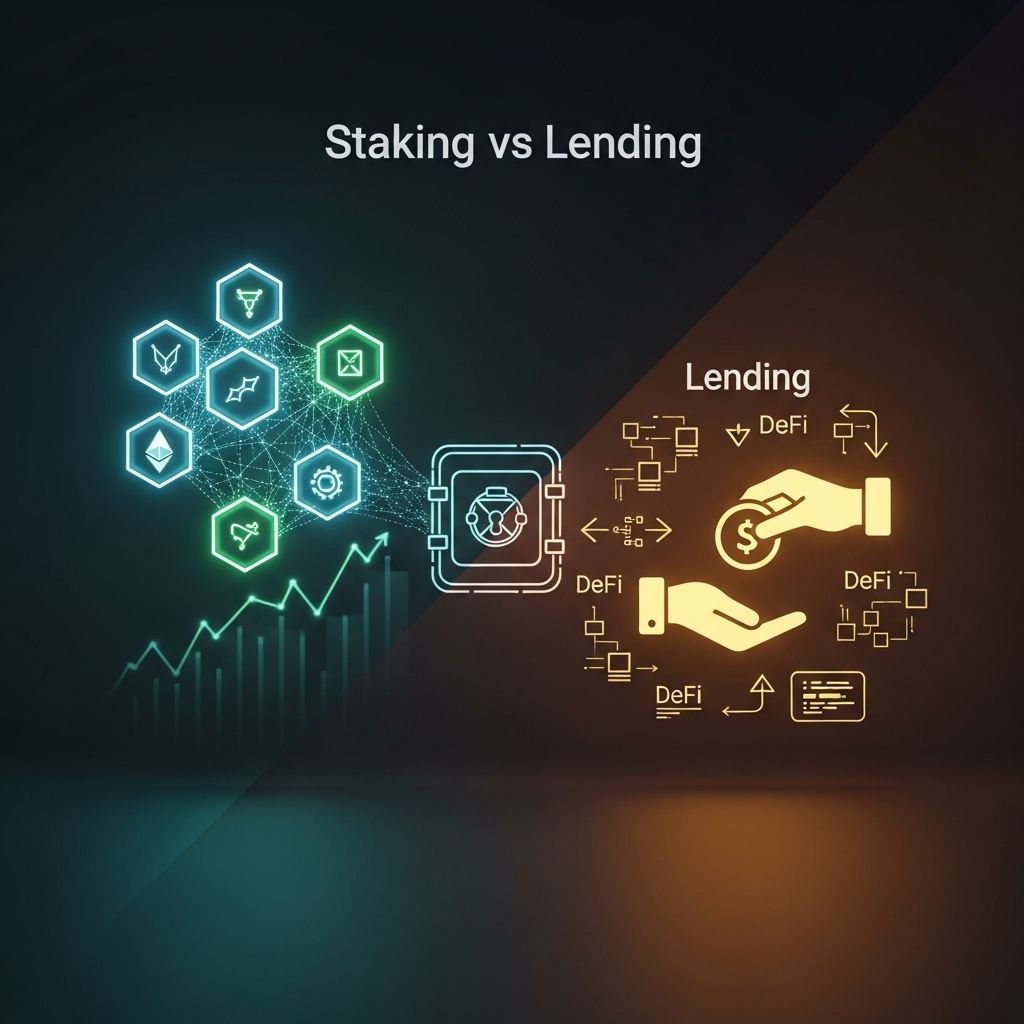
Staking and lending represent two prominent methods for generating passive income with cryptocurrencies, each leveraging digital assets differently to produce returns. Staking supports blockchain security in proof-of-stake networks, while lending facilitates borrowing on platforms, mimicking traditional finance but with unique crypto dynamics.
Understanding Crypto Staking Fundamentals
Crypto staking involves committing digital assets to a blockchain network that operates on a proof-of-stake consensus mechanism. Participants lock up tokens to validate transactions and secure the network, earning newly minted coins as rewards. This process replaces energy-intensive mining used in proof-of-work systems like Bitcoin.
To participate, users either run their own validator node—requiring significant hardware and stake—or delegate tokens to existing validators via exchanges or wallets. Validators propose and confirm blocks, achieving network consensus. Rewards accrue based on the staked amount and network parameters, often expressed as annual percentage yield (APY).
- Lock-up periods: Funds are typically illiquid during staking, with unstaking delays ranging from days to weeks.
- Rewards distribution: Proportional to stake size; APYs vary from 3% to 10% or higher depending on the chain.
- Governance perks: Stakers often gain voting rights on protocol upgrades.
Ethereum, Cardano, and emerging chains like Celestia offer staking opportunities, with platforms like exchanges simplifying access by handling validation.
Demystifying Crypto Lending Mechanics
Crypto lending allows holders to deposit assets into platforms where borrowers access funds in exchange for interest payments. This mirrors bank lending but operates on decentralized (DeFi) or centralized platforms, often with over-collateralization to mitigate defaults.
Depositors earn a share of borrower interest, credited periodically. Centralized platforms like Ledn lend to institutions for stable yields, while DeFi protocols like Aave use smart contracts for peer-to-pool lending. Minimum deposits apply, but entry barriers are lower than solo staking.
- Flexibility: Many platforms allow withdrawals without fixed lock-ups, unlike staking.
- Asset variety: Works with any borrowable token, including stablecoins yielding 3-12% APY.
- Interest accrual: Compounded or paid out monthly, influenced by supply-demand dynamics.
Lending suits diverse portfolios, extending to Bitcoin or stablecoins where staking isn’t viable.
Core Differences: Staking Compared to Lending
| Aspect | Staking | Lending |
|---|---|---|
| Purpose | Secure PoS blockchain via validation | Provide liquidity to borrowers |
| Eligibility | PoS tokens only (e.g., ETH, ADA) | Any lendable asset (BTC, USDC, etc.) |
| Setup | Validator or delegation; hardware for solo | Deposit to platform; no hardware |
| Liquidity | Lock-ups common (days-weeks) | Often instant access |
| Rewards Source | Network emissions | Borrower interest |
Staking ties returns to network health and participation, while lending depends on borrower demand and platform efficiency.
Potential Returns: APY Breakdown
Both strategies offer competitive yields, often surpassing traditional savings. Staking APYs range from 3.38% on Ethereum to 10% on high-reward chains like Celestia, adjusted for inflation. Lending yields 3-12% for stablecoins, potentially higher in volatile markets via liquidity incentives.
Comparable returns emerge after fees: staking edges out in stability, but lending can spike with demand. Yield farming variants amplify both but introduce complexity.
- Staking: Predictable, network-driven (5-20% in DeFi staking).
- Lending: Market-responsive, up to 12% stable, higher for alts.
Navigating Risks in Staking and Lending
Risks differentiate these approaches significantly. Staking exposes users to slashing—penalties for validator downtime or misconduct, potentially forfeiting 1-30% of stake. Token devaluation from inflation or market drops affects both, but lock-ups prevent hedging.
Lending carries platform risk: centralized failures like Celsius and BlockFi bankruptcies froze billions, lacking FDIC insurance. Hacks, smart contract bugs, and regulatory crackdowns amplify threats. DeFi mitigates centralization but adds impermanent loss in pools.
Volatility impacts locked funds universally; diversification and reputable providers are key.
Choosing Platforms: Centralized vs Decentralized
Centralized exchanges (e.g., Binance, Coinbase) offer user-friendly staking/lending with custodial control. Yields are competitive, but users sacrifice self-custody.
DeFi platforms like Lido for staking or Compound for lending provide non-custodial access via wallets, appealing to sovereignty seekers. Gas fees and complexity deter beginners.
Select based on experience: novices favor centralized ease; experts prefer DeFi control.
Tax and Regulatory Considerations
Staking rewards count as income at receipt, per IRS guidelines, with disposal triggering capital gains. Lending interest follows similar taxation. Track basis meticulously amid evolving rules.
Regulations vary: U.S. SEC scrutiny hit lending platforms; staking faces securities debates. Use compliant platforms to minimize exposure.
Advanced Strategies: Beyond Basics
Liquid staking (e.g., stETH) issues tradable tokens for staked assets, blending yield with liquidity. Lending pairs with borrowing for leveraged positions, though risky.
Yield farming optimizes by rotating into high-APY pools, but impermanent loss and rug pulls loom large.
Getting Started: Practical Steps
- Research assets: Confirm PoS for staking; check lendability.
- Select platform: Balance yield, security, liquidity.
- Start small: Test with minimal stake/loan.
- Monitor: Track APY, risks, unstaking windows.
- Diversify: Mix strategies across chains/platforms.
Frequently Asked Questions (FAQs)
Is staking safer than lending?
Staking generally poses lower counterparty risk, avoiding platform bankruptcies, but includes slashing. Lending’s higher yields come with centralized failure history.
Can I stake Bitcoin?
No, Bitcoin uses proof-of-work. Wrapped BTC enables DeFi staking equivalents.
What are typical APYs in 2026?
Staking: 4-10%; Lending: 3-12%, fluctuating with markets.
Are rewards taxable?
Yes, as ordinary income; consult tax pros.
What’s the minimum to start?
Staking: 32 ETH solo, less delegated; Lending: Varies, often $100+.
References
- Staking vs. Lending | Learn Crypto — Coinmerce. 2023. https://coinmerce.io/en/learn/staking-and-lending/
- Crypto Lending Vs Crypto Staking – What’s The Difference — YouTube (Ledn). 2023-05-15. https://www.youtube.com/watch?v=4G4rul4_8VI
- Stablecoin Earn vs. Staking: What’s the Right Fit for You? — Trust Wallet. 2024. https://trustwallet.com/pt-PT/blog/guides/stablecoin-earn-vs-staking-whats-the-right-fit-for-you
- What is the Difference Between Crypto Lending and Crypto Staking? — Bitstamp. 2024. https://www.bitstamp.net/learn/crypto-101/what-is-the-difference-between-crypto-lending-and-crypto-staking/
- Crypto Lending vs. Staking vs. Liquidity Mining vs. Yield Farming — Sovryn. 2024. https://sovryn.com/all-things-sovryn/crypto-lending-vs-staking-vs-liquidity-mining-vs-yield-farming
- What’s the Difference Between Crypto Lending and Staking? — Experian. 2024-06-12. https://www.experian.com/blogs/ask-experian/crypto-lending-vs-staking/
Similar Articles








Read full bio of medha deb