Stakeholder: Definition, Types, and Business Impact
Understanding stakeholders: Their roles, impact, and importance in organizational success.
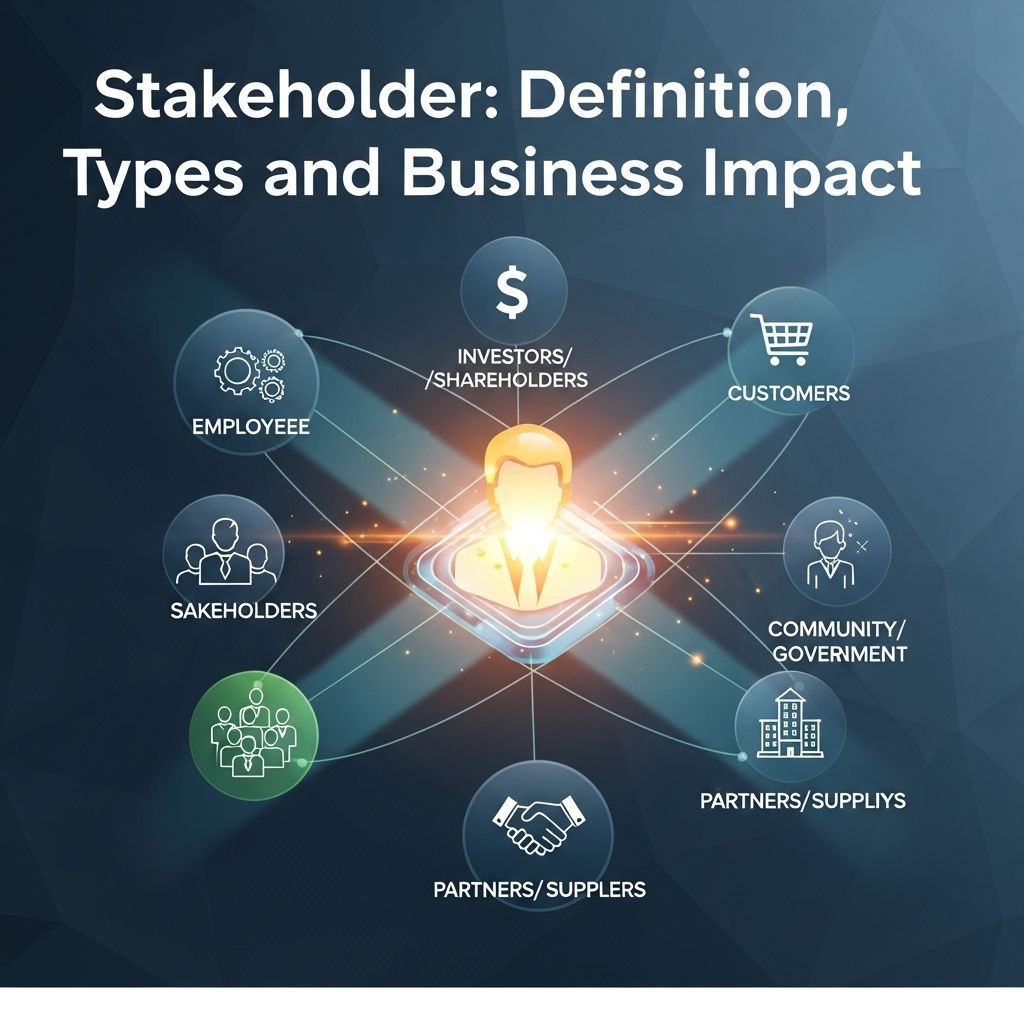
What Is a Stakeholder?
A stakeholder is any individual, group, or organization that has a vested interest in the decision-making and activities of a business, organization, or project. Stakeholders can be members of the organization they have a stake in, or they may have no official affiliation. What defines a stakeholder is their capacity to influence or be influenced by the organization’s actions and outcomes. Their support is often required for business and project success, making stakeholder management a critical component of modern organizational strategy.
The International Organization for Standardization’s ISO 26000 provides a framework for identifying stakeholders through specific criteria. An organization is legally obligated to stakeholders; they might be positively or negatively impacted by an organization’s decisions; and they are likely to express concerns and be involved in the activities of an organization. Understanding these criteria helps businesses identify who their stakeholders are and why their interests matter.
Types of Stakeholders
Stakeholders can be categorized in multiple ways, with the most common distinction being between internal and external stakeholders. Each category plays a unique role in organizational success and requires different management approaches.
Internal Stakeholders
Internal stakeholders are those within a company whose interest stems from direct employment, ownership, or investment. These individuals often have significant influence over organizational decisions and are sometimes referred to as primary stakeholders or key stakeholders because they have a direct stake and important role in the company’s or project’s success.
Common internal stakeholders include:
- Employees who contribute their skills and time to organizational objectives
- Project managers who oversee and direct project execution
- Boards of directors who provide governance and strategic oversight
- Donors who provide financial support to organizations
- Investors who have financial capital invested in the organization
External Stakeholders
External stakeholders are those outside of a company who are indirectly affected by its decisions and outcomes. These entities are often referred to as secondary stakeholders because their stake in the company or project is typically more representational than direct, yet their influence can be substantial.
Common external stakeholders include:
- Customers who purchase products or services
- Suppliers who provide raw materials or services
- Government agencies that regulate business activities
- Creditors who have extended credit to the organization
- Labor unions representing worker interests
- Community groups and local residents affected by operations
Common Examples of Stakeholders by Industry
Stakeholders exist across all industries and organizational types. Understanding stakeholder composition helps organizations better manage relationships and anticipate needs.
Healthcare Industry
In healthcare, stakeholders include doctors, nurses, and other medical professionals; hospitals, clinics, and healthcare providers; healthcare IT vendors and medical equipment suppliers; governing bodies and regulatory agencies; nonprofit organizations; insurance companies; and patients. Each group has distinct interests in healthcare service delivery and quality outcomes.
Project Settings
In project management, stakeholders are people who have direct influence on whether a project is successful. Key project stakeholders typically include:
- Customers: Whose satisfaction with a product or project is the primary goal
- Project managers: Who manage and lead the project to completion
- Project sponsors: Who finance the project and authorize resources
- Project team members: Employees who execute the project work
Legal Contexts
In legal proceedings, a stakeholder is an individual or group in temporary possession of money or property while the owner is being determined in court, representing a neutral third party protecting interests during disputes.
Stakeholders vs. Shareholders: Key Differences
While the terms are often used interchangeably, stakeholders and shareholders have important distinctions that affect their roles and interests in an organization.
| Characteristic | Stakeholder | Shareholder |
|---|---|---|
| Definition | Anyone affected by or affecting organization decisions | Owner of company stock/equity |
| Financial Interest | May or may not be financially invested | Financially invested with ownership stake |
| Primary Concern | Overall organizational performance and impact | Stock price and return on investment |
| Voting Rights | Generally no formal voting rights | Often have voting rights on major decisions |
| Influence Level | Varies; can be direct or indirect | Typically greater influence based on shares held |
Shareholders are stakeholders who are financially invested in an organization, but the relationship is not reciprocal. While all shareholders are stakeholders, not all stakeholders are shareholders. A shareholder’s investment helps fund an organization and its activities. Depending on the size of the investment, shareholders can sometimes have more influence on an organization than other stakeholders.
Stakeholder Theory and Modern Business Philosophy
Stakeholder theory, introduced in the 1980s by theorist R. Edward Freeman in his seminal work Strategic Management: A Stakeholder Approach, fundamentally shifted how businesses think about their purpose and responsibilities. Freeman defined a stakeholder as a group or individual “who can affect or is affected by” the organization’s success.
Prior to stakeholder theory, most businesses operated under the assumption that they existed primarily to satisfy stockholders or private owners. Freeman’s groundbreaking perspective highlighted that the parties affected by an organization were far more numerous and diverse than just stockholders. His 1983 article with David L. Reed, “Stockholders and Stakeholders: A New Perspective on Corporate Governance,” proposed that for a business to succeed, it must create value for owners and stockholders, but it must also create value for stakeholders who do not have direct financial interest but whose assistance is essential for business viability.
According to Freeman and Reed’s analysis, the job of the entrepreneur is to identify who the stakeholders are and determine where their interests intersect with those of stockholders. This framework has become foundational to modern corporate governance and business ethics.
Common Stakeholder Categories and Their Interests
Different stakeholders have fundamentally different interests and concerns regarding an organization. Understanding these distinct perspectives helps companies make balanced decisions.
Customers
Customers usually expect organizations to deliver products and services of value. In industries like aviation, customers literally have their lives in the company’s hands, making quality and safety paramount concerns. Customer satisfaction is the end goal of most project plans and business operations.
Employees
Employees are often project stakeholders who want to contribute to meaningful work related to their job functions. Beyond financial compensation, employees typically seek job security, career development opportunities, fair treatment, and workplace safety.
Owners and Investors
Owners supply an organization’s equity and capital and are responsible for organizational goals and strategic direction. Investors and shareholders invest in organizations in exchange for financial returns and often receive regular financial reporting on the companies they invest in as well as voting power in major decisions.
Suppliers
Suppliers are concerned with being paid fairly and receiving realistic delivery schedules that allow them to succeed in their own business operations. They benefit from stable, long-term relationships with organizations.
Government and Communities
Government agencies at all levels receive taxes from organizations and regulate business activities. Local communities benefit from organizational presence and success but also may be affected by environmental impacts or operational changes.
Stakeholder Management and Analysis
Effective stakeholder management has become essential for organizational success. The key components in managing stakeholders include analysis, prioritization, and engagement.
Stakeholder Analysis
Stakeholder analysis is a central part of stakeholder management. This process begins with identifying and ranking a project’s or organization’s major stakeholders. Once stakeholders are identified, stakeholder analysis weighs the demands and influence of those stakeholders, then ranks which ones are most likely to influence or be influenced by the company’s actions. This information is used to make more balanced and effective business decisions that consider diverse perspectives and potential impacts.
When conducting stakeholder analysis, both internal and external stakeholders must be considered. This comprehensive approach ensures that decision-makers have a complete picture of how their choices will affect different groups and what unintended consequences might arise.
Stakeholder Prioritization
Different organizations prioritize stakeholders differently based on their business model, life stage, and values. Jack Ma, the CEO of Alibaba, has famously outlined a specific stakeholder priority sequence that reflects his company’s philosophy. Many other CEOs prioritize shareholder interests above all others.
Much of the prioritization depends on the stage a company is in. For example, if it’s a startup or early-stage business, customers and employees are likely to be considered foremost, as they are essential to achieving product-market fit and initial growth. If it’s a mature, publicly-traded company, shareholders are likely to be front and center, though institutional investors increasingly expect consideration of broader stakeholder interests.
Frequently Asked Questions
What is the primary definition of a stakeholder in business?
A stakeholder is any individual, group, or organization with a vested interest in the decision-making and activities of a business, organization, or project. They can have direct or indirect influence on organizational outcomes and may be affected positively or negatively by organizational decisions.
How do internal stakeholders differ from external stakeholders?
Internal stakeholders are directly employed by or invested in the organization and include employees, managers, and investors. External stakeholders are outside the organization but affected by its decisions and include customers, suppliers, governments, and community groups. Internal stakeholders typically have more direct influence on operations.
Are all shareholders considered stakeholders?
Yes, all shareholders are stakeholders because they have a financial interest in the organization and are affected by its performance. However, not all stakeholders are shareholders, as many stakeholders have no financial ownership stake in the organization.
What is stakeholder theory and who developed it?
Stakeholder theory was developed by R. Edward Freeman in the 1980s and proposes that organizations should consider and balance the interests of all stakeholders, not just shareholders. The theory fundamentally changed how businesses think about their responsibilities and purposes.
How do companies typically prioritize competing stakeholder interests?
Companies prioritize stakeholder interests based on their business model, life stage, values, and strategic goals. Early-stage companies often prioritize customers and employees, while mature public companies may prioritize shareholders. Ultimately, the CEO and board of directors determine the appropriate ranking when competing interests arise.
Why is stakeholder management important?
Stakeholder management is important because it helps organizations maintain positive relationships, anticipate needs and concerns, make balanced decisions, and achieve long-term success. Effective stakeholder engagement reduces conflict, builds trust, and ensures that diverse perspectives inform organizational strategy.
References
- What is a Stakeholder? Definition, Types, Examples — TechTarget. Accessed November 2025. https://www.techtarget.com/searchcio/definition/stakeholder
- Stakeholder — Corporate Finance Institute. Accessed November 2025. https://corporatefinanceinstitute.com/resources/accounting/stakeholder/
- Stakeholder Theory — EBSCO Research Starters. Accessed November 2025. https://www.ebsco.com/research-starters/social-sciences-and-humanities/stakeholder-theory
- Strategic Management: A Stakeholder Approach — R. Edward Freeman. 1984. Pitman Publishing.
- ISO 26000:2010 — Guidance on social responsibility — International Organization for Standardization. 2010. https://www.iso.org/standard/42546.html
Similar Articles








Read full bio of medha deb