Spousal Inheritance Rights Explained
Discover whether spouses must share inheritances, key legal protections, and strategies to control your estate distribution effectively.

Surviving spouses in the United States enjoy significant legal protections when it comes to inheriting from their deceased partners, but these rights vary by state and depend on factors like property classification and estate planning documents. While community property states grant automatic ownership shares, other jurisdictions rely on intestate succession or wills to determine distributions, ensuring spouses cannot be fully disinherited in most cases.
Understanding Property Classification in Marriage
Central to spousal inheritance is distinguishing between
community property
andseparate property
, which directly impacts what a surviving spouse automatically owns or inherits. In community property states like California, assets acquired during marriage—such as income, homes, or vehicles purchased jointly—are split 50/50 between spouses from the moment of acquisition.Separate property, conversely, includes assets owned before marriage, gifts, or inheritances received by one spouse individually. These remain outside the marital estate unless commingled, meaning they do not automatically transfer to the surviving spouse upon death.
| Property Type | Description | Spousal Rights |
|---|---|---|
| Community Property | Assets gained during marriage (e.g., salary, joint purchases) | Automatic 50% ownership for each spouse; full transfer to survivor in some cases |
| Separate Property | Pre-marital assets, gifts, inheritances | No automatic ownership; subject to will or intestate laws |
Intestate Succession: Default Rules for Spouses
When someone dies without a will—known as intestate—their state’s intestate succession laws dictate asset distribution, heavily favoring the surviving spouse. For instance, in California, if there are no children or other relatives, the spouse inherits 100% of both community and separate property.
- No surviving children or relatives: Spouse receives everything.
- One child or parent: Spouse gets 100% community property plus 50% separate property.
- Multiple children (not shared with spouse): Spouse entitled to one-third of the estate.
These rules prevent total disinheritance, providing a statutory safety net. However, they only apply to probate assets; non-probate items like joint accounts bypass this process.
Protections for Omitted or Disinherited Spouses
Even with a will or trust, most states protect “omitted spouses”—those unintentionally left out—by granting them the same share as under intestate laws. Courts may intervene if the document shows clear intent to disinherit, alternative provisions exist (e.g., life insurance), or waivers were signed prenuptially.
Spouses can challenge unfair distributions through probate petitions, asserting community property claims or creditor rights against the estate. Registered domestic partners often receive identical protections in states recognizing these unions.
Beneficiary Designations and Non-Probate Transfers
Many assets avoid probate via
payable-on-death (POD)
ortransfer-on-death (TOD)
designations on bank accounts, investments, or real estate. These allow the owner to retain control during life while directing post-death transfers directly to named beneficiaries, potentially overriding spousal claims unless the spouse is designated.Joint tenancy with right of survivorship also automatically passes property to the co-owner spouse, sidestepping wills entirely. Couples should review these designations regularly to align with inheritance goals.
State Variations in Spousal Rights
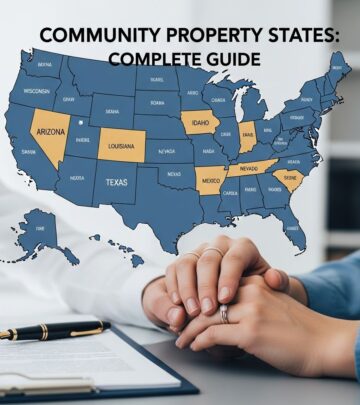
Inheritance laws differ sharply between community property states (e.g., California, Texas) and equitable distribution states. The latter do not presume 50% marital ownership but may allow spouses to claim one-third to one-half of the augmented estate via elective shares.
| State Type | Key Feature | Example Distribution (No Will) |
|---|---|---|
| Community Property (CA) | 50/50 marital assets | Spouse: 100% community + share of separate |
| Equitable Distribution | No automatic 50% split | Spouse petitions for statutory share |
Multi-state couples face added complexity, as property situs determines applicable law.
Prenuptial and Postnuptial Agreements
These contracts can modify default rights, waiving community property claims or inheritance shares, but cannot eliminate core protections entirely. They must be fair, fully disclosed, and voluntarily signed to withstand challenges. Such agreements prove vital in second marriages or high-asset unions.
Estate Planning Strategies for Married Couples
To control inheritance beyond spousal defaults, couples use wills, revocable trusts, and life insurance. Trusts shelter assets from probate while specifying distributions, such as to children from prior relationships.
- Update beneficiary forms on retirement accounts and insurance.
- Use QTIP trusts to provide for spouse while preserving remainder for others.
- Consider irrevocable life insurance trusts for tax-efficient transfers.
Regular reviews ensure plans reflect life changes like remarriage or births.
Common Pitfalls in Spousal Inheritance
Blended families often spark disputes, as intestate laws may divide separate property among children, leaving spouses with less. Failing to classify property correctly or overlooking beneficiary changes can lead to unintended outcomes.
Taxes also factor in: Federal law exempts spousal inheritances from estate taxes, but state rules vary. Surviving spouses receive a stepped-up basis on inherited assets, minimizing capital gains.
Steps for Surviving Spouses to Claim Rights
- Locate documents: Will, trust, deeds, account statements.
- Petition probate court: File for community property or omitted spouse status if needed.
- Assert claims: Challenge designations or distributions within statutory deadlines.
- Consult professionals: Estate attorneys clarify options like spousal property petitions.
Frequently Asked Questions
Can a spouse be completely cut out of an inheritance?
No, statutory protections ensure a minimum share, though waivers or alternative provisions can limit it.
Does remarriage affect prior inheritance rights?
New spouses gain rights to the current estate, but prior designations hold unless updated.
What about out-of-state property?
Law of the property’s location governs, requiring multi-jurisdictional planning.
Are domestic partners protected similarly?
Yes, in recognizing states like California.
How does probate impact spousal inheritance?
Only probate assets follow intestate rules; joint or designated assets pass directly.
Planning Ahead for Marital Asset Security
Proactive estate planning empowers couples to balance spousal support with legacy goals for children or charities. By understanding property rules and leveraging tools like trusts, individuals safeguard loved ones while minimizing disputes. Always seek tailored legal advice, as laws evolve and personal circumstances vary.
References
- What Are My Rights as a Surviving Spouse? — Keystone Law Group. 2023. https://keystone-law.com/surviving-spouse
- Inheritance Laws [2026 Explained] — Stange Law Firm. 2026. https://www.stangelawfirm.com/blog/multi-state-inheritance-laws/
- California Inheritance Laws & Community Property for Spouses — Ridley Law Offices. 2024. https://ridleylawoffices.com/spousal-rights-california-inheritance/
- A Spouse’s Rights Under California Inheritance Law — Sirkin Law Group. 2023. https://sirkinlawgroup.com/a-spouses-rights-under-california-inheritance-law/
- What Are the Inheritance Rights of Spouses? — OC Trial Group. 2024. https://www.octrial.com/what-are-the-inheritance-rights-of-spouses/
- Does a Spouse Automatically Inherit Everything? — LawInfo.com. 2025. https://www.lawinfo.com/resources/estate-planning/does-a-spouse-automatically-inherit-everything.html
Similar Articles








Read full bio of Sneha Tete