Spousal Income on Credit Card Applications
Learn how to leverage household income when applying for credit cards

When applying for a credit card, understanding what income sources you can report is crucial for improving your chances of approval. Many applicants overlook the opportunity to include their spouse’s income on their applications, potentially missing a significant advantage. Whether you can use spousal income depends on several factors, including your age, marital status, and the specific policies of the credit card issuer. This guide explores the rules surrounding household income on credit card applications and helps you navigate the application process effectively.
The Legal Framework Behind Income Requirements
The Credit CARD Act of 2009 established important protections for consumers seeking credit. Under this legislation, credit card issuers must ensure that applicants can afford to make at least minimum payments on their balances. However, the law does not mandate specific minimum income thresholds. Instead, it requires creditors to evaluate whether applicants possess the financial capacity to meet their obligations.
This flexibility allows card issuers to set their own income requirements and policies, which explains why different companies have varying standards. For example, some issuers may require applicants’ income to exceed their monthly housing expenses by a certain amount, while others focus primarily on the applicant’s debt-to-income ratio. Understanding this framework helps explain why income eligibility varies across different credit card products.
Age Restrictions on Household Income Reporting
Age plays a critical role in determining whether you can include spousal or household income on your credit card application. The Credit CARD Act distinguishes between applicants based on their age, creating two distinct categories with different rules.
Applicants Between 18 and 20 Years Old
Young applicants face stricter income verification rules. If you are between 18 and 20 years old, you can only report your own independent income. This means you cannot include your spouse’s income, parents’ income, or other household members’ earnings, even if those individuals have agreed to help pay your credit card bill. Independent income can include earnings from full-time or part-time employment, freelance work, or other personal financial sources like allowances or grants.
Applicants 21 and Older
Once you reach age 21, credit card issuers grant you significantly more flexibility. At this point, you can include household income in your application. The updated CARD Act allows borrowers over 21 to report any income to which they have a “reasonable expectation of access,” which broadly includes spousal or partner income. This expansion recognizes that adult applicants often have legitimate access to household financial resources.
What Counts as Household Income
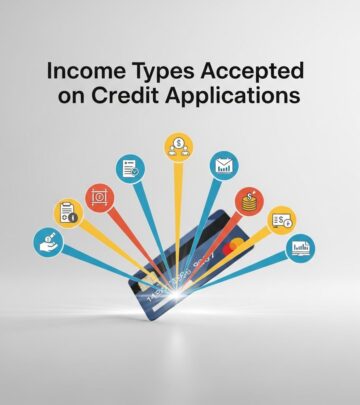
Credit card issuers accept a diverse range of income sources when evaluating applications. Understanding what qualifies helps you present the strongest possible financial profile.
Employment-Based Income
- Wages and salaries from full-time employment
- Income from part-time positions
- Tips and commissions earned at your job
- Bonuses received from employers
- Self-employment earnings and freelance income
Government and Retirement Income
- Social Security benefits
- Unemployment benefits (though policies vary by issuer)
- Pension distributions
- Retirement account withdrawals
- Disability benefits
Household and Support Income
- Spouse’s or partner’s income
- Child support or alimony received
- Separate maintenance income
- Regular household member income (if you have reasonable access)
Educational and Investment Income
- Scholarship distributions (after tuition is paid)
- Grant funds (after educational expenses)
- Investment returns and dividends
- Trust fund distributions
- Inheritance distributions
Income Sources That Do Not Qualify
Just as importantly, credit card issuers will not count certain income sources toward your application. Being aware of these exclusions prevents confusion during the application process.
Loan proceeds do not count as income, regardless of the source. Additionally, your parents’ or guardians’ income cannot be included unless you are a minor with a guarantor. Non-cash assistance programs, such as utility subsidies or food assistance, do not qualify. Certain types of financial aid and one-time gifts are also excluded. Understanding these limitations ensures you report only eligible income sources.
The Debt-to-Income Ratio: The Real Measure of Approval
While income is important, credit card issuers ultimately care most about your ability to repay. This ability is measured through your debt-to-income ratio, commonly referred to as DTI. Your DTI compares your total monthly debt obligations to your gross monthly income, expressed as a percentage.
Here’s how the calculation works: suppose you have monthly debt obligations of $1,600 from student loans, car payments, and existing credit cards. If your monthly household income is $2,500, your DTI would be 64 percent ($1,600 ÷ $2,500 = 0.64). This relatively high ratio might make you ineligible for some credit cards. However, if your household income is $3,700 with the same $1,600 in monthly debts, your DTI drops to approximately 43 percent, significantly improving your approval odds.
Generally, a lower DTI signals to lenders that you have adequate financial resources to meet your obligations. While there is no universal credit card DTI requirement (unlike mortgages, where lenders often use a 43 percent threshold), most issuers view DTI below 40 percent as favorable.
Strategic Approaches to Including Spousal Income
If you are married or in a committed partnership and are at least 21 years old, including your spouse’s income can strengthen your application significantly. However, there are important considerations to keep in mind.
Meeting the Reasonable Access Test
To include spousal income, you must demonstrate a reasonable expectation of access to those funds. This typically means showing that the income is available through a joint bank account, shared financial resources, or explicit consent from your spouse. If your spouse objects or the funds are not genuinely accessible to you, issuers may question the legitimacy of including that income.
Timing and Financial Stability
Including spousal income works best when your spouse’s employment is stable and ongoing. Recent job changes, contract work, or anticipated unemployment can raise questions about income reliability. Issuers want to see consistent, verifiable income streams that support the credit card limits they are considering.
Complete Financial Disclosure
When listing spousal income, be prepared to provide supporting documentation if requested. This might include recent pay stubs, tax returns, or employment verification letters. While many credit card issuers do not verify income for lower credit limits, they increasingly do so for higher limits or applicants with less established credit histories.
Special Considerations for Different Applicant Groups
Students and Young Professionals
Students aged 21 or older have more flexibility than their younger counterparts. Beyond employment income, students can report scholarship funds (after tuition is paid), grants, allowances, and spousal income. However, financial aid specifically used for tuition or mandatory fees does not count. Only excess funds from scholarships and grants that you actually receive qualify as income.
Self-Employed Applicants
Self-employed individuals can report their business income, but verification may be more rigorous. Tax returns, business profit and loss statements, and bank records demonstrating consistent income are helpful. If you are married and self-employed while your spouse has traditional employment, including your spouse’s regular salary provides stability that can strengthen your overall application.
Unemployed or Low-Income Applicants
You can qualify for a credit card even without employment, provided you have another income source. Unemployment benefits, government assistance, allowances, or spousal income may be sufficient. However, card issuers will be more selective about which products you qualify for, typically favoring secured cards or student cards with more lenient requirements.
How Income Affects Your Credit Limit
Income not only determines approval but also influences the credit limit the issuer offers. Card issuers use income to calculate the maximum credit they are comfortable extending. A higher income generally results in a higher credit limit, assuming your DTI is also reasonable and your credit score is acceptable.
For example, if you have an excellent credit score but report $25,000 in annual income, the issuer might offer a $500 to $1,000 limit. By including your spouse’s $40,000 annual income, your combined household income becomes $65,000, potentially supporting a $2,000 to $3,000 credit limit instead. The relationship between income and credit limits varies by issuer and card type, but the principle remains consistent: higher verified income supports higher credit limits.
Issuer-Specific Policies and Variations
While the Credit CARD Act sets baseline protections, individual issuers maintain their own specific policies. Some issuers have concrete minimum income requirements, debt-to-income ratio thresholds, and minimum credit limit standards. Premium credit cards typically have stricter income requirements than entry-level or secured cards.
Before applying, review the issuer’s specific terms and conditions if available. Some banks publish their requirements, while others keep them confidential. If you have questions about whether your spousal income qualifies, contacting the issuer’s customer service before applying can provide clarity.
Documentation and Verification
While credit card issuers typically do not verify income for lower credit limits, the verification landscape is changing. If your application raises questions or if you are requesting a substantial credit limit, be prepared with documentation. Recent pay stubs, tax returns, employment verification letters, and bank statements showing income deposits serve as useful supporting materials.
If including spousal income, similar documentation for your spouse strengthens your case. Having these materials organized before applying accelerates the process should the issuer request them.
Common Questions About Spousal Income
- Can I include my spouse’s income if we file taxes separately?
- Yes, if you are legally married, you generally can include your spouse’s income on your credit card application at age 21 and older, even if you file separate tax returns. The key requirement is having reasonable access to those funds.
- What if my spouse is unemployed but I receive spousal support payments?
- Spousal support or alimony payments count as qualifying income that you can report on your application. These are treated as regular income similar to employment earnings.
- Does including spousal income affect their credit in any way?
- No. Reporting spousal income on your credit card application does not impact your spouse’s credit report or score. The credit account belongs to you alone unless your spouse is a co-applicant or co-signer.
- Can I include my partner’s income if we are not married?
- The CARD Act specifically references spouse or partner income for those 21 and older, suggesting unmarried partners’ income may qualify if you have reasonable access to it. However, individual issuers interpret
Similar Articles








Read full bio of Sneha Tete