Sortino Ratio: Measuring Downside Risk in Investments
Learn how the Sortino ratio measures downside risk and helps investors evaluate risk-adjusted returns.

Understanding the Sortino Ratio: A Guide to Downside Risk Assessment
When evaluating investment opportunities, investors face a critical challenge: determining which investments offer the best returns relative to the risks involved. Among the various metrics available for this assessment, the Sortino ratio stands out as a powerful tool specifically designed to measure downside risk. Unlike broader volatility measures, the Sortino ratio focuses exclusively on the potential for losses, making it particularly valuable for investors with limited risk tolerance or shorter investment time horizons. This comprehensive guide explores how the Sortino ratio works, why it matters, and how investors can use it to make more informed financial decisions.
What Is the Sortino Ratio?
The Sortino ratio is a risk-adjusted performance metric that measures an investment’s return relative to its downside volatility. Named after economist Frank Sortino, who developed this formula in the early 1980s, the Sortino ratio represents a refinement of earlier risk assessment methods. The metric addresses a fundamental limitation in traditional volatility measures by concentrating solely on negative price movements rather than all price fluctuations.
The Sortino ratio belongs to a group of three primary risk-adjusted performance metrics utilized by professional portfolio managers. These three key metrics include:
- The Sortino ratio
- The Sharpe ratio
- The Information ratio
While the Sharpe ratio evaluates excess returns against total volatility—encompassing both gains and losses—the Sortino ratio takes a different approach by isolating downside risk. This distinction proves particularly important for investors seeking to understand the true downside potential of their investments without the noise created by upside volatility.
The Sortino Ratio vs. the Sharpe Ratio
Understanding the differences between the Sortino ratio and the Sharpe ratio helps investors choose the most appropriate metric for their needs. While both measure risk-adjusted returns, they operate on fundamentally different principles.
The Sharpe ratio incorporates all volatility—both upside and downside—when calculating risk-adjusted returns. This approach treats positive and negative deviations from average returns identically, viewing any deviation as risk. For many investors, this creates a problem: upside volatility, or the potential for gains exceeding expectations, should not be penalized in the same way as downside volatility, which represents actual losses.
The Sortino ratio addresses this concern by using only downside deviation in its calculation. By focusing exclusively on negative returns and losses below a target threshold, the Sortino ratio provides a more nuanced view of investment risk that aligns with how investors actually experience losses. This makes the Sortino ratio particularly useful for conservative investors who want to understand the true downside risk they face.
How to Calculate the Sortino Ratio
Calculating the Sortino ratio requires understanding several key components and how they work together in the formula. The calculation begins with identifying a target return that an investor wishes to exceed, based on their risk tolerance and investment time horizon.
The formula for the Sortino ratio can be expressed as:
Sortino Ratio = (Rp – Rf) / Downside Deviation
Where:
- Rp = Investment return (actual or forecast), typically the investment’s current annual return found in fund fact sheets or prospectuses
- Rf = Risk-free rate, usually a U.S. Treasury yield, though investors can use alternative measures such as a minimal acceptable return (MAR)
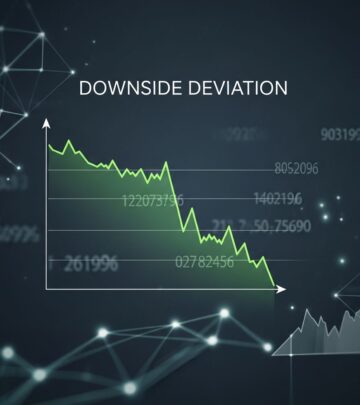
- Downside Deviation = A measure of the investment’s downside volatility or losses, calculated using only negative returns below the target threshold
The calculation process involves several steps. First, investors must select an appropriate risk-free rate or target return against which to measure performance. Many investors use U.S. Treasury yields as their baseline, as these represent low-risk returns guaranteed by the government. Alternatively, professional portfolio managers may work with clients to establish a minimum acceptable return (MAR) that reflects specific financial goals or requirements.
Next, investors calculate the downside deviation by examining only those periods when the investment performed below the target return. This downside deviation measures the volatility of negative returns, with a lower standard deviation indicating less risk and consequently a higher Sortino ratio. Conversely, a higher standard deviation reflects greater risk and produces a lower Sortino ratio.
The numerator of the formula—the excess return—represents how much the investment outperformed the risk-free rate or target return. When divided by the downside deviation, this excess return is normalized by the level of downside risk taken on, producing the final Sortino ratio.
Interpreting Sortino Ratio Values
Understanding what constitutes a good Sortino ratio requires knowledge of standard benchmarks established through years of investment analysis and performance tracking. These benchmarks provide context for evaluating whether an investment’s risk-adjusted returns are acceptable.
| Sortino Ratio Range | Assessment | Interpretation |
|---|---|---|
| Less than 0 | Not Acceptable | The investment is underperforming the risk-free rate and should not be included in most portfolios |
| 0.00 – 1.00 | Suboptimal | The investment provides inadequate returns relative to its downside risk |
| 1.00 – 2.00 | Good | The investment delivers solid risk-adjusted returns and is suitable for many investors |
| 2.00 – 3.00 | Very Good | The investment demonstrates strong risk-adjusted performance |
| Above 3.00 | Excellent | The investment shows exceptional risk-adjusted returns relative to downside risk |
These benchmarks help investors quickly assess whether an investment deserves further consideration. An investment with a Sortino ratio above 1.00 is generally considered acceptable, while ratios above 2.00 indicate particularly attractive risk-adjusted returns. However, investors should remember that these are general guidelines rather than absolute rules, and context matters significantly.
Who Should Use the Sortino Ratio?
The Sortino ratio proves most valuable for specific types of investors with particular characteristics and investment goals. Professional investment managers frequently recommend the Sortino ratio to clients with low risk tolerance and short-term investment time horizons of less than three years. These investors—such as those saving for a home down payment, a child’s first year of college, or other near-term financial goals—cannot afford significant losses that might set them back from achieving their objectives.
For these short-term investors, the Sortino ratio offers a more relevant assessment of investment suitability than broader volatility measures. By concentrating on downside risk rather than total volatility, the Sortino ratio helps identify investments that are less likely to produce the devastating losses that could derail near-term financial plans.
In contrast, investors with longer-term investment time horizons—typically five years or more—may find the Sharpe ratio or Information ratio more useful for evaluating broader risk-return profiles. Long-term investors can better tolerate short-term volatility and may benefit from the upside potential that can develop over extended investment periods. For these investors, focusing exclusively on downside risk could cause them to miss opportunities for growth.
Advantages of the Sortino Ratio
The Sortino ratio offers several significant advantages for investors and portfolio managers evaluating investment opportunities. First, by focusing exclusively on downside volatility, the Sortino ratio provides a more intuitive and accurate representation of investment risk. Many investors view risk as the potential for losses rather than as any deviation from average returns, making the Sortino ratio’s approach more aligned with how people naturally think about risk.
Second, the Sortino ratio allows investors to customize their target return threshold based on personal circumstances and goals. Whether using a standard risk-free rate or establishing a minimal acceptable return tied to specific financial objectives, investors gain flexibility in how they assess performance relative to their needs.
Third, the Sortino ratio can reveal important differences between investments that might appear similar when evaluated using the Sharpe ratio. An investment with significant upside volatility but limited downside volatility would receive a higher Sortino ratio than Sharpe ratio, correctly reflecting that the upside potential does not represent a risk to investors.
Limitations of the Sortino Ratio
Despite its strengths, the Sortino ratio has important limitations that investors must understand before relying on it exclusively. One critical limitation is that the Sortino ratio relies entirely on historical performance data, which may not accurately predict future results. Market conditions change, economic cycles shift, and investment strategies may fail to perform as they have in the past. Investors should view the Sortino ratio as a snapshot of potential loss risk based on available historical data rather than as a guarantee of future performance.
The Sortino ratio also fails to provide useful information for highly volatile investments, sometimes called alternative investments, which include commodities, publicly traded hedge funds, real estate, and certain long/short strategies. Because the Sortino ratio ignores upside volatility entirely, it may understate the attractiveness of investments that experience significant gains alongside occasional losses.
Additionally, the Sortino ratio becomes less reliable when comparing investments with very different return characteristics or when dealing with investments that have experienced very few downside periods. In such cases, the downside deviation may not accurately represent true downside risk.
Practical Applications of the Sortino Ratio
Investors can apply the Sortino ratio in several practical ways to improve their investment decision-making. When evaluating mutual funds or exchange-traded funds for short-term goals, investors should review the fund’s Sortino ratio alongside other performance metrics. Many fund prospectuses and fact sheets now include this metric, making it readily available for analysis.
Portfolio managers can use the Sortino ratio to construct portfolios specifically designed for clients with short-term objectives and low risk tolerance. By selecting investments with high Sortino ratios, managers can build portfolios that minimize the potential for losses that might disrupt client financial plans.
Individual investors can also use the Sortino ratio as one component of their investment research process. When deciding between two similar investments with comparable long-term performance, examining their Sortino ratios can reveal which option better limits downside risk.
Frequently Asked Questions About the Sortino Ratio
Q: Why is the Sortino ratio better than the Sharpe ratio for short-term investors?
A: The Sortino ratio focuses exclusively on downside risk, providing a clearer picture of potential losses for investors with short-term horizons who cannot afford significant declines. The Sharpe ratio includes all volatility, which may not accurately reflect the actual risk concern for near-term investors.
Q: What is a minimal acceptable return (MAR)?
A: A minimal acceptable return is a custom target return established by investors or portfolio managers based on specific financial goals and requirements. Instead of using a standard risk-free rate, investors can use their own MAR to calculate the Sortino ratio.
Q: Can the Sortino ratio be negative?
A: Yes, the Sortino ratio can be negative if the investment’s return falls below the risk-free rate or target return. A negative Sortino ratio indicates that the investment is underperforming expectations and generally should not be included in a portfolio.
Q: How does the Sortino ratio handle positive volatility?
A: The Sortino ratio completely ignores positive volatility or upside gains that exceed the target return. This approach focuses assessment exclusively on downside risk, which better reflects the concerns of investors with short time horizons.
Q: Is a Sortino ratio of 2.0 always better than a ratio of 1.5?
A: While a higher Sortino ratio generally indicates better risk-adjusted returns, other factors should influence investment decisions. An investor should consider the fund’s overall strategy, fees, investment style, and consistency alongside the Sortino ratio when making final investment decisions.
Conclusion
The Sortino ratio represents an important tool for investors evaluating risk-adjusted investment returns, particularly for those with short-term investment horizons and low risk tolerance. By focusing exclusively on downside volatility rather than total volatility, the Sortino ratio provides a more intuitive and accurate assessment of investment risk for many investors. When combined with other risk-adjusted performance metrics such as the Sharpe ratio and Information ratio, the Sortino ratio enables investors and portfolio managers to make more informed decisions aligned with specific financial goals and risk preferences. While the Sortino ratio has limitations—particularly its reliance on historical data and unsuitability for alternative investments—it remains an invaluable component of comprehensive investment analysis for those seeking to understand and minimize downside risk.
References
- Using the Sortino Ratio to Gauge Downside Risk — Charles Schwab. 2024. https://www.schwab.com/learn/story/using-sortino-ratio-to-gauge-downside-risk
- Sortino, Frank A. The Downside: Risk-Adjusted Performance and the New Finance — Butterworth-Heinemann. 2007.
- Investment Risk and Performance Metrics — CFA Institute. 2023. https://www.cfainstitute.org/
Similar Articles








Read full bio of medha deb