Solo 401(k) vs SEP IRA: Which Retirement Plan Is Best?
Compare solo 401(k) and SEP IRA plans to find the best retirement strategy for self-employed workers.
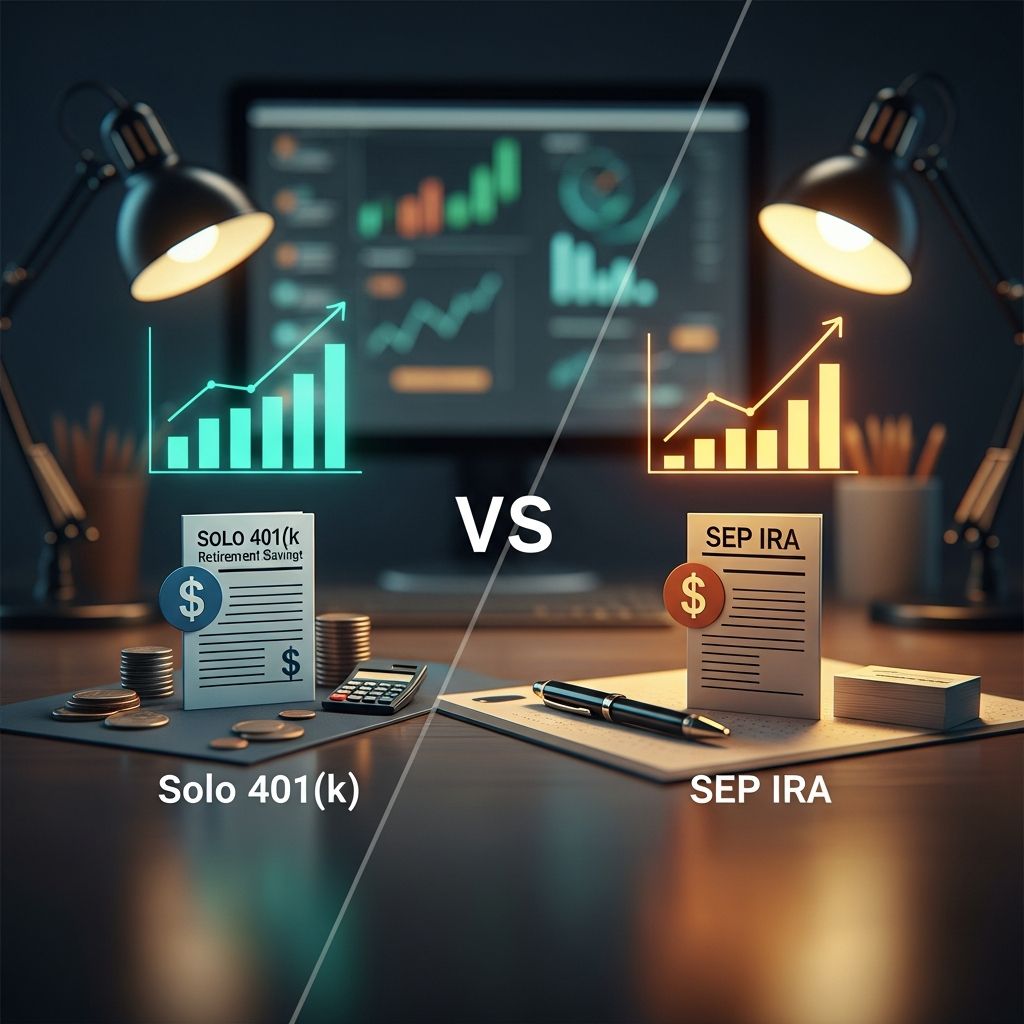
Solo 401(k) vs SEP IRA: Which Retirement Plan Is Best for Self-Employed Workers?
When you’re self-employed or running a small business, choosing the right retirement plan is crucial for your financial future. Two popular options for self-employed individuals are the solo 401(k) and the SEP IRA. Both plans offer tax advantages and allow you to save significantly for retirement, but they differ in important ways. Understanding these differences can help you make the best decision for your specific situation and maximize your retirement savings.
Understanding Solo 401(k) Plans
A solo 401(k), also known as an individual 401(k) or uni-401(k), is a retirement plan designed specifically for self-employed individuals and small business owners without employees. This plan allows you to make contributions as both an employee and an employer, giving you greater flexibility in how much you can save annually.
The solo 401(k) structure enables you to contribute funds from two sources: employee deferrals and employer contributions. As an employee, you can defer up to $23,500 in 2025, with additional catch-up contributions available if you’re age 50 or older. If you’re between 60 and 63, you can contribute an extra $11,250, bringing your potential employee deferral to $34,750. Additionally, as an employer, you can contribute up to 25% of your net self-employment income.
This dual contribution structure means that high-earning self-employed individuals can accumulate retirement savings much more quickly than with other plan types. The total contribution limit for a solo 401(k) can reach up to $70,000 in 2025, or even higher with catch-up contributions for those 50 and older.
Understanding SEP IRA Plans
A Simplified Employee Pension (SEP) IRA is a straightforward retirement savings option for self-employed individuals and small business owners. It allows employers to make tax-deductible contributions to retirement accounts for themselves and their employees, if any.
With a SEP IRA, you can contribute up to 25% of your net self-employment income, with a maximum contribution limit of $70,000 in 2025. Unlike the solo 401(k), SEP IRAs only allow employer contributions—there are no employee deferrals. This simplicity is one of the primary advantages of choosing a SEP IRA, as it requires minimal administrative overhead and paperwork.
The SEP IRA is particularly appealing for business owners who want a low-maintenance retirement solution without the complexity of annual reporting and compliance requirements associated with other retirement plans.
Contribution Limits: A Detailed Comparison
While both the solo 401(k) and SEP IRA share a maximum annual contribution limit of $70,000, the way you reach that limit differs significantly. Understanding these differences is essential for maximizing your retirement savings.
| Feature | Solo 401(k) | SEP IRA |
|---|---|---|
| Employee Contributions | Up to $23,500 (2025) | Not available |
| Employer Contributions | Up to 25% of net income | Up to 25% of net income |
| Catch-up (Age 50+) | $7,500 additional | Not available |
| Enhanced Catch-up (Age 60-63) | $11,250 additional | Not available |
| Total Limit | $70,000+ (with catch-up) | $70,000 |
The key advantage of the solo 401(k) lies in its flexibility. You can contribute up to 100% of your earned income as an employee deferral (up to the annual limit) before calculating your employer contribution. This means you could potentially reach the $70,000 maximum contribution limit even with modest business income, whereas with a SEP IRA, you would need to earn approximately $280,000 to maximize the $70,000 contribution limit.
Catch-Up Contributions for Older Savers
If you’re nearing retirement, catch-up contributions can be particularly valuable. The solo 401(k) offers significant advantages for savers age 50 and older. At age 50 and above, you can make additional catch-up contributions of $7,500 annually. Even more generously, if you’re between 60 and 63 years old, you can contribute an additional $11,250 per year.
The SEP IRA does not offer catch-up contributions for any age group, which can be a disadvantage if you’re looking to accelerate your retirement savings as you approach retirement age. This feature makes the solo 401(k) particularly attractive for individuals in their late 50s and early 60s who want to maximize their tax-advantaged retirement savings.
Tax Implications and Deductions
Both retirement plans offer valuable tax benefits, but they work slightly differently. Contributions to both a solo 401(k) and a SEP IRA are typically tax-deductible, reducing your taxable income in the year you make the contribution. This immediate tax deduction can result in significant tax savings, especially for higher earners making substantial contributions.
With a solo 401(k), employee contributions reduce your taxable income on your personal tax return, while employer contributions provide benefits on your business tax return. SEP IRA contributions are similarly tax-deductible and provide immediate tax relief.
Both plans also offer tax-deferred growth, meaning investment earnings within the account grow without being taxed annually. However, distributions taken before age 59½ are generally subject to a 10% early withdrawal penalty plus regular income tax, with certain exceptions. Recent changes under the SECURE Act 2.0 now allow both plans to offer optional Roth features, giving you the choice between traditional tax-deductible contributions and Roth contributions that grow tax-free.
Loan Provisions: An Important Distinction
One significant advantage of the solo 401(k) is the ability to borrow against your account balance. If you need funds for emergencies or other purposes, you can typically borrow from your solo 401(k) account and repay the loan with interest, with the interest going back into your retirement account. This provides valuable financial flexibility and a safety net if you face unexpected expenses.
SEP IRAs do not offer loan provisions. Once money is in a SEP IRA, you cannot borrow against it without triggering the early withdrawal penalty and income tax consequences. This is an important consideration if you value financial flexibility or anticipate that you might need access to funds before retirement.
Administrative Requirements and Compliance
A major distinction between these two retirement plans relates to administrative burden and compliance requirements. The SEP IRA is significantly simpler to maintain. It requires no annual reporting to the IRS and minimal paperwork beyond the initial setup. This makes it an attractive option for busy entrepreneurs who want to minimize administrative overhead.
The solo 401(k), while offering more contribution flexibility, requires more documentation and ongoing management. Once your account balance exceeds $250,000, you must file Form 5500 annually with the IRS. Additionally, solo 401(k)s require “substantial and recurring” contributions to avoid plan termination. These administrative requirements mean you may want to work with a financial advisor or accountant to ensure compliance.
The increased complexity of solo 401(k)s can also result in higher setup and maintenance costs, though many providers now offer affordable online administration services.
Eligibility Requirements
The two plans have different eligibility criteria. A solo 401(k) is designed for self-employed individuals without employees, though you can include a spouse if they have earned income from the business. If you have full-time employees, a solo 401(k) is not an option.
A SEP IRA is more flexible in this regard. You can establish a SEP IRA whether you have employees or not, making it a viable option for small business owners planning to hire staff in the future. If you do have employees, you must contribute the same percentage of compensation to their accounts as you do to your own, which can significantly increase your contribution obligations.
Flexibility and Contributions
The SEP IRA excels in flexibility regarding contributions. Unlike the solo 401(k), which requires consistent contributions, you have complete discretion with a SEP IRA. In profitable years, you can maximize your contributions. In years when business income is down, you can reduce or even forgo contributions entirely without penalty.
This flexibility makes the SEP IRA ideal for freelancers, consultants, and business owners with variable or seasonal income. You can adjust your contributions based on your actual business performance each year, reducing financial pressure during lean periods.
Backdoor Roth Contributions
If you have high income and want to make Roth contributions, the solo 401(k) offers an advantage. With a solo 401(k), you can make backdoor Roth contributions without worrying about the pro-rata rule, which applies to traditional and Roth IRA conversions. The pro-rata rule can reduce the tax benefits of a backdoor Roth if you have significant traditional IRA balances. This tax planning strategy can be valuable for high-income earners seeking additional tax-free growth opportunities.
Which Plan Is Right for You?
Choosing between a solo 401(k) and a SEP IRA depends on your specific circumstances. Consider the solo 401(k) if you have significant self-employment income and want to maximize retirement contributions, if you’re age 50 or older and want to take advantage of catch-up contributions, if you want the flexibility to borrow from your retirement account, or if you anticipate needing backdoor Roth strategies.
Choose a SEP IRA if you prefer simplicity and minimal administrative burden, if your business income is variable or seasonal, if you want complete flexibility in adjusting annual contributions, or if you’re younger than 50 and don’t have immediate catch-up contribution needs. The SEP IRA is also the better choice if you plan to hire employees and want them to participate in retirement benefits.
Frequently Asked Questions
Q: Can I have both a solo 401(k) and a SEP IRA?
A: No, you cannot have both plans simultaneously. You can maintain only one of these plans at a time. If you switch from one to the other, you’ll need to close the previous plan first.
Q: What happens if my business income increases significantly?
A: With a solo 401(k), you can continue contributing up to the annual limits regardless of income increases. With a SEP IRA, higher income simply allows you to contribute a greater amount, up to the maximum limit. Both plans accommodate income growth well.
Q: Can I switch from a SEP IRA to a solo 401(k)?
A: Yes, you can switch from a SEP IRA to a solo 401(k). However, you’ll need to close your existing SEP IRA first. It’s advisable to consult with a financial advisor or tax professional before making this transition to understand the tax implications.
Q: Are there any income limits for solo 401(k) or SEP IRA contributions?
A: Neither plan has income limits for eligibility or contributions. However, the solo 401(k) catch-up contributions for ages 60-63 have specific eligibility requirements related to plan participation.
Q: What’s the deadline for establishing these retirement plans?
A: Generally, you must establish the plan by December 31 of the tax year in which you want to make contributions, though you can make contributions until your tax filing deadline (including extensions).
Q: Can I contribute to both a solo 401(k) and another retirement plan?
A: If you have self-employment income from different sources, you may be able to maintain multiple plans, but this is complex. Consult a tax professional to understand your specific situation and any aggregation rules that may apply.
Q: What are the investment options in each plan?
A: Both plans offer diverse investment options, including stocks, bonds, mutual funds, and exchange-traded funds. Your investment choices depend on the financial institution administering your plan.
References
- Solo 401(k) vs. SEP IRA – Self-Employed Retirement Plans — Guideline. 2025. https://www.guideline.com/education/articles/solo-401k-vs-sep-ira
- Solo 401(k) Vs SEP IRA: Which Is Better? — Bankrate. 2025. https://www.bankrate.com/retirement/solo-401k-vs-sep-ira/
- Solo 401(k) vs. SEP IRA: Self-Employed Retirement Options — Thrivent. 2025. https://www.thrivent.com/insights/retirement-planning/solo-401k-vs-sep-ira-choosing-the-right-retirement-plan-for-your-business
- SEP IRA vs. Solo 401(k): Which Is Better? — Kiplinger. 2025. https://www.kiplinger.com/retirement/retirement-planning/sep-ira-vs-solo-401k-which-is-better
- Retirement plans for self-employed people — Internal Revenue Service. 2025. https://www.irs.gov/retirement-plans/retirement-plans-for-self-employed-people
Similar Articles








Read full bio of medha deb