Sole Proprietorship vs LLC: Key Differences
Compare sole proprietorships and LLCs to choose the right business structure for your needs.
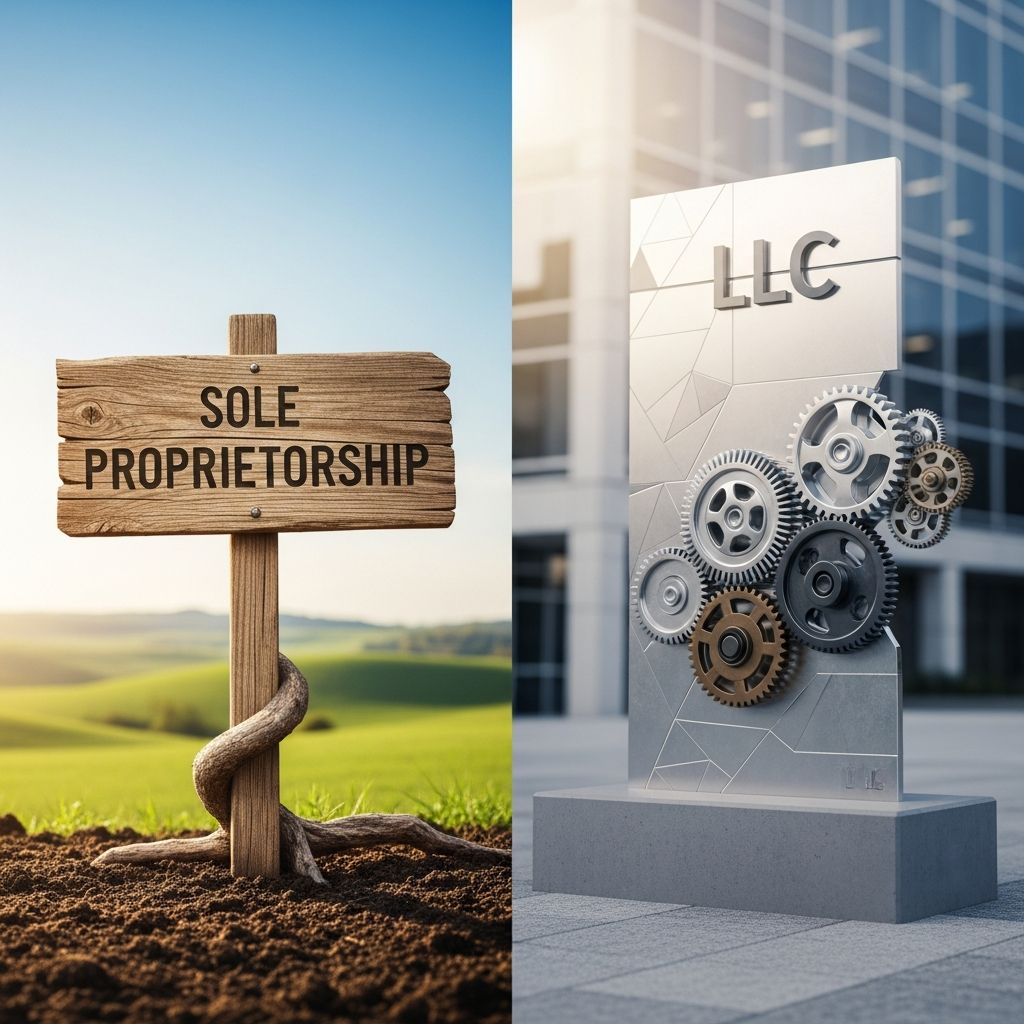
Sole Proprietorship vs LLC: Understanding Your Business Structure Options
Choosing the right business structure is one of the most important decisions you’ll make as an entrepreneur. The two most common options for small business owners are sole proprietorships and limited liability companies (LLCs). While both structures have their advantages and disadvantages, they differ significantly in terms of liability protection, taxation, startup costs, and ongoing compliance requirements. Understanding these differences will help you make an informed decision that aligns with your business goals and personal circumstances.
A sole proprietorship is the simplest and most affordable business structure, requiring minimal paperwork and formal registration. In contrast, an LLC provides a more formal business structure with added legal protections and flexibility. Neither option is inherently better than the other—the right choice depends on your specific situation, risk tolerance, and growth plans.
What Is a Sole Proprietorship?
A sole proprietorship is the most basic form of business ownership, where one individual owns and operates the business. In this structure, there is no legal distinction between you and your business. The business is an extension of your personal identity, meaning your personal assets and business assets are intertwined.
Sole proprietorships are incredibly easy to establish. You can start operating with minimal paperwork—often just a local business license or a DBA (Doing Business As) registration if required by your state. There are no state filing requirements, making this structure appealing to freelancers, consultants, and small business owners who want to get up and running quickly without significant administrative burden or expense.
What Is an LLC?
A Limited Liability Company (LLC) is a business structure that combines elements of both corporations and sole proprietorships. An LLC is a separate legal entity formed at the state level, which means it exists independently from its owner or owners. This separation between you and your business is one of the defining characteristics that distinguishes an LLC from a sole proprietorship.
Forming an LLC requires more formal steps than establishing a sole proprietorship. You must file articles of organization with your state, potentially pay state filing fees, and in many cases, create an operating agreement that outlines how the business will be managed and operated. Despite these additional requirements, LLCs remain relatively simple compared to corporations.
Key Differences Between Sole Proprietorships and LLCs
Liability Protection
One of the most significant differences between these two structures is liability protection. In a sole proprietorship, you are personally responsible for all business debts and legal obligations. If your business is sued or incurs debts, creditors can seize your personal assets—including your home, car, savings, and other property—to satisfy business obligations. This unlimited personal liability is one of the major drawbacks of sole proprietorships, particularly if your business involves significant risk or potential litigation.
With an LLC, you receive limited liability protection. Your LLC is a separate legal entity, meaning that business debts and lawsuits are generally limited to the LLC’s assets. Your personal assets are typically shielded from business-related creditors and legal judgments. This protection is especially valuable for businesses in high-risk industries or those that hire employees, maintain physical locations, or sell products where liability concerns are prominent.
Taxation
Both sole proprietorships and LLCs use pass-through taxation by default, where business income is reported on the owner’s personal tax return. However, LLCs offer significantly more flexibility in tax planning.
For a sole proprietorship, your business income and personal income are taxed together as self-employment income. You’ll report your business activities on Schedule C and pay self-employment taxes on net profits.
With an LLC, you have the flexibility to choose how you want to be taxed. You can elect to be taxed as a sole proprietorship (for single-member LLCs), as a partnership (for multi-member LLCs), as an S corporation, or as a C corporation. This flexibility allows you to optimize your tax situation based on your specific circumstances. For example, electing S corporation status might reduce your self-employment tax obligations or allow you to qualify for additional deductions, potentially resulting in significant tax savings for profitable businesses.
Formation Requirements and Costs
Starting a sole proprietorship is extremely affordable and straightforward. In most cases, you only need to register a DBA (if required by your state) and obtain a local business license. Total costs are typically minimal, often under $100. The process can be completed quickly, sometimes in a matter of days or even hours.
Forming an LLC requires more effort and expense. You must file articles of organization with your state secretary of state office, which typically costs between $50 and $500 depending on your state. Some states may require you to publish a notice of formation in local newspapers, adding further costs. You may also want to create an operating agreement, which can involve additional fees if you hire an attorney. Overall, LLC formation typically costs between $100 and $1,000, though some states charge more.
Ongoing Compliance and Administrative Requirements
Sole proprietorships have minimal ongoing compliance requirements. You typically only need to maintain a local business license and keep accurate business records for tax purposes. There are no annual reports to file, no state fees to renew, and no formal compliance meetings required. This simplicity is attractive to many small business owners.
LLCs, however, require more ongoing compliance. Most states require LLCs to file annual reports and pay annual renewal fees. You should maintain separate business bank accounts and accounting records. You may need to file additional tax forms and comply with state-specific regulations. You should also maintain an operating agreement and document major business decisions. These ongoing requirements mean that managing an LLC involves more administrative work and potentially higher costs than managing a sole proprietorship.
Management Structure and Ownership Flexibility
In a sole proprietorship, you have complete control over all business decisions. You are the sole decision-maker, with no need to consult partners or members. This direct control appeals to entrepreneurs who want full autonomy. However, a sole proprietorship is limited to one owner, making it difficult to bring in partners or scale the business structure as it grows.
An LLC offers greater flexibility in ownership and management structure. A single-member LLC (with one owner) operates similarly to a sole proprietorship in terms of management. However, you can easily add members to create a multi-member LLC. This makes it easier to bring in business partners, bring in investors, or transition ownership. The operating agreement can specify how profits are distributed and how management decisions are made, providing flexibility that a sole proprietorship cannot offer.
Professional Credibility
Sole proprietorships may be viewed as less formal or established compared to other business structures. While there’s nothing wrong with this structure, clients, vendors, partners, and investors may perceive it as a smaller or less professional operation. This perception can sometimes make it harder to secure business partnerships, loans, or investment funding.
LLCs typically enjoy greater credibility and professionalism. The formal structure, separate legal entity status, and liability protection create a perception of legitimacy and stability. Clients, suppliers, partners, and potential investors often view LLCs as more professional and trustworthy, which can help you establish better business relationships and potentially access better financing terms.
Comparison Table: Sole Proprietorship vs LLC
| Factor | Sole Proprietorship | LLC |
|---|---|---|
| Liability Protection | None—personal assets are at risk | Limited—personal assets generally protected |
| Formation Cost | $0–$100 (minimal fees) | $100–$1,000+ (varies by state) |
| Formation Timeline | Days or less | Days to weeks |
| Taxation Options | Pass-through only | Pass-through, S corp, or C corp |
| Annual Reporting | Minimal to none | Annual reports and fees required |
| Ownership Flexibility | Single owner only | One or multiple owners |
| Professional Credibility | Lower perception of formality | Higher perception of formality |
| Ease of Setup | Very simple | More complex |
When to Choose a Sole Proprietorship
A sole proprietorship may be the right choice if you:
- Are starting a low-risk business with minimal liability concerns
- Want to minimize startup costs and administrative burden
- Prefer complete control and simple decision-making
- Are operating as a freelancer or consultant with limited employees
- Don’t plan to seek outside investment
- Want quick formation and minimal ongoing compliance
- Have adequate personal insurance to cover potential liabilities
When to Choose an LLC
An LLC may be the right choice if you:
- Want personal liability protection for your assets
- Plan to hire employees or maintain a physical business location
- Sell products that could involve product liability concerns
- Want flexibility in tax planning and potentially reduce tax burden
- Plan to bring in business partners or investors
- Want a more professional image and credibility with clients and partners
- Plan to scale your business and may need multiple ownership tiers
- Operate in multiple states and need consistent structure
Tax Considerations for Both Structures
Understanding the tax implications of each structure is crucial for long-term financial planning. Both sole proprietorships and single-member LLCs use pass-through taxation by default, where you report business income on your personal tax return and pay self-employment taxes on net profits. This means you’ll pay both the employer and employee portions of Social Security and Medicare taxes, totaling approximately 15.3% of net profits.
However, an LLC’s tax flexibility can lead to significant savings. If you elect S corporation taxation, you can pay yourself a reasonable salary subject to payroll taxes and take remaining profits as distributions, potentially reducing your self-employment tax burden. A C corporation election might be beneficial if you plan to reinvest profits in the business. Consulting with a tax professional can help you determine the most advantageous tax structure for your specific situation.
Scaling Your Business: From Sole Proprietorship to LLC
Many entrepreneurs start with a sole proprietorship due to its simplicity and low cost, then transition to an LLC as their business grows. This transition is relatively straightforward. You can convert your sole proprietorship to an LLC by filing articles of organization with your state and updating your business registrations and licenses. The conversion typically doesn’t disrupt ongoing business operations and can be completed within weeks.
Making this transition becomes increasingly important as your business grows because the additional liability protection becomes more valuable, and the ability to bring in partners or investors becomes more necessary. Additionally, the tax flexibility of an LLC becomes more advantageous as your profits increase.
Frequently Asked Questions
Q: Is a single-member LLC the same as a sole proprietorship?
No. While both are owned by one person and can be taxed similarly, an LLC is a separate legal entity offering liability protection and requiring formal state registration. A sole proprietorship has no legal distinction between you and your business.
Q: Can an LLC have one owner?
Yes. A single-member LLC is legally permitted in all states and is a popular choice for freelancers and consultants seeking liability protection without the complexity of multiple ownership structures.
Q: What happens to my sole proprietorship if I pass away?
A sole proprietorship typically dissolves upon the owner’s death. The business assets become part of your estate and are distributed according to your will or state law. An LLC can be structured to continue operating and pass to heirs or designated successors.
Q: Can I change my business structure from LLC to sole proprietorship?
Yes, you can dissolve your LLC and operate as a sole proprietorship. However, this is unusual because most business transitions move toward more formal structures rather than less formal ones.
Q: Do I need a lawyer to form an LLC?
No, but it’s often advisable. While you can file articles of organization yourself, an attorney can ensure proper formation and help create an operating agreement that protects your interests.
Q: Which structure is better for hiring employees?
An LLC is generally better for hiring employees because it provides liability protection if an employee is injured or causes damage. The formal structure also gives employees more confidence in the business stability and professionalism.
Q: How much does it cost to maintain an LLC annually?
Annual LLC costs vary by state but typically range from $50 to $500 for state renewal fees. You should also budget for accounting services and possibly legal consultation, adding $500 to several thousand dollars depending on your business complexity.
References
- Sole Proprietorship vs. LLC: Which Structure Should You Choose? — U.S. Small Business Administration. 2025. https://www.sba.gov/business-guide/launch-your-business/choose-business-structure
- 7 Key Differences: Sole Proprietorship Vs LLC For U.S. Entrepreneurs — Cornerstone Licensing. 2025. https://cornerstonelicensing.com/resources/sole-proprietorship-vs-llc-deciding-the-right-business-structure-for-u-s-entrepreneurs/
- LLC vs. Sole Proprietorship: Which Is Right for Your Business? — LegalZoom. 2025. https://www.legalzoom.com/articles/llc-vs-sole-proprietorship
- Sole Proprietorship vs. LLC: What’s Best For Your Business? — Salesforce. 2025. https://www.salesforce.com/blog/sole-proprietorship-vs-llc/
- Sole Proprietorship vs. LLC: Which is Right for You? — TaxAct Blog. 2025. https://blog.taxact.com/sole-proprietorship-vs-llc-which-is-best/
- Sole Proprietorship vs LLC – How to Decide — Bonsai. 2025. https://www.hellobonsai.com/blog/sole-proprietorship-vs-llc
Similar Articles








Read full bio of medha deb