Social Science: Definition, Branches, and Career Paths
Understanding human behavior and society through systematic research and analysis.
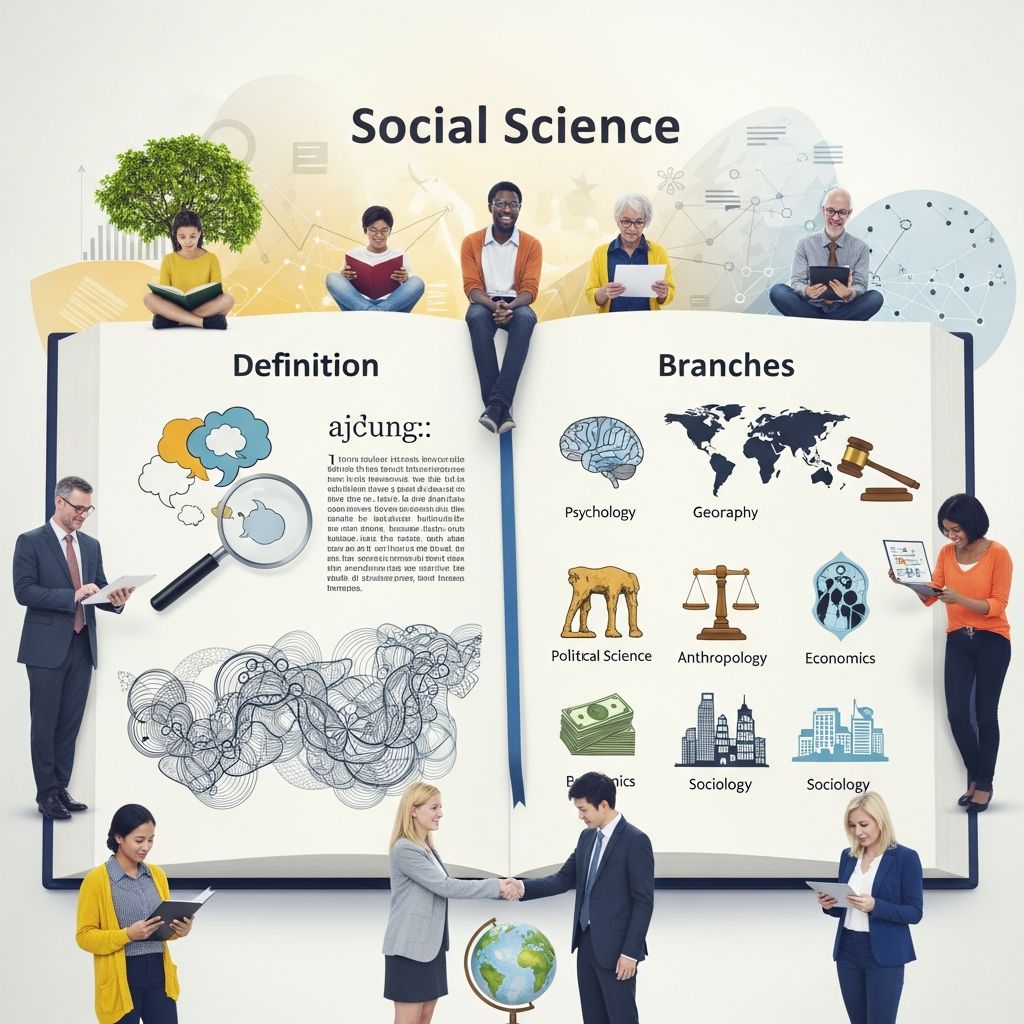
Social science represents a systematic approach to understanding how humans behave, interact, and organize themselves within societies. As an academic discipline, it emerged as a distinct field during the early 19th century, making it relatively modern compared to the humanities and natural sciences. Social science employs rigorous research methodologies to investigate the complex dynamics of human civilization, from economic systems and political structures to family relationships and cultural institutions.
The fundamental goal of social science is to generate evidence-based insights into what drives human behavior and the conditions that enable individuals and communities to flourish. These findings have profound implications, informing education programs, shaping public policy decisions, guiding urban planning initiatives, and helping organizations create more inclusive and effective institutions within society.
What Is Social Science?
Social science is the study of how humans behave and interact within societies through scientific and systematic inquiry. Unlike the natural sciences, which examine the physical world through chemistry, biology, and physics, social science focuses on the relationships and cultures within the constructed world created by human beings. This discipline seeks to understand the patterns, structures, and dynamics that characterize human social life.
Social scientists investigate a wide range of phenomena including government structures, economic systems, family dynamics, and social institutions. The primary objective is to gain comprehensive insight into the factors that shape human behavior and determine the social conditions necessary for people to achieve wellbeing and success.
Major Branches of Social Science
Social science encompasses several interconnected disciplines, each offering unique perspectives on human society:
Sociology
Sociology is the scientific study of patterns in human social behavior, relationships, and interactions, including how these patterns are shaped by social institutions. Sociologists examine crime rates, poverty, family structures, community dynamics, and social stratification. By collecting and analyzing data on these phenomena, sociologists identify trends and patterns that inform public policy and social interventions.
Psychology
Psychology explores how people’s emotions, thoughts, and behaviors are influenced by actual or imagined interactions with others. Psychologists investigate individual cognition, emotional processes, personality development, and interpersonal relationships. This field bridges personal experience with broader social contexts, examining both individual mental processes and group dynamics.
Anthropology
Anthropology is a broad discipline that delves into the history and development of human societies and cultures across time and geography. Anthropologists study languages, belief systems, material goods, social structures, and cultural practices. This discipline often combines fieldwork with theoretical analysis to understand human cultural diversity and social organization.
Economics
Economics is concerned with the production, distribution, and consumption of goods and services, with particular focus on decision-making by individuals, governments, and businesses. Economists analyze market dynamics, consumer behavior, resource allocation, and policy implications of economic choices.
Political Science
Political science examines political theory, ideologies, governance structures, and international relations to understand how local, national, and international governments function and impact societies. Political scientists analyze power dynamics, policy formation, and political institutions.
Related Disciplines
History, geography, law, and linguistics occupy a complex position within the social sciences and humanities. There is ongoing scholarly debate regarding whether these fields should be classified primarily as social sciences or humanities, reflecting their combined focus on human experience and systematic analysis.
Research Methods in Social Science
Quantitative Approaches
Social science frequently employs quantitative data analysis to study different facets of society. This scientific approach involves collecting numerical data, applying statistical methods, and drawing evidence-based conclusions. For example, sociologists research and collect data on crime and poverty, analyze it using statistical techniques, and present findings that guide public policy decisions.
Qualitative Approaches
While quantitative methods dominate much social science research, qualitative approaches provide crucial insights into human motivations and social interactions. Qualitative methods include interviews, focus groups, ethnographic observation, and textual analysis. These approaches allow researchers to explore the subjective experiences and meanings individuals attach to their social worlds.
Mixed Methods
Many contemporary social scientists employ mixed-methods approaches, combining quantitative and qualitative techniques to gain comprehensive understanding of social phenomena. This integration allows researchers to identify patterns through quantitative data while exploring underlying mechanisms through qualitative inquiry.
How Social Science Differs from Humanities
While both social science and humanities study human experience, they employ fundamentally different approaches and methodologies. Humanities focus on abstract or theoretical ideas when examining ethics, poetry, philosophy, and questions about meaningful living. Humanities scholars primarily employ qualitative research approaches, making analytical, moral, or speculative interpretations regarding cultural traditions and creative works.
In contrast, social scientists emphasize observable patterns and systematic data collection. Rather than focusing on individual interpretation and subjective meaning, social scientists aim to identify generalizable patterns applicable across populations and contexts. This distinction reflects the social sciences’ commitment to empirical evidence and scientific methodology.
Career Opportunities in Social Science
Graduates with degrees in social science possess analytical, research, and problem-solving skills applicable across diverse professional sectors. The field offers numerous career pathways:
Social Science Research
Professional social scientists use the scientific method to study how particular aspects of human society and relationships function, change, and coexist. Examples include economists conducting labor market analysis, political scientists examining governance structures, sociologists studying demographic trends, and psychologists investigating behavioral patterns. Entry-level positions typically require a master’s or doctoral degree, though some research roles accept bachelor’s degree holders in supporting capacities.
Business and Corporate Sectors
The combination of strong analytical and research skills with knowledge of human behavior applies to multiple business functions. Market research analysts help companies understand consumer buying preferences and demographics. Business intelligence analysts create financial and market data reports that inform strategic decisions. Demand for market research analyst positions is expected to increase 19% by 2031, while business intelligence analyst roles are projected to grow 11% during the same period.
Additional business applications include:
- Data analysis and interpretation
- Marketing strategy and consumer behavior analysis
- Communications and public relations
- Management and organizational development
- Human resources and talent management
Government and Public Policy
Government agencies employ social scientists to inform policy development, program evaluation, and strategic planning. Social science research provides evidence-based foundations for education reform, healthcare policy, criminal justice initiatives, and social welfare programs.
Nonprofit and International Organizations
Nonprofits and international organizations utilize social science expertise for program design, impact assessment, and community development initiatives. These positions often focus on addressing social challenges and improving organizational effectiveness.
Essential Skills for Social Scientists
Analytical Abilities
Strong analytical skills form the foundation of social science practice. This includes logical reasoning, problem-solving, and decision-making capabilities. Social scientists must reach logical conclusions through both qualitative and quantitative analyses of numerical data, survey results, and written sources.
Research Competencies
Successful social scientists identify and analyze reputable sources, extract important evidence and data, and present sound conclusions based on rigorous research. These skills encompass literature review, research design, data collection methodologies, and evidence synthesis.
Creativity and Empathy
Beyond technical skills, social scientists benefit from creativity in developing original ideas and solutions to complex problems. Equally important is empathy—the ability to understand and appreciate the feelings, viewpoints, and perspectives of diverse populations. This human-centered approach enriches research quality and practical applicability.
Why Social Science Matters
Social science provides systematic, evidence-based understanding of human society at a time when complex social challenges demand rigorous analysis. From addressing poverty and inequality to understanding political polarization and cultural change, social science offers frameworks and methodologies for investigating fundamental questions about human organization.
The discipline contributes to informed decision-making across sectors—government agencies base policies on social science research, businesses develop strategies informed by consumer behavior studies, and nonprofit organizations design interventions grounded in empirical evidence. By systematically studying human behavior and social structures, social science helps societies make more effective, equitable, and evidence-informed choices.
Frequently Asked Questions
Q: What is the difference between social science and sociology?
A: Social science is a broad academic umbrella encompassing multiple disciplines including sociology, psychology, economics, political science, and anthropology. Sociology is one specific branch of social science focused on studying social patterns, relationships, and institutions.
Q: Do social scientists always use quantitative methods?
A: No. While quantitative methods are common in social science, researchers also employ qualitative approaches like interviews and ethnographic observation. Many contemporary studies use mixed-methods combining both approaches for comprehensive understanding.
Q: What educational requirements are needed for social science careers?
A: Requirements vary by position. Research-focused roles typically require master’s or doctoral degrees. Business and policy positions often accept bachelor’s degrees. Some specialized positions may require additional certifications or professional credentials.
Q: How is social science different from the humanities?
A: Social science emphasizes observable patterns and scientific methodology with quantitative data analysis, while humanities focus on abstract ideas, interpretation, and qualitative analysis of cultural works, texts, and human expression.
Q: What types of organizations hire social scientists?
A: Social scientists work in government agencies, corporations, universities, nonprofits, international organizations, research institutes, and educational institutions. Career opportunities span policy, research, business analysis, program evaluation, and consulting roles.
References
- Humanities vs. Social Science: Exploring the Dichotomy — University of Pennsylvania, Lauder Institute. Accessed 2025-11-29. https://lpsonline.sas.upenn.edu/features/humanities-vs-social-science-exploring-dichotomy
Similar Articles








Read full bio of Sneha Tete