Skewness in Statistics: Definition, Types, and Applications
Understanding skewness: A comprehensive guide to asymmetry in probability distributions and financial returns.
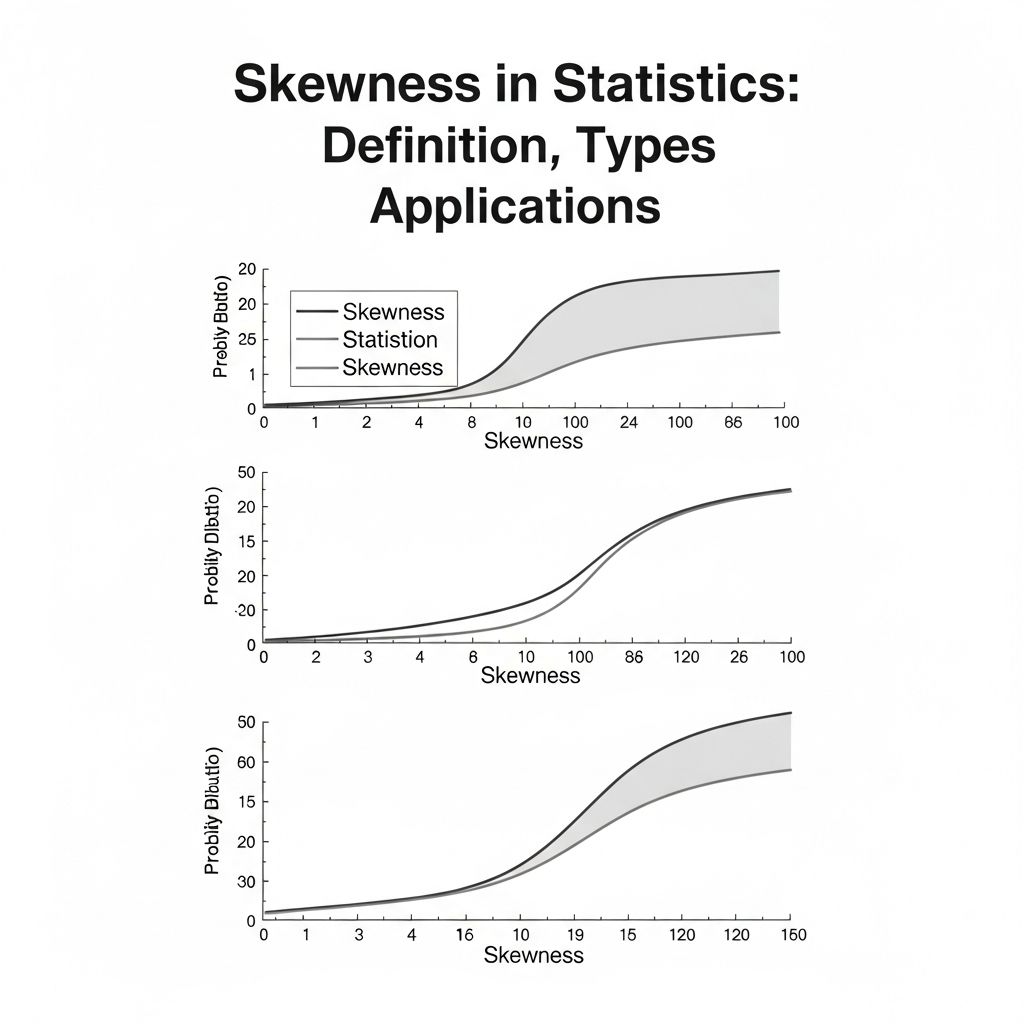
What is Skewness?
Skewness is a statistical measure that quantifies the asymmetry of a probability distribution around its mean. In simpler terms, it describes how the data in a distribution tails off on either side of the center. Unlike a perfectly symmetrical distribution where data is evenly distributed on both sides of the mean, real-world data often exhibits asymmetry that can significantly impact analysis and decision-making.
In finance and investment analysis, skewness plays a crucial role in understanding return distributions. Most financial data, including stock returns and asset prices, do not follow a perfectly normal distribution. Understanding skewness helps investors and analysts better anticipate the likelihood of extreme outcomes—both positive and negative—beyond what standard measures like standard deviation alone can reveal.
Skewness is particularly important because it reveals information about the tail behavior of distributions. While variance measures the spread of data around the mean, skewness specifically captures the direction and extent of asymmetry. A distribution might have identical variances to another but very different skewness characteristics, leading to fundamentally different risk and return profiles.
Types of Skewness
Skewness manifests in two primary forms: positive skewness and negative skewness, each with distinct characteristics and implications.
Positive Skewness (Right Skew)
Positive skewness occurs when a distribution has a longer or fatter tail on the right side of the mean. In a positively skewed distribution, the mean is typically greater than the median, and the bulk of the data concentrates on the left side with outliers extending toward the right. This creates the characteristic appearance of a distribution that trails off toward higher values.
In financial contexts, positively skewed assets often represent opportunity for significant upside returns, though such opportunities may be infrequent. Investors frequently display a preference for positively skewed return profiles, as these distributions offer the potential for occasional large gains even if the average return is modest. Examples of positively skewed assets include initial public offerings (IPOs), which often feature winner-take-all economics, and venture capital investments, where most investments yield modest returns but occasional investments generate substantial profits.
Negative Skewness (Left Skew)
Negative skewness occurs when a distribution has a longer or fatter tail on the left side of the mean. In a negatively skewed distribution, the mean is typically less than the median, and the concentration of data occurs on the right side with outliers extending toward lower values. This pattern suggests a higher probability of negative outliers relative to positive ones.
Negatively skewed distributions are generally less attractive to investors as they suggest a higher likelihood of significant downside outcomes. However, understanding negative skewness is essential for risk management, as it indicates where potential losses may be concentrated in a portfolio.
Measuring Skewness
Several mathematical approaches exist for measuring skewness, each with particular applications and advantages.
Pearson’s Coefficient of Skewness
One traditional method is the nonparametric measure defined as ( (mu – u) / sigma ), where ( mu ) represents the mean, ( u ) represents the median, and ( sigma ) represents the standard deviation. This formula provides an intuitive relationship: when the mean exceeds the median, the distribution exhibits positive skew, and when the mean is less than the median, negative skew is indicated.
Groeneveld and Meeden’s Coefficient
An alternative approach, proposed by Groeneveld and Meeden, uses the formula ( operatorname{skew}(X) = frac{mu – u}{operatorname{E}(|X – u|)} ), where the denominator represents the expected absolute deviation from the median. This measure offers greater robustness to outliers compared to traditional methods.
The Medcouple
The medcouple represents a more sophisticated, scale-invariant robust measure of skewness. It features a breakdown point of 25%, meaning that up to 25% of the data can be arbitrary before the measure becomes unreliable. This robustness makes it particularly valuable for analyzing datasets with potential outliers or measurement errors.
Important Limitations of Skewness
While skewness provides valuable insights, it has significant limitations that practitioners must understand:
Sensitivity to Outliers
Skewness measures are highly sensitive to extreme values in the dataset. A single outlier can substantially alter the skewness calculation, potentially misrepresenting the overall asymmetry of the distribution. This sensitivity means that skewness estimates require very large quantities of data to achieve accuracy.
Mean-Median Relationship Misconceptions
A common misconception holds that under positive skew the mean is always to the right of the median, and under negative skew the mean is always to the left. In reality, this relationship frequently fails, particularly in multimodal distributions, discrete distributions, or distributions where one tail is long while the other is fat. For instance, in the distribution of household sizes across U.S. residents, the skew is rightward, yet the mean falls in the heavier left tail because most households are smaller than the mode.
Incomplete Picture of Asymmetry
A zero skewness value does not necessarily indicate a symmetric distribution. A distribution can have zero skewness when one tail is long and thin while the other is short but fat, as these effects offset. Consequently, relying solely on skewness to assess distribution symmetry is risky; the actual shape of the distribution must be examined visually and through other statistical measures.
Skewness in Financial Markets
Skewness carries particular significance in portfolio management and asset pricing. Research demonstrates that investors systematically prefer positively skewed assets, even when these assets generate lower average returns. This preference can be explained through behavioral economics frameworks like Prospect Theory, which models decision-making under uncertainty more realistically than traditional expected utility theory.
Asset Pricing and Idiosyncratic Skewness
Under traditional expected utility frameworks, only systematic skewness—the contribution of an asset’s skewness to the overall portfolio’s skewness, termed co-skewness—should influence pricing. However, empirical evidence reveals that idiosyncratic skewness (an asset’s own skewness independent of the market) also significantly affects pricing. Positively skewed assets tend to be overpriced and deliver lower average returns, while negatively skewed assets tend to be underpriced and deliver higher average returns.
This pattern appears particularly strong among smaller-cap stocks, suggesting that individual investor preferences drive this phenomenon more than institutional investor behavior. The pricing of idiosyncratic skewness occurs through two mechanisms: investors willingly taking large undiversified positions in skewed assets, or investors evaluating holdings on an asset-by-asset basis rather than considering portfolio effects.
Examples of Skewed Asset Classes
Several asset classes demonstrate systematic skewness patterns. Initial public offerings typically exhibit positive skewness due to winner-take-all economics in underlying industries, combined with the fact that much of young firms’ value derives from future growth prospects resembling option-like payoffs. Distressed stocks and over-the-counter stocks similarly demonstrate positive skewness and below-average long-term returns. Venture capital investments exemplify this dynamic, where investors accept low average returns in exchange for positively skewed outcomes offering potential for exceptional gains.
Practical Applications and Considerations
Risk Management and Value-at-Risk
Skewness plays an important role in sophisticated risk management techniques. The Cornish-Fisher expansion uses skewness (along with other distribution characteristics) to obtain approximate probabilities and quantiles of distributions, including value-at-risk calculations used extensively in finance. Understanding skewness helps risk managers more accurately estimate the probability of extreme losses beyond what normal distribution assumptions would suggest.
Estimating Skewness Accurately
Because skewness is difficult to measure empirically with precision, practitioners benefit from incorporating theoretical predictions into their estimates. For example, if economic theory suggests that IPO stocks will exhibit positively skewed returns, this insight can inform skewness estimates. Additionally, cross-sectional approaches prove valuable: computing skewness across a group of similar assets provides better estimates of individual asset skewness than relying solely on that asset’s historical return series.
Frequently Asked Questions
Q: What does zero skewness mean?
A: Zero skewness indicates that a distribution is perfectly symmetric around the mean, with tails on both sides balancing out. However, zero skewness can also occur in asymmetric distributions where one tail is long and thin while the other is short but fat. Therefore, zero skewness alone does not guarantee perfect symmetry.
Q: Why do investors prefer positively skewed returns?
A: Prospect Theory and behavioral economics explain that investors are attracted to positively skewed return distributions because they offer occasional large gains despite lower average returns. This preference may have evolutionary roots and reflects psychological factors beyond traditional expected utility maximization. This preference is particularly strong among individual investors.
Q: How does skewness differ from standard deviation?
A: Standard deviation measures the spread or variability of data around the mean, treating deviations equally regardless of direction. Skewness specifically measures the asymmetry of the distribution, capturing whether the tail extends more toward higher or lower values. Two distributions can have identical standard deviations but very different skewness characteristics.
Q: Can skewness be negative?
A: Yes, skewness can be negative, zero, or positive. Negative skewness indicates a distribution with a longer tail on the left side, suggesting higher probability of downside outcomes. Positive skewness indicates a longer tail on the right side, suggesting potential for upside outliers.
Q: Why is skewness important in portfolio management?
A: Skewness reveals information about extreme outcomes beyond what variance alone can capture. In portfolio construction, understanding skewness helps managers assess tail risk, anticipate the probability of large gains or losses, and align asset selections with investor preferences for specific return distribution characteristics.
References
- Skewness | Man Group — Man Group. 2025. https://www.man.com/insights/skewness
- Skewness — Wikipedia — Wikimedia Foundation. 2025. https://en.wikipedia.org/wiki/Skewness
- Barberis, N., & Huang, M. — The Journal of Finance, 2008. Research on skewness preferences in asset pricing under Prospect Theory framework.
- Campbell, J. Y., Hilscher, J., & Szilagyi, J. — The Journal of Finance, 2008. Study on distressed stocks and return characteristics.
Similar Articles








Read full bio of medha deb