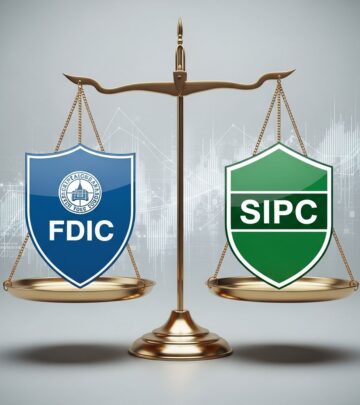
SIPC Protection: Safeguarding Investments
Discover how SIPC shields your brokerage assets from firm failure, with key limits and coverage details every investor needs to know.

The Securities Investor Protection Corporation (SIPC) serves as a critical safety net for investors whose brokerage firms encounter financial distress. Established to restore missing securities and cash when a member firm fails, SIPC steps in during rare brokerage insolvencies to protect customer assets up to specified limits. This protection applies specifically to custody failures, not market fluctuations or poor investment choices.
Understanding the Core Mission of SIPC
SIPC operates as a nonprofit, private membership organization, distinct from government insurance programs. Created under the Securities Investor Protection Act (SIPA), it mandates membership for most registered brokers and dealers. Its primary role activates when a brokerage cannot return customer property due to bankruptcy or liquidation, arranging transfers to solvent firms or compensating through trustees. Brokerage failures remain infrequent, with over 99% of eligible investors recovering assets fully.
SIPC’s fund derives from assessments on member firms, ensuring readiness without taxpayer funding. It coordinates with courts, the SEC, and self-regulatory bodies to oversee liquidations efficiently. Investors benefit from this structured process, which prioritizes returning securities in-kind or their cash equivalent.
Standard Coverage Limits and What They Include
Each eligible customer receives up to $500,000 in protection, encompassing securities and cash, with a $250,000 sub-limit for uninvested cash awaiting security purchases. Money market funds held as cash sweeps qualify as securities, extending to the full $500,000 limit rather than the cash cap.
Protection calculates per “separate capacity,” meaning distinct account types or ownership structures receive individual limits. This maximizes coverage for diversified holdings across qualifying accounts at the same firm.
| Asset Type | Coverage Amount | Notes |
|---|---|---|
| Securities (stocks, bonds, mutual funds, ETFs) | Up to $500,000 | Includes Treasury securities, CDs, options |
| Cash (uninvested) | Up to $250,000 | For funds awaiting investment |
| Money Market Funds | Up to $500,000 | Treated as securities |
Types of Accounts Protected by SIPC
SIPC safeguards a range of brokerage accounts held in separate capacities at member firms. Common examples include:
- Individual brokerage accounts owned solely by one person.
- Joint accounts co-owned by spouses or partners.
- Corporate or business accounts.
- Trust accounts established under state law.
- Individual Retirement Accounts (IRAs), including Roth IRAs.
- Estate accounts managed by executors.
- Guardian accounts for minors or wards.
Multiple traditional IRAs under one name at a single firm aggregate under one $500,000 limit, but IRAs at different firms or an IRA versus a joint account each qualify separately. Margin accounts do not create separate capacity and fall under the primary account’s limit. Non-member firms offer no protection, so verifying membership via SIPC’s database is essential.
Assets Covered Under SIPC Protection
SIPC protects standard securities and cash held for investment purposes. Protected assets encompass:
- Stocks and bonds.
- Mutual funds and exchange-traded funds (ETFs).
- Treasury securities and certificates of deposit.
- Options contracts, including calls, puts, and straddles.
- Cash balances intended for securities purchases.
This list focuses on registered securities; commodities, futures, or unregistered investment contracts fall outside scope. Unauthorized trades may qualify if proven, requiring prompt written complaints to brokers.
What SIPC Does Not Cover: Key Exclusions
SIPC addresses brokerage custody failures exclusively, excluding several common risks:
- Market losses: Declines in asset value due to volatility or bad decisions receive no coverage.
- Non-member firms: Assets at non-SIPC brokers lack protection.
- Investment performance guarantees: Promises of returns or advisory failures are unprotected.
- Certain contracts: Unregistered investment products or futures.
- Digital assets: Cryptocurrencies or non-security digital holdings typically excluded.
Investors must distinguish SIPC’s narrow role from broader risks, supplementing with diversification and due diligence.
SIPC vs. FDIC: Critical Differences for Investors
While SIPC protects brokerage accounts, FDIC insures bank deposits. Key distinctions include:
| Feature | SIPC | FDIC |
|---|---|---|
| Coverage Scope | Cash and securities in brokerages | Cash in banks |
| Limit | $500K ($250K cash) per separate capacity | $250K per depositor per bank |
| Trigger | Firm fails to custody assets | Bank failure |
| Market Loss Protection | No | Yes, principal + interest |
Brokerage cash often exceeds FDIC via SIPC, but bank CDs may dual-insure. Investors holding cash sweeps should confirm treatment.
The Process: How SIPC Handles Firm Failures
Upon a member firm’s distress, SIPC petitions courts for trusteeship, initiating liquidation or account transfers. Trustees verify claims, prioritizing customer property recovery. Investors receive securities certificates or market-value checks. The SEC oversees SIPC operations, with self-regulatory groups aiding inspections. Prompt reporting of issues accelerates resolutions.
Most cases resolve without loss, underscoring SIPC’s efficacy despite rare activations.
Verifying Brokerage Membership and Maximizing Protection
Confirm SIPC status via the official membership database or direct inquiry—firms must disclose non-membership. Strategies to enhance security:
- Split assets across firms for multiplied limits.
- Use separate-capacity accounts strategically.
- Avoid non-members and unregistered products.
- Monitor statements for unauthorized activity.
Excess coverage through private insurers may supplement SIPC limits at some firms.
Frequently Asked Questions (FAQs)
What triggers SIPC protection?
Protection activates if an SIPC-member brokerage fails and cannot return your cash or securities.
Does SIPC cover cryptocurrency?
No, SIPC generally excludes digital assets unless classified as registered securities.
Are joint accounts fully protected?
Yes, as separate capacity up to $500,000 total, not split per owner like FDIC.
Can I get more than $500,000 coverage?
Yes, via multiple separate capacities or different firms.
How do I check if my broker is SIPC-protected?
Use SIPC’s membership search tool or ask the firm directly.
Empowering Investors with Knowledge
Grasping SIPC’s parameters equips investors to navigate brokerage risks confidently. While not a panacea, its targeted safeguards preserve assets during institutional failures. Pairing SIPC awareness with prudent strategies fosters resilient portfolios.
References
- Securities Investor Protection Corporation (SIPC) — Investor.gov. 2023. https://www.investor.gov/introduction-investing/investing-basics/glossary/securities-investor-protection-corporation-sipc
- What is SIPC coverage and how does it work? — Fidelity Investments. 2024-01-15. https://www.fidelity.com/learning-center/smart-money/sipc
- What is SIPC? — SIPC.org. 2025. https://www.sipc.org/for-investors/introduction
- SIPC Insurance: What It Is, What It Covers — NerdWallet. 2024-06-10. https://www.nerdwallet.com/investing/learn/sipc-insurance-what-it-does-and-does-not-protect
- Securities Investor Protection Act (SIPA) — United States Courts. 2023-11-20. https://www.uscourts.gov/court-programs/bankruptcy/bankruptcy-basics/securities-investor-protection-act-sipa
- Understanding the Securities Investor Protection Corporation (SIPC) — Cetera Investment Services. 2024. https://cetera.com/cetera-investment-services/disclosures/understanding-the-securities-investor-protection-corporation-(SIPC)
- What Is The Securities Investor Protection Corporation? — SIPC.org. 2025. https://www.sipc.org/video
Similar Articles








Read full bio of medha deb