Single-Step vs Multi-Step Income Statement
Understand the key differences between single-step and multi-step income statements for better financial analysis.
Understanding Income Statements: Single-Step vs Multi-Step
Income statements, also known as profit and loss statements, are fundamental financial documents that every business prepares to measure profitability over a specific period. These statements reveal whether a company has made a profit or suffered a loss by comparing total revenues against total expenses. However, not all income statements are created equal. Two primary formats exist for presenting this crucial financial information: the single-step income statement and the multi-step income statement. Each approach offers distinct advantages and serves different business needs, making it essential for business owners and financial professionals to understand the key differences between them.
What is a Single-Step Income Statement?
A single-step income statement represents the simplest approach to presenting a company’s financial performance. This format uses one straightforward calculation to determine net income by subtracting total expenses and losses from total revenues and gains. The fundamental equation is remarkably straightforward:
Net Income = (Revenues + Gains) – (Expenses + Losses)
The single-step format combines all revenue sources into one category and groups all expenses into another category. This creates a streamlined presentation that requires minimal calculation steps, making it ideal for businesses seeking quick profitability snapshots without extensive financial detail.
Components of a Single-Step Income Statement
The single-step income statement typically includes two main sections:
Revenues and Gains: This section aggregates all income sources, including sales revenue, service income, interest earned, gains on asset sales, and any other profits regardless of their origin or nature.
Expenses and Losses: This section lists all costs associated with business operations, including cost of goods sold (COGS), salaries, rent, utilities, marketing expenses, depreciation, and any losses incurred during the period.
What is a Multi-Step Income Statement?
A multi-step income statement provides a significantly more detailed analysis of a company’s financial performance. Unlike its single-step counterpart, the multi-step format employs multiple calculation steps to arrive at net income, separating operational activities from non-operational activities. This comprehensive approach allows stakeholders to understand not just the final profit figure, but also how that profit was generated through various business operations.
The Three-Step Process
The multi-step income statement follows a distinct three-step calculation process:
Step 1: Calculate Gross Profit by subtracting cost of goods sold from net sales revenue.
Step 2: Calculate Operating Income by subtracting operating expenses from gross profit.
Step 3: Calculate Net Income by adjusting operating income for non-operating revenues, expenses, gains, and losses.
Components of a Multi-Step Income Statement
The multi-step income statement includes several distinct components that provide detailed financial insights:
Gross Profit: Determined by deducting cost of goods sold from total sales revenue, gross profit demonstrates how efficiently the company’s core operations generate income from product sales or primary business activities.
Operating Income: This figure represents profitability from routine business operations, calculated by subtracting operating expenses (such as selling, general, and administrative expenses) from gross profit. Operating income excludes the effects of financing and investment activities.
Non-Operating Activities: This section includes revenues, expenses, gains, and losses unrelated to core business operations, such as interest income, investment gains or losses, and other miscellaneous items.
Key Differences Between Single-Step and Multi-Step Income Statements
| Aspect | Single-Step Income Statement | Multi-Step Income Statement |
|---|---|---|
| Structure | Simple format with one calculation step | Complex format with multiple calculation steps |
| Calculation Method | Total revenues minus total expenses in one operation | Revenues separated into operating and non-operating categories with multiple subtractions |
| Gross Profit Display | Not shown as a separate line item | Displayed as a distinct subtotal |
| Operating Income | Not separately calculated or displayed | Shown as a distinct line item |
| Expense Categorization | All expenses listed together without distinction | Expenses clearly separated by type and function |
| Complexity | Easier to prepare and understand | More detailed and requires additional calculations |
| Best For | Small businesses with simple operations | Larger companies and those requiring detailed analysis |
Format and Presentation Differences
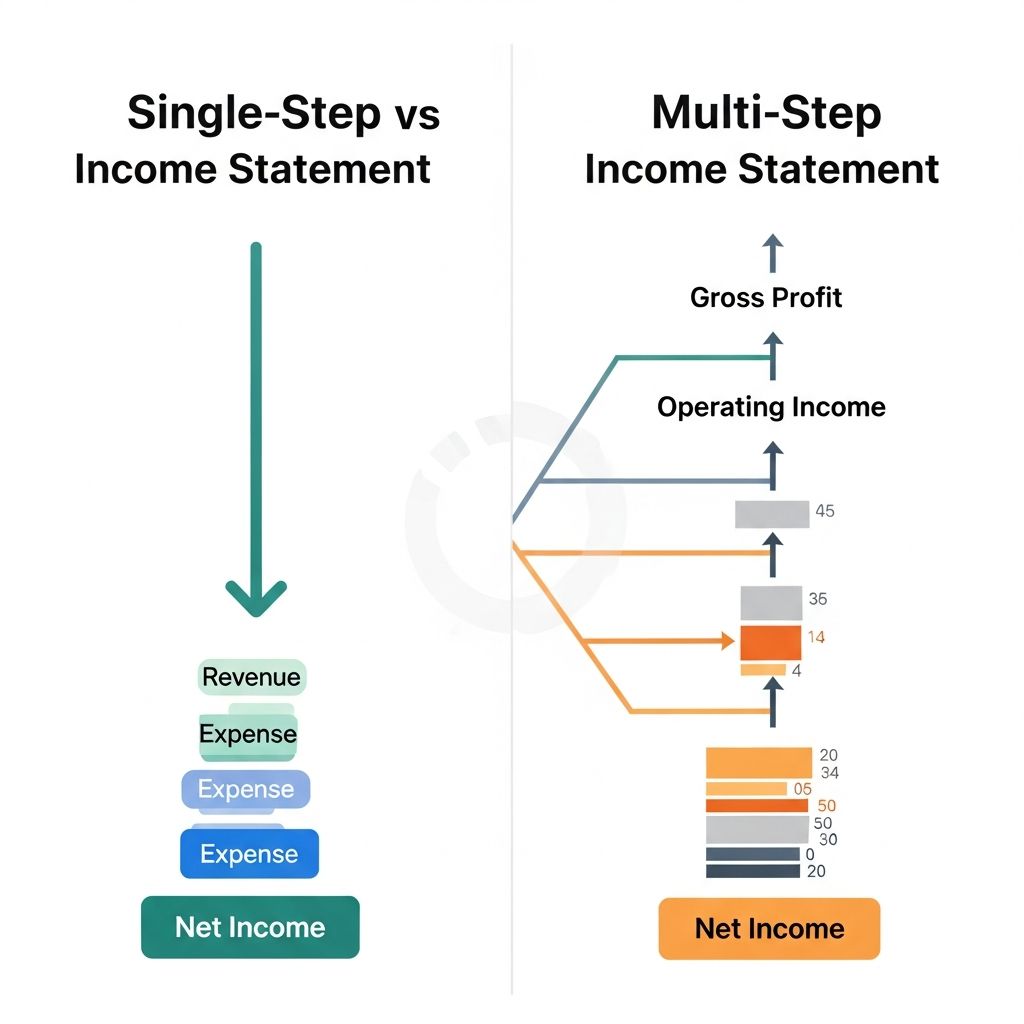
The presentation format of these two income statements reveals their fundamental philosophical differences. A single-step income statement presents information in a highly condensed manner, using a single subtotal for all revenue items and another single subtotal for all expense items, with net profit or loss appearing at the bottom. This clean, minimalist approach makes it easy to see the bottom line result quickly.
The multi-step income statement, by contrast, presents information in a cascading format, with each calculation step building on the previous one. This format allows readers to see intermediate profitability metrics at each stage, understanding how gross profit eventually becomes operating income and finally net income. The visual presentation itself tells a more complete financial story.
Revenue and Expense Reporting
Single-Step Approach
In a single-step income statement, revenue reporting is straightforward. All revenue is typically reported as a single line item titled “Total Revenue,” which combines sales revenue, service income, investment income, and other revenue sources without distinction. Similarly, all expenses are listed together in one section, often categorized by type (rent, salaries, advertising) but not distinguished by their operational nature or relationship to core business activities.
Multi-Step Approach
The multi-step income statement takes a more sophisticated approach to revenue and expense reporting. Operating revenue (generated from core business activities) is clearly separated from non-operating revenue (such as interest income or gains on asset sales). Expenses are similarly categorized into cost of goods sold, operating expenses, and non-operating expenses. This segmentation provides a nuanced view of where a company’s income originates and how its expenses are structured, offering valuable insights into business efficiency and operational performance.
Advantages and Disadvantages
Single-Step Income Statement Advantages
The single-step income statement offers several compelling advantages. Its simplicity makes it easy to prepare, requiring minimal calculations and less accounting expertise. For small business owners managing their finances, this straightforward format reduces complexity and potential for calculation errors. The format provides quick profitability snapshots that clearly show whether the business is profitable without requiring extensive analysis. Additionally, for businesses with uncomplicated operations and limited stakeholder groups, the single-step format typically provides all necessary financial information for decision-making.
Single-Step Income Statement Disadvantages
Despite its simplicity, the single-step income statement has notable limitations. It provides limited insight into operational efficiency because gross profit is not separately calculated. Business analysts cannot determine how well the company’s core operations are performing relative to other income sources. The format also fails to distinguish between operating and non-operating activities, making it difficult to assess the sustainability of earnings from core business operations versus one-time gains or losses.
Multi-Step Income Statement Advantages
The multi-step income statement excels at providing detailed financial analysis. By calculating and displaying gross profit, it shows precisely how efficiently the company manufactures or acquires products and generates revenue from core operations. Operating income measurement allows stakeholders to evaluate the profitability of regular business operations independent of financing decisions or investment activities. This format facilitates trend analysis and long-term planning by providing multiple profitability metrics. The detailed breakdown also aids in identifying problem areas within the business and opportunities for improvement. For companies seeking financing, investors, or conducting business evaluations, the multi-step format provides the comprehensive information these stakeholders require.
Multi-Step Income Statement Disadvantages
The primary disadvantage of the multi-step income statement is its increased complexity. More calculations are required, and the format is more time-consuming to prepare. Individuals without strong accounting knowledge may find the format confusing, and the additional detail, while valuable, can overwhelm readers seeking only basic profitability information. The format also requires greater accounting expertise to prepare accurately.
Which Format Should Your Business Use?
Selecting between single-step and multi-step income statements depends on several factors unique to your business situation.
Single-Step is Ideal For:
Small businesses with straightforward operations, including sole proprietorships and partnerships, typically benefit from single-step income statements. Businesses with uncomplicated revenue streams and standardized expenses find this format sufficient. Additionally, businesses operating primarily in service industries where gross profit distinction is less meaningful may find the single-step format adequate. When financial statements are prepared primarily for internal management purposes and stakeholders do not require extensive financial detail, the single-step format provides all necessary information efficiently.
Multi-Step is Ideal For:
Larger companies with complex operations benefit significantly from multi-step income statements. Retail and manufacturing companies, which have distinct cost of goods sold that should be separated from operating expenses, find the multi-step format essential. Businesses preparing financial statements for external stakeholders—such as banks, investors, or potential acquirers—should use the multi-step format. Companies requiring detailed analysis of operational performance, trend analysis, or benchmarking against industry standards benefit from the additional detail the multi-step format provides. Additionally, businesses with significant non-operating income or expenses find the multi-step format particularly valuable for distinguishing these items from core operational results.
Frequently Asked Questions
Q: Can a single-step income statement show the same net income as a multi-step income statement?
A: Yes, absolutely. Both formats arrive at the same net income figure. The difference lies in how they present the path to that final number, not in the final result itself. The single-step uses one calculation, while the multi-step uses multiple steps, but both ultimately show the same bottom-line profit or loss.
Q: How does gross profit help in business analysis?
A: Gross profit, visible only in multi-step income statements, reveals how efficiently a company manufactures or purchases products and sells them. By comparing gross profit to net sales, business analysts can assess production efficiency and pricing strategy. A declining gross profit margin may indicate rising production costs or pricing pressure, signaling potential operational problems.
Q: Is the single-step income statement acceptable for bank loans or investor presentations?
A: While not preferred, a single-step income statement may be acceptable for small business loans from local banks familiar with the business. However, for significant financing, investment capital, or business acquisitions, most financial institutions and investors expect or require a multi-step income statement that provides detailed operational analysis.
Q: How frequently should income statements be prepared?
A: Most businesses prepare income statements monthly for internal management purposes and quarterly or annually for external reporting and tax purposes. Some rapidly changing businesses or those under investor scrutiny may prepare weekly or even daily statements for management review.
Q: Can a business switch between single-step and multi-step formats?
A: Yes, businesses can transition between formats as their complexity grows. As a small business expands and requires more detailed financial analysis, switching from single-step to multi-step income statements is both practical and common. However, for consistency and comparability, businesses typically maintain the same format across multiple reporting periods.
Conclusion
Understanding the differences between single-step and multi-step income statements is crucial for making informed financial decisions. The single-step income statement provides a simplified, quick snapshot of profitability suitable for small businesses with uncomplicated operations. Its ease of preparation and straightforward presentation make it accessible to business owners without extensive accounting expertise. However, as businesses grow in complexity, the multi-step income statement becomes increasingly valuable for its detailed analysis of operational performance, expense categorization, and stakeholder communication.
The multi-step format’s ability to distinguish gross profit from operating income and separate operational from non-operational activities provides insights that support strategic decision-making, performance analysis, and long-term planning. For larger businesses, those seeking external financing, or those preparing for acquisition or investment, the multi-step format is typically essential.
Ultimately, the choice between these formats should align with your business’s size, complexity, operational structure, and stakeholder requirements. Many businesses may benefit from preparing both formats internally—using the single-step for quick reference and the multi-step for detailed analysis—thereby leveraging the strengths of each approach. By selecting the appropriate income statement format for your specific business needs, you ensure that your financial reporting provides the clarity and insight necessary for sound business management.
References
- Differences between Single-Step Vs. Multiple Step Income Statement — AI Countly. 2025. https://www.aicountly.com/help/learning/differences-between-single-step-vs-multiple-step-income-statement/
- Single Step vs Multi Step Income Statement: A Guide for Small Businesses — Taxfyle. 2025. https://www.taxfyle.com/blog/single-step-vs-multi-step-income-statement
- Guide to Single-Step and Multi-Step Income Statements — SoFi Learn. 2025. https://www.sofi.com/learn/content/multi-step-income-statement/
- Single-Step vs Multi-Step Income Statement — FreshBooks. 2025. https://www.freshbooks.com/hub/accounting/single-step-vs-multi-step-income-statement
- Describe and Prepare Multi-Step and Simple Income Statements for Merchandising Companies — LibreTexts. 2025. https://biz.libretexts.org/Bookshelves/Accounting/Financial_Accounting_(OpenStax)/06:_Merchandising_Transactions/6.06:_Describe_and_Prepare_Multi-Step_and_Simple_Income_Statements_for_Merchandising_Companies
Similar Articles








Read full bio of Sneha Tete