Simple vs Compound Interest: Complete Guide
Master the difference between simple and compound interest and grow your wealth.
Understanding Simple and Compound Interest
Interest is one of the fundamental concepts in finance and investing. Whether you’re saving money in a bank account, investing in stocks, or borrowing money for a loan, understanding how interest works is essential to making informed financial decisions. There are two primary types of interest calculations: simple interest and compound interest. While they may sound similar, they operate quite differently and can significantly impact your financial outcomes over time.
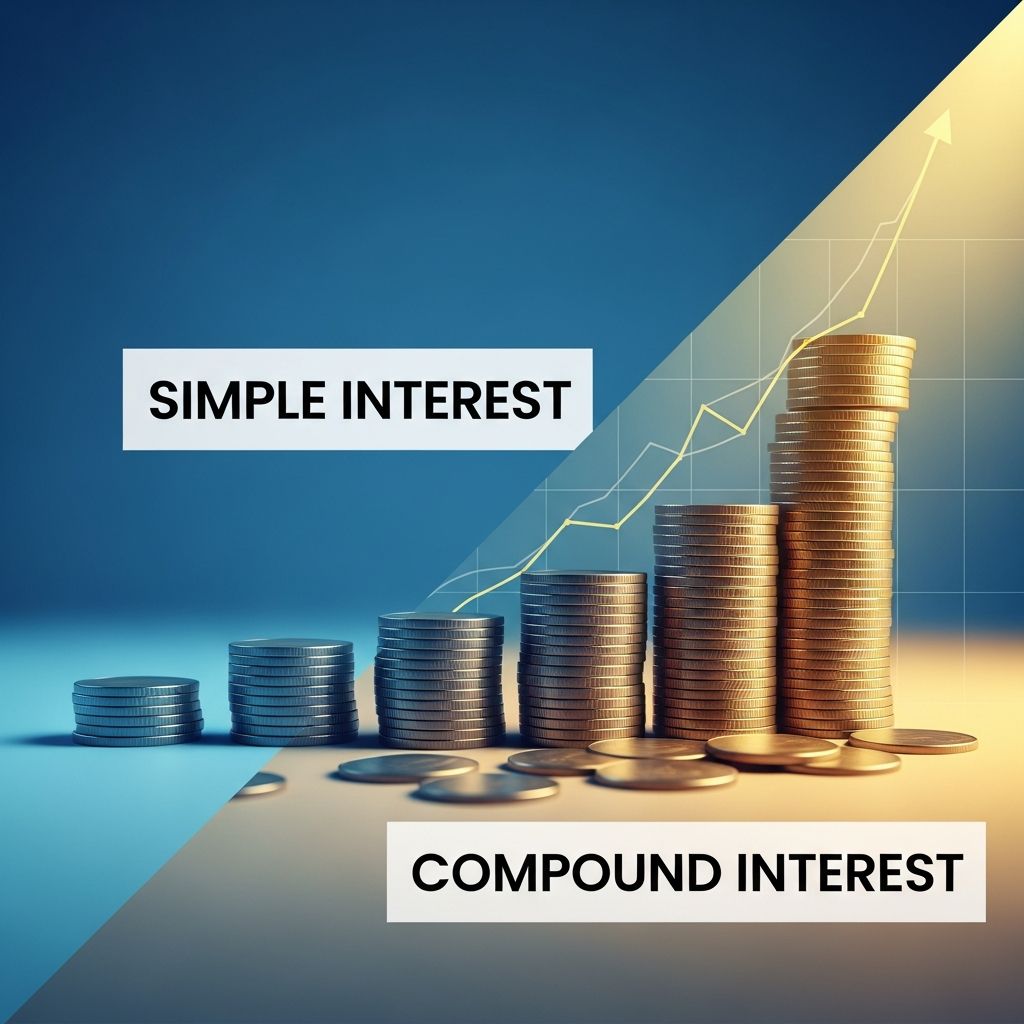
Simple interest is calculated only on the principal amount—the original sum of money you invested or borrowed. Compound interest, on the other hand, is calculated on both the principal and the accumulated interest from previous periods. This fundamental difference creates what many consider one of the most powerful concepts in finance: the exponential growth potential of compound interest.
What Is Simple Interest?
Simple interest is the most straightforward form of interest calculation. It is calculated only on the original principal amount, regardless of how many time periods pass. The formula for simple interest is:
Simple Interest = Principal × Interest Rate × Time
In simple interest scenarios, the interest you earn remains constant each period. This means if you invest $10,000 at a 5% simple interest rate for three years, you would earn $500 each year ($10,000 × 0.05 = $500). Over three years, your total interest earnings would be $1,500 ($500 × 3), resulting in a final balance of $11,500.
The straightforward nature of simple interest makes it easy to calculate and understand. However, this predictability also means your money grows at a slower rate compared to compound interest. Simple interest is commonly used for short-term loans, bonds with fixed coupon payments, and some savings accounts.
What Is Compound Interest?
Compound interest is often referred to as “interest on interest.” With compound interest, you earn returns not only on your principal investment but also on all the accumulated interest from previous periods. This creates a snowball effect where your money grows exponentially over time.
The power of compound interest becomes especially pronounced over longer time periods. As the amount of earned interest grows larger, the effect of compounding becomes increasingly powerful, creating substantial wealth accumulation for patient investors.
To illustrate how compound interest works, consider the same $10,000 investment at 5% interest compounded annually over three years:
- Year 1: You earn 5% on $10,000, which equals $500. Your balance becomes $10,500.
- Year 2: You earn 5% on $10,500 (not just the original $10,000), which equals $525. Your balance becomes $11,025.
- Year 3: You earn 5% on $11,025, which equals $551.25. Your balance becomes $11,576.25.
Over three years with compound interest, you earn a total of $1,576.25 in interest, compared to $1,500 with simple interest. While the difference of $76.25 may seem modest in this short timeframe, the advantage of compound interest becomes dramatically more significant over decades of investing.
Simple Interest vs. Compound Interest: Key Differences
Understanding the key differences between simple and compound interest is crucial for making smart financial decisions:
| Feature | Simple Interest | Compound Interest |
|---|---|---|
| Calculation Base | Principal only | Principal plus accumulated interest |
| Growth Pattern | Linear (same amount each period) | Exponential (accelerating growth) |
| Formula | I = P × r × t | A = P(1 + r/n)^(nt) |
| Long-term Returns | Lower returns | Significantly higher returns |
| Typical Uses | Short-term loans, some bonds | Savings accounts, investments, retirement accounts |
| Time Value Impact | Minimal over short periods | Dramatic over extended periods |
The Power of Compounding Over Time
One of the most striking aspects of compound interest is how dramatically it outpaces simple interest as time progresses. Consider an investor who invests $1,000 at an 8% annual return over 35 years—a typical professional career length.
With simple interest, the investor would earn exactly $280 each year ($1,000 × 0.08), resulting in a total of $9,800 in interest over 35 years, with a final balance of $10,800.
With compound interest, the same $1,000 investment grows exponentially. After the first year, the balance is $1,080. After the second year, with an 8% return on $1,080, the balance becomes $1,166.40—already $6.40 more than simple interest would have provided. This gap continues to widen exponentially. Over a full 35-year career, the power of compound interest transforms this investment into tens of thousands of dollars.
This demonstrates why Einstein allegedly called compound interest “the eighth wonder of the world.” The longer your money compounds, the more dramatic the results become. This principle is foundational to long-term wealth building and retirement planning.
How Compounding Frequency Affects Returns
The frequency with which interest is compounded significantly impacts your returns. Interest can be compounded annually, semi-annually, quarterly, monthly, daily, or even continuously. More frequent compounding results in higher returns because you earn interest on a larger accumulated total more often.
For example, if your bank compounds interest daily instead of annually, you’ll earn slightly more because each day’s interest calculation includes all previously earned interest. Over years and decades, this difference becomes substantial. When evaluating savings accounts or investment options, always pay attention to the compounding frequency, as it directly affects your wealth accumulation.
Real-World Applications of Compound Interest
Compound interest isn’t just a theoretical concept—it’s fundamental to numerous real-world financial situations:
Savings Accounts and Certificates of Deposit
Most savings accounts use compound interest to reward depositors. By keeping your money in these accounts over extended periods, you benefit from compounding returns, though current interest rates vary based on economic conditions.
Investment Accounts and Mutual Funds
When you invest in mutual funds or other securities, your returns compound over time. If you reinvest dividends and capital gains rather than withdrawing them, compound interest accelerates your wealth accumulation significantly.
Retirement Accounts
401(k)s, IRAs, and other retirement accounts are specifically designed to leverage compound interest over decades. Starting early—even in your teens or twenties—allows decades of compounding to work in your favor, potentially resulting in substantial retirement savings.
Mortgage and Loan Interest
While compound interest works in your favor for investments, it works against you with loans. Creditors use compound interest calculations, meaning you pay interest on accumulated interest, making early repayment beneficial.
Starting Early: The Compound Interest Advantage
Perhaps the most important lesson about compound interest is the advantage of starting early. Because compounding requires time to demonstrate its exponential power, beginning to invest in your teenage years or early twenties, even with small amounts, can result in dramatically larger wealth by retirement than starting later with larger amounts.
Consider a high school student who invests modest summer earnings in a diversified mutual fund. Even without regular contributions, that initial investment compounds over 35+ years of a professional career. The earlier you start, the more time your money has to work for you through the power of compounding.
If you’re nervous about investing and worried about losing money in the market, that concern is valid. However, starting early allows you to benefit from compound interest even if you make conservative investment choices. The key is to begin as soon as your financial situation permits and choose passive investment options like mutual funds if you’re uncomfortable actively selecting individual stocks and bonds.
Strategies to Maximize Compound Interest
To truly harness the power of compound interest, consider these strategies:
Reinvest Your Earnings
Rather than withdrawing interest, dividends, or capital gains, reinvest them back into your account. This ensures that your compound interest calculations include these earnings, accelerating overall growth.
Maintain Consistent Contributions
Regular, consistent investments allow compound interest to work on an ever-growing principal base. Even small monthly contributions compound dramatically over decades.
Choose Tax-Advantaged Accounts
Maximize contributions to 401(k)s, IRAs, and other tax-advantaged accounts where your money can compound without the drag of annual taxes.
Invest in Diversified Portfolios
Select well-diversified investment options, such as mutual funds that own stocks across different industries and asset classes, to balance risk while allowing compound returns.
Minimize Withdrawals
Avoid withdrawing money from investment accounts before retirement. Each withdrawal reduces the principal amount subject to compounding, significantly impacting long-term returns.
The Role of Inflation and Real Returns
While compound interest helps your money grow, it’s important to consider inflation’s impact on your purchasing power. Most savings accounts earn interest rates lower than inflation rates, meaning your real purchasing power actually decreases over time, even though your account balance increases nominally.
This is why investing—where you can potentially earn returns exceeding inflation rates—is crucial for long-term wealth building. By investing in stocks, bonds, and other assets through diversified mutual funds or individual security selection, you increase the likelihood that your returns will outpace inflation and build genuine wealth.
Frequently Asked Questions
Q: What is the difference between simple and compound interest?
A: Simple interest is calculated only on the principal amount, resulting in consistent interest payments each period. Compound interest is calculated on both the principal and accumulated interest, creating exponential growth over time.
Q: Why is compound interest called the eighth wonder of the world?
A: Compound interest is powerful because it creates exponential wealth growth over time. Even modest investments can grow into substantial sums through decades of compounding, making it an incredibly effective wealth-building tool.
Q: How does compounding frequency affect my returns?
A: More frequent compounding (daily, monthly, or quarterly) results in higher returns than less frequent compounding (annual). Each compounding period earns interest on a larger accumulated total, accelerating growth.
Q: When should I start investing to benefit from compound interest?
A: The earlier you start, the better. Even small investments made in your teens or twenties can grow into substantial wealth by retirement due to decades of compounding. Starting early is more valuable than starting late with larger amounts.
Q: Can compound interest work against me?
A: Yes. With loans and credit card debt, compound interest works against you, meaning you pay interest on accumulated interest. This is why paying off high-interest debt quickly is important.
Q: Should I reinvest my earnings or withdraw them?
A: Reinvesting earnings maximizes compound interest because your calculations include the reinvested earnings. Withdrawing reduces the principal available for compounding, slowing long-term growth.
Q: What’s the best way to start investing if I’m nervous about the market?
A: Consider starting with diversified mutual funds or index funds through a brokerage account. These passive investments let professionals select assets for you, reducing decision anxiety while allowing you to benefit from compound interest.
References
- What Is Compound Interest? — Investopedia. 2013-08-22. https://www.investopedia.com/video/play/compound-interest/
- The Power of Compound Interest — University of Pennsylvania. 2020-10-14. https://srfs.upenn.edu/financial-wellness/blog/power-compound-interest
- Understanding The Time Value Of Money — Investopedia. https://www.investopedia.com/articles/03/082703.asp
Similar Articles








Read full bio of medha deb