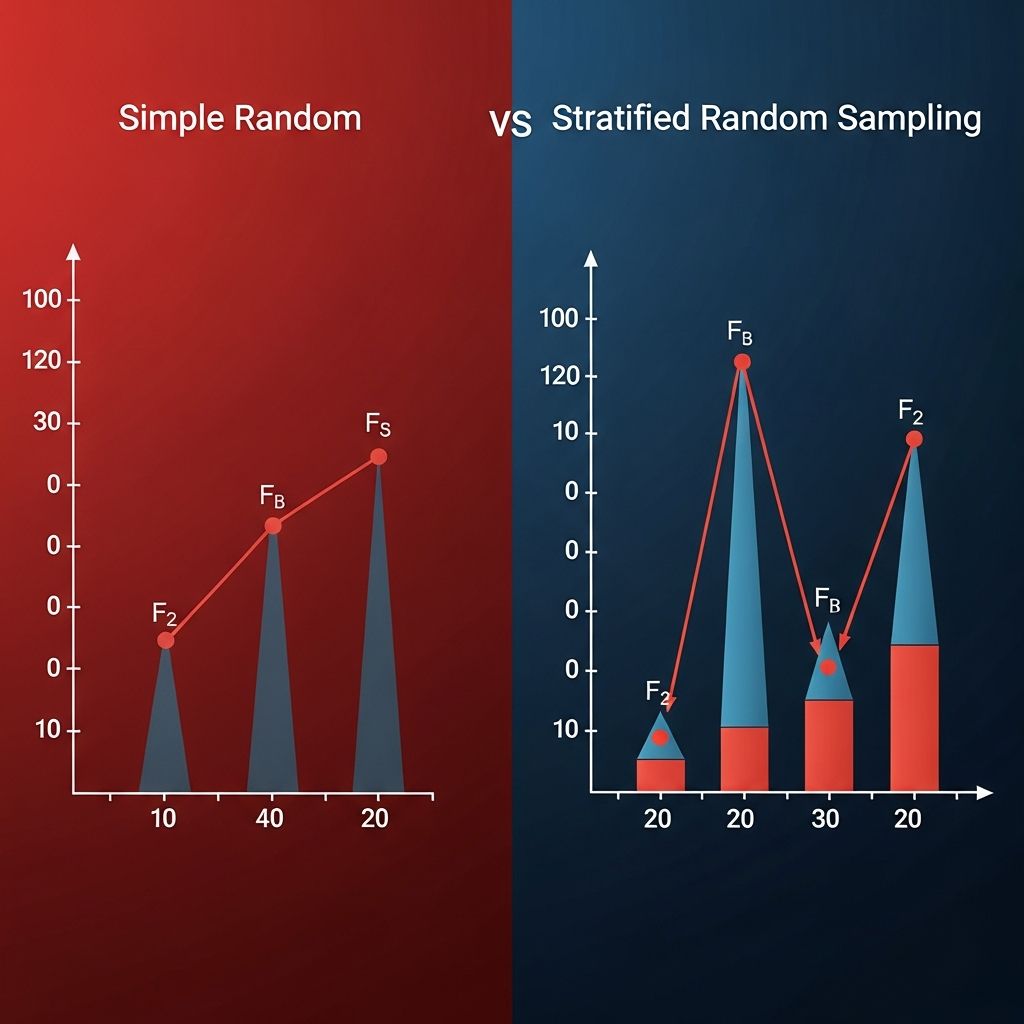
Simple Random vs Stratified Random Sampling
Master the key differences between simple and stratified random sampling methods for accurate statistical analysis.
Understanding Simple Random Sampling and Stratified Random Sampling
Sampling is a fundamental technique in statistics and research that allows analysts to draw conclusions about an entire population by examining a representative subset. Two of the most widely used sampling methods are simple random sampling and stratified random sampling. While both techniques aim to produce unbiased and representative samples, they differ significantly in their methodology, application, and effectiveness in different contexts. Understanding these differences is crucial for researchers, analysts, and statisticians who need to select the most appropriate sampling method for their specific research objectives.
What is Simple Random Sampling?
Simple random sampling is one of the most straightforward and theoretically ideal sampling methods. In this approach, every member or element of the population has an equal probability of being selected for the sample. The method involves creating a complete list of all population members, known as a sampling frame, and then using random number generators or other randomization techniques to select individuals from this list.
The primary advantage of simple random sampling is that it produces an unbiased sample that theoretically represents the population in an objective manner. Since each member has an identical chance of selection, there is no systematic bias introduced into the sampling process. This makes simple random sampling particularly valuable when the population is relatively homogeneous, meaning that members share similar characteristics and there are no significant subgroups within the population.
However, simple random sampling has notable limitations. It can be difficult and expensive to implement when dealing with large populations or dispersed populations. Additionally, if the population contains distinct subgroups with markedly different characteristics, simple random sampling may fail to adequately represent all segments of the population. Minority groups or smaller segments might become underrepresented in the final sample, leading to skewed results that do not accurately reflect the entire population.
What is Stratified Random Sampling?
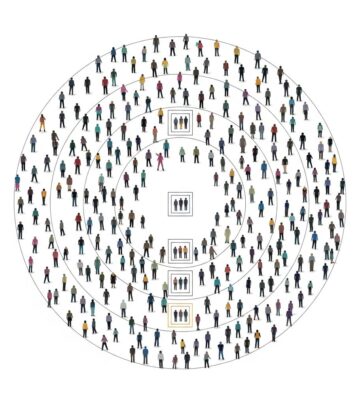
Stratified random sampling is a more sophisticated sampling technique designed to address the limitations of simple random sampling, particularly when dealing with heterogeneous populations. In stratified random sampling, the population is first divided into separate groups called strata (the singular form is stratum). Each stratum comprises elements that share a common characteristic that distinguishes them from other groups.
Once the population has been divided into strata, a simple random sample is taken from within each stratum independently. These individual samples are then combined to form the overall final sample. The key distinction is that the number of members selected from each stratum typically corresponds to the stratum’s size relative to the total population, ensuring that each segment is represented proportionally in the final sample.
Stratified random sampling is particularly appropriate for large populations that are heterogeneous in nature, containing distinct subgroups with different characteristics. Common stratification variables include age, gender, income level, education, geographic location, occupation, ethnicity, or any other relevant demographic or characteristic factor. This method ensures that different segments within the population are equally and adequately represented in the sample, preventing the underrepresentation of minority groups or smaller population segments.
Key Differences Between the Two Methods
While both simple random sampling and stratified random sampling are types of random sampling that aim to produce representative samples, they differ in several fundamental ways:
| Characteristic | Simple Random Sampling | Stratified Random Sampling |
|---|---|---|
| Population Division | Population is treated as a single, undivided unit | Population is divided into distinct subgroups (strata) |
| Selection Process | Each member selected directly from the entire population | Members selected from within each stratum separately |
| Best For | Homogeneous populations with similar characteristics | Heterogeneous populations with distinct subgroups |
| Implementation Complexity | Relatively simple and straightforward | More complex and requires detailed population knowledge |
| Representation of Minorities | Minority groups may be underrepresented | All subgroups are adequately represented |
| Bias Risk | Lower bias for homogeneous populations | Effectively reduces bias in heterogeneous populations |
| Cost and Resources | Generally less expensive to implement | More resource-intensive and time-consuming |
Practical Example of Stratified Random Sampling
To illustrate how stratified random sampling works in practice, consider the following scenario: An advertising firm wants to determine the extent to which they should emphasize television advertisements in a district. They decide to conduct a survey to estimate the mean number of hours spent by households watching television per week.
The district consists of three distinct towns with different demographic characteristics:
- Town A: An urbanized area adjacent to a major factory where most residents work. The population is primarily composed of working adults with school-aged children.
- Town B: An urbanized area that mainly harbors retired individuals with different media consumption patterns.
- Town C: A rural area where most people practice agriculture and may have different television watching habits than urban residents.
The town distribution is as follows: Town A has 160 households, Town B has 60 households, and Town C has 80 households, for a total of 300 households in the district. Given the significant differences in the composition and characteristics of each region, the firm decides to use stratified random sampling to draw a sample of 50 households, taking the total number of families in each stratum into account.
To determine how many households should be sampled from each region, the firm applies the stratified sampling formula:
Number of households in sample = (Number of households in region / Total number of households) × Required sample size
Applying this formula:
- Town A: (160/300) × 50 = 26.67 ≈ 27 households
- Town B: (60/300) × 50 = 10 households
- Town C: (80/300) × 50 = 13.33 ≈ 13 households
The total sample comprises 50 households (27 + 10 + 13), with each stratum represented proportionally to its size in the population. This approach ensures that the television viewing habits of all three community types are adequately captured in the analysis.
Advantages and Disadvantages
Advantages of Simple Random Sampling
- Produces unbiased samples with no systematic errors introduced by the selection process
- Theoretically ideal and straightforward to understand and explain
- Requires less prior knowledge about the population structure
- Generally more cost-effective and faster to implement
- Well-suited for homogeneous populations
Disadvantages of Simple Random Sampling
- May result in underrepresentation of minority groups or smaller population segments
- Difficult and expensive to implement with large or geographically dispersed populations
- Requires a complete and accurate sampling frame
- Less effective for heterogeneous populations with distinct subgroups
- May produce less precise estimates when population contains significant variation
Advantages of Stratified Random Sampling
- Ensures all population subgroups are adequately and proportionally represented
- Reduces sampling error and increases precision of estimates
- Prevents underrepresentation of minority groups
- Particularly effective for heterogeneous populations
- Can produce more representative and reliable results
Disadvantages of Stratified Random Sampling
- More complex to design and implement than simple random sampling
- Requires detailed prior knowledge about the population structure
- More time-consuming and resource-intensive
- Requires identification of appropriate stratification variables
- More expensive than simple random sampling methods
When to Use Each Method
Use Simple Random Sampling when: The population is relatively homogeneous with similar characteristics across all members. The population is not geographically dispersed and a complete sampling frame is readily available. Cost and implementation speed are primary concerns. The research question does not require specific representation of subgroups. You need a theoretically unbiased approach with minimal administrative complexity.
Use Stratified Random Sampling when: The population is heterogeneous with distinct and identifiable subgroups. Accurate representation of all population segments is essential for the research objectives. Minority groups or smaller segments must be adequately represented. You have sufficient knowledge about relevant stratification variables. Resources are available for more complex sampling procedures. The precision of estimates is a priority over implementation simplicity.
Real-World Applications
In clinical research, stratified random sampling is frequently employed to ensure that different demographic groups are adequately represented in medical studies. Researchers might stratify by age, gender, disease severity, or socioeconomic status to ensure that study findings are applicable across diverse patient populations.
Market research firms often use stratified sampling to survey consumer satisfaction, ensuring that opinions from different customer segments, departments, or geographic regions are equally represented. Educational institutions might stratify by grade level, department, or socioeconomic background when conducting campus-wide surveys.
Government agencies and statistical organizations frequently employ stratified sampling in census activities and national surveys to ensure accurate representation of different population segments based on geographic location, income levels, or other demographic factors.
Frequently Asked Questions
Q: What is the main difference between simple and stratified random sampling?
A: The main difference is that simple random sampling treats the entire population as one unit and randomly selects members directly from it, while stratified random sampling first divides the population into subgroups (strata) based on specific characteristics, then randomly selects members from within each stratum to ensure proportional representation of all subgroups.
Q: Why might simple random sampling fail with heterogeneous populations?
A: Simple random sampling can result in underrepresentation of minority groups or smaller population segments because there is no guarantee that all subgroups will be adequately included in the sample. Stratified sampling prevents this by ensuring each stratum is represented proportionally.
Q: How do you determine how many samples to take from each stratum?
A: The number of samples from each stratum is typically determined proportionally based on the stratum’s size relative to the total population. The formula is: (Size of stratum / Total population size) × Total sample size needed.
Q: Is stratified random sampling always better than simple random sampling?
A: Not necessarily. While stratified random sampling is more effective for heterogeneous populations, simple random sampling is more efficient and cost-effective for homogeneous populations. The choice depends on the population characteristics and research objectives.
Q: What are strata in stratified random sampling?
A: Strata are subgroups or divisions of the population created based on shared characteristics such as age, gender, income level, geographic location, education, or any other relevant demographic factor that distinguishes one group from another.
Q: Can stratified sampling introduce bias?
A: If stratification variables are chosen inappropriately or if the stratification does not accurately reflect important population differences, bias can still occur. However, when designed properly, stratified sampling reduces bias and improves representation compared to simple random sampling.
References
- Simple vs. Stratified Random Sampling — AnalystPrep. 2024. https://analystprep.com/cfa-level-1-exam/quantitative-methods/simple-random-vs-stratified-random-sampling/
- 4 Types of Random Sampling Techniques Explained — Built In. 2024. https://builtin.com/data-science/types-of-random-sampling
- Types of Sampling Methods — Khan Academy. 2024. https://www.khanacademy.org/math/statistics-probability/designing-studies/sampling-methods-stats/a/sampling-methods-review
- Sampling Methods in Clinical Research: An Educational Review — National Center for Biotechnology Information (NCBI). 2017. https://pmc.ncbi.nlm.nih.gov/articles/PMC5325924/
- Sampling Methods: Types, Techniques & Examples — Scribbr. 2024. https://www.scribbr.com/methodology/sampling-methods/
Similar Articles








Read full bio of Sneha Tete