Simple Interest: Overview and Calculations Guide
Master simple interest calculations with formulas, examples, and practical applications for loans and investments.
Simple Interest: Overview and Calculations
Simple interest is one of the most fundamental concepts in personal finance and investing. Whether you’re borrowing money for a car, taking out a personal loan, or investing your savings, understanding how simple interest works is essential to making informed financial decisions. Unlike compound interest, which calculates interest on both the principal and accumulated interest, simple interest is calculated only on the original amount borrowed or invested.
This comprehensive guide will walk you through everything you need to know about simple interest, including how to calculate it, practical examples for both borrowers and lenders, and how it compares to other types of interest calculations.
What Is Simple Interest?
Simple interest is a method of calculating interest charges or earnings on a loan or investment based solely on the principal amount. The principal is the original sum of money that is borrowed or invested. This interest calculation method does not take into account any previously earned or charged interest, making it straightforward and easy to understand.
When you borrow money and agree to simple interest terms, the lender calculates interest based only on what you borrowed initially. This means that unlike compound interest, your interest payments remain predictable and consistent throughout the loan term. Similarly, if you invest money with simple interest, you earn a fixed amount of interest each period based on your initial investment.
Simple interest is commonly used for short-term loans, personal loans, auto loans, and some types of savings accounts. It’s also frequently used in Treasury bills and bonds. Because simple interest is easier to calculate and understand than compound interest, many consumers find it more transparent and manageable.
The Simple Interest Formula
Calculating simple interest requires three key components and is straightforward once you understand the formula. The basic simple interest formula is:
I = P × R × T
Where:
- I = Interest amount (the money charged or earned)
- P = Principal (the original amount borrowed or invested)
- R = Interest rate (expressed as a decimal)
- T = Time period (usually expressed in years)
To convert a percentage interest rate to decimal form, divide the percentage by 100. For example, a 5% interest rate becomes 0.05.
Once you calculate the simple interest (I), you can find the total amount owed or earned (Future Value) using this formula:
A = P + I or A = P(1 + RT)
Where A represents the total amount that will be repaid or received at the end of the loan or investment period.
How to Calculate Simple Interest Step-by-Step
Calculating simple interest is a straightforward process when you follow these steps:
Step 1: Identify the Principal Amount
The principal is the initial amount of money that is being borrowed or invested. This is the starting point for all your calculations and remains constant throughout the loan or investment period.
Step 2: Determine the Interest Rate
The interest rate is typically expressed as an annual percentage. Make sure you understand whether the rate provided is annual or for a different period. If necessary, convert it to match your time period.
Step 3: Calculate the Time Period
Time should be expressed in years for the standard formula. If you have a loan for 6 months, you would use 0.5 years. If you have a loan for 18 months, you would use 1.5 years.
Step 4: Convert the Rate to Decimal Form
Divide the interest rate percentage by 100 to convert it to decimal form. This is necessary for the mathematical calculation.
Step 5: Apply the Formula
Multiply the principal by the interest rate (in decimal form) and the time period. This gives you the total interest amount.
Step 6: Calculate Total Amount Owed or Earned
Add the interest to the principal to determine the total amount that will be repaid (for a loan) or received (for an investment).
Simple Interest Examples for Borrowers
Let’s examine how simple interest works when you’re borrowing money. These examples demonstrate how the formula applies in real-world situations.
Example 1: Personal Loan
Suppose you take out a personal loan of $5,000 with an annual interest rate of 6.3% for 5 years.
Given:
- Principal (P) = $5,000
- Rate (R) = 6.3% or 0.063
- Time (T) = 5 years
Calculation:
I = $5,000 × 0.063 × 5 = $1,575
Total Amount Owed = $5,000 + $1,575 = $6,575
Over the 5-year loan term, you would pay $1,575 in interest, for a total repayment of $6,575.
Example 2: Business Loan
A hardware store borrows $10,000 at a rate of 3.5% over 5 years.
Given:
- Principal (P) = $10,000
- Rate (R) = 3.5% or 0.035
- Time (T) = 5 years
Calculation:
I = $10,000 × 0.035 × 5 = $1,750
Total Amount Owed = $10,000 + $1,750 = $11,750
The business would pay $1,750 in total interest over the five-year period.
Example 3: Auto Loan
You finance a vehicle purchase of $40,000 with a 6% annual interest rate for 6 years.
Given:
- Principal (P) = $40,000
- Rate (R) = 6% or 0.06
- Time (T) = 6 years
Calculation:
I = $40,000 × 0.06 × 6 = $14,400
Total Amount Owed = $40,000 + $14,400 = $54,400
Over the 6-year loan term, you would pay $14,400 in simple interest.
Simple Interest Examples for Investors and Lenders
Simple interest also applies when you’re earning money on investments or savings. These examples show how investors benefit from simple interest.
Example 1: Investment Returns
You invest $10,000 at a simple interest rate of 3.5% for 10 years.
Given:
- Principal (P) = $10,000
- Rate (R) = 3.5% or 0.035
- Time (T) = 10 years
Calculation:
I = $10,000 × 0.035 × 10 = $3,500
Total Amount = $10,000 + $3,500 = $13,500
After 10 years, your investment would grow to $13,500, earning you $3,500 in interest.
Example 2: Monthly Interest Calculations
Using the investment example above, if you want to know how much interest you earn each month, divide the total interest by the number of months:
Monthly Interest = $3,500 ÷ 120 months = approximately $29.17 per month
This demonstrates how simple interest provides consistent, predictable returns each period.
Example 3: Short-Term Investment
You invest $3,000 in a savings instrument earning 3% simple interest annually for 5 years.
Given:
- Principal (P) = $3,000
- Rate (R) = 3% or 0.03
- Time (T) = 5 years
Calculation:
I = $3,000 × 0.03 × 5 = $450
Total Amount = $3,000 + $450 = $3,450
Your investment earns $450 in interest over 5 years.
Simple Interest vs. Compound Interest
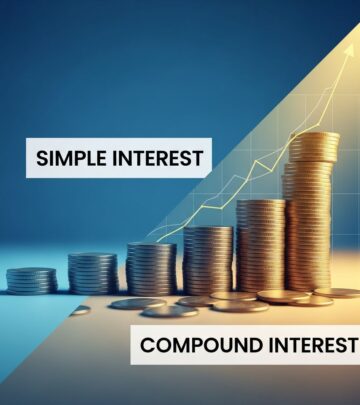
Understanding the difference between simple and compound interest is crucial for making informed financial decisions. While simple interest is calculated only on the principal, compound interest is calculated on both the principal and any previously earned interest.
With simple interest, the amount of interest remains constant each year. With compound interest, the interest grows exponentially because you earn “interest on interest.” For long-term investments, compound interest typically results in higher returns. However, for short-term loans or investments, simple interest may be more favorable to borrowers because they pay less total interest.
When Is Simple Interest Used?
Simple interest is commonly used in several financial situations:
- Personal Loans: Many personal loan agreements use simple interest calculations.
- Auto Loans: Most car loans are calculated using simple interest.
- Short-Term Business Loans: Companies often use simple interest for short-term financing.
- Treasury Bills: U.S. government securities typically use simple interest.
- Bonds: Many bond types calculate interest using the simple interest method.
- Money Lending: Personal loans between individuals often use simple interest.
Frequently Asked Questions About Simple Interest
Q: What is the main advantage of simple interest for borrowers?
A: The main advantage is predictability. With simple interest, borrowers know exactly how much interest they will pay over the life of the loan, making budgeting easier and more transparent.
Q: Can simple interest be calculated for periods less than one year?
A: Yes. Simply convert the time period into years as a fraction. For example, 6 months would be 0.5 years, and 3 months would be 0.25 years.
Q: Is simple interest better than compound interest for investors?
A: Not necessarily. For long-term investments, compound interest typically yields better returns. However, for short-term investments or when interest rates are very high, simple interest may be competitive.
Q: How do I find the interest rate if I know the principal, interest amount, and time?
A: Rearrange the formula to solve for R: R = I ÷ (P × T). Divide the total interest by the product of the principal and time to find the rate.
Q: Why is simple interest called “simple”?
A: It’s called simple because the calculation is straightforward—interest is computed only on the original principal amount, without the complexity of calculating interest on accumulated interest.
Q: Does the frequency of interest payments affect the total simple interest?
A: No. The total simple interest remains the same regardless of how often payments are made. Only the amount of each individual payment changes based on payment frequency.
Key Takeaways About Simple Interest
Simple interest is a fundamental financial concept that applies to loans, investments, and savings accounts. By mastering the simple interest formula and understanding how to apply it, you can make better financial decisions whether you’re borrowing or investing money. The formula I = P × R × T provides a reliable method for calculating the interest you’ll pay or earn over any loan or investment period.
Remember that simple interest calculations assume a fixed interest rate over the entire period and do not account for additional fees, prepayment penalties, or other charges that might apply to your specific loan or investment. Always review the complete terms and conditions of any financial agreement to ensure you understand all costs involved.
References
- Simple Interest Definition and How to Calculate It — Indeed Career Advice. 2025. https://www.indeed.com/career-advice/career-development/simple-interest
- Simple Interest Definition, Formula & Examples — Study.com Academy. 2025. https://study.com/academy/lesson/how-to-find-simple-interest-rate-definition-formula-examples.html
- What Is Simple Interest? How is it calculated? — Ally Financial. 2025. https://www.ally.com/stories/save/what-is-simple-interest/
- 6.1 Simple Interest – Topics in Mathematics — Pima Community College Open Press. 2025. https://pimaopen.pressbooks.pub/topicsinmathematics/chapter/6-1-simple-interest/
- What Is Simple Interest? — Capital One Learn & Grow. 2025. https://www.capitalone.com/learn-grow/money-management/simple-interest/
Similar Articles








Read full bio of medha deb