Simple Interest: Definition, Formula, and Calculation
Master simple interest calculations and understand how it differs from compound interest.

What Is Simple Interest?
Simple interest is a straightforward method of calculating the cost of borrowing money or the return on an investment. It represents interest calculated only on the principal amount—the original sum of money borrowed or invested—rather than on accumulated interest. This contrasts sharply with compound interest, where you earn or pay interest on both the principal and previously accumulated interest.
Simple interest is commonly used in various financial contexts, including personal loans, auto loans, and short-term investments. Understanding how simple interest works is fundamental to making informed financial decisions and comparing different borrowing or investment options.
How Simple Interest Works
The mechanics of simple interest are straightforward. When you borrow money or make an investment that accrues simple interest, the interest amount remains constant throughout the loan or investment period. This means that regardless of how much time passes, the interest earned or owed each year stays the same.
For example, if you deposit $10,000 into a savings account with a 5% simple interest rate for three years, you would earn $500 in interest each year. By the end of three years, your total interest would be $1,500, yielding a final balance of $11,500. The interest calculation never changes year to year because it’s always based on the original $10,000 principal.
This predictability makes simple interest easier to understand and calculate compared to compound interest, making it an excellent starting point for learning about financial mathematics.
Simple Interest Formula
The formula for calculating simple interest is elegant in its simplicity:
Interest = Principal × Rate × Time
Where:
- Principal (P) is the original amount of money borrowed or invested
- Rate (R) is the annual interest rate expressed as a decimal
- Time (T) is the length of time the money is borrowed or invested, typically measured in years
To find the total amount due or accumulated, you would add the interest to the principal: Total Amount = Principal + Interest
Simple Interest Calculation Examples
Understanding simple interest becomes much clearer through practical examples. Let’s explore several scenarios to see how this formula works in real-world situations.
Example 1: Short-Term Personal Loan
Suppose you borrow $5,000 for a car repair at a 6% annual simple interest rate for 2 years. Using the formula:
Interest = $5,000 × 0.06 × 2 = $600
Total Amount Due = $5,000 + $600 = $5,600
You would need to repay $5,600 total, with $600 representing the cost of borrowing the money.
Example 2: Savings Account Investment
If you invest $2,000 in a certificate of deposit offering 3% simple annual interest for 5 years:
Interest = $2,000 × 0.03 × 5 = $300
Total Amount = $2,000 + $300 = $2,300
Your investment would grow to $2,300 after five years, earning $300 in interest.
Example 3: Bond Investment
Consider a $10,000 bond with a 4% simple interest rate held for 3 years:
Interest = $10,000 × 0.04 × 3 = $1,200
Total Amount = $10,000 + $1,200 = $11,200
The bond would return $11,200 at maturity, providing $1,200 in interest income.
Simple Interest vs. Compound Interest
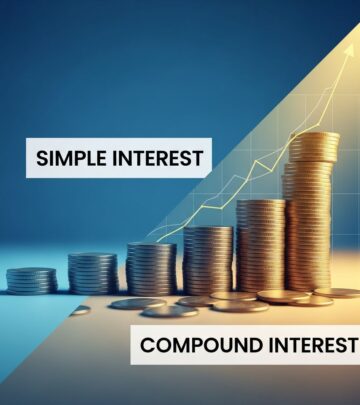
While simple interest calculates returns only on the principal, compound interest calculates interest on both the principal and previously earned interest. This seemingly small difference creates a significant impact over time, especially for longer periods or higher interest rates.
Comparative Analysis
Using the same initial example of $10,000 at 5% interest over 3 years:
| Year | Simple Interest | Compound Interest |
|---|---|---|
| Year 1 | $500 earned | $500 earned |
| Year 2 | $500 earned | $525 earned |
| Year 3 | $500 earned | $551.25 earned |
| Total Interest | $1,500 | $1,576.25 |
As demonstrated in the table, compound interest yields an additional $76.25 over three years. This advantage grows exponentially over longer time periods, making compound interest significantly more powerful for long-term investments while more expensive for long-term borrowing.
Where Simple Interest Is Used
Simple interest appears in various financial products and scenarios:
Personal Loans
Many personal loans from banks and credit unions use simple interest calculations, particularly for shorter-term loans. This makes the total repayment amount predictable and easy to understand for borrowers.
Auto Loans
Some auto loans, especially those with shorter terms, may use simple interest structures, though many modern auto loans use compound interest or amortization schedules.
Short-Term Bonds
Certain types of bonds and fixed-income securities offer simple interest payments, particularly short-term Treasury instruments and corporate bonds.
Student Loans
Federal student loans often use simple interest, with interest accruing only on the principal balance during the in-school and grace periods.
Savings Accounts and CDs
While many modern savings products use compound interest, some certificates of deposit and savings vehicles still employ simple interest calculations, particularly for very short terms.
Advantages and Disadvantages of Simple Interest
Advantages
- Simplicity: Easy to calculate and understand, even for those without financial expertise
- Predictability: Interest amounts remain constant, making budgeting straightforward
- Transparency: Clear understanding of total cost or return from the beginning
- Lower cost for borrowers: Results in less total interest paid on loans
Disadvantages
- Lower returns for investors: Earns less money compared to compound interest over time
- Inflation impact: Fixed interest doesn’t account for inflation over longer periods
- Limited growth: Linear growth rather than exponential growth of wealth
- Less common: Increasingly rare in modern financial products
Simple Interest in Different Financial Contexts
For Borrowers
Borrowers benefit from simple interest because they pay less total interest compared to compound interest over the same period. A $10,000 loan at 5% simple interest over 5 years costs $2,500 in interest, whereas compound interest might result in higher costs. This makes simple interest loans attractive for those seeking predictable, lower-cost borrowing.
For Savers and Investors
Savers and investors typically prefer compound interest because it generates greater returns. However, understanding simple interest helps in evaluating short-term investment opportunities and comparing different financial products. Some high-yield savings accounts and money market accounts still offer competitive simple interest rates.
Calculating Simple Interest for Different Time Periods
Simple interest can be calculated for various time periods, not just years. The formula remains the same, but time must be expressed in the same units as the interest rate.
For Months
If the interest rate is annual but you need interest for months, divide the number of months by 12. For example, 6 months would be 0.5 years in the formula.
For Days
For daily simple interest, use 365 days as the year. If calculating interest for 90 days at 4% annual rate on $1,000:
Interest = $1,000 × 0.04 × (90/365) = $9.86
Real-World Applications and Considerations
Understanding simple interest helps in making informed financial decisions. When evaluating loans, always compare the simple interest calculation with any fees or additional charges. Some lenders quote rates that don’t account for all costs of borrowing.
For investments, recognize that while simple interest is easier to calculate, most modern investment vehicles use compound interest, making it important to understand both concepts for accurate financial planning.
Frequently Asked Questions
Q: What is the main difference between simple and compound interest?
A: Simple interest is calculated only on the principal amount, while compound interest is calculated on both the principal and accumulated interest. Over time, compound interest results in significantly higher returns or costs.
Q: How do I calculate simple interest quickly?
A: Use the formula: Interest = Principal × Rate × Time. Simply multiply the principal by the annual rate (as a decimal) and the number of years. This gives you the total interest earned or owed.
Q: Is simple interest still used in modern banking?
A: While less common than compound interest, simple interest is still used for certain products like short-term loans, some bonds, and specific student loan programs. Most savings accounts and investments now use compound interest.
Q: Can simple interest be calculated for less than one year?
A: Yes, simple interest can be calculated for any time period by adjusting the time variable in the formula. For example, for 6 months, use 0.5 years; for 90 days, use 90/365 years.
Q: Why would a lender offer simple interest instead of compound interest?
A: Lenders offering simple interest on loans make the terms more attractive to borrowers since they pay less total interest. For short-term lending, the difference is minimal, and the transparency of simple interest can be a marketing advantage.
Q: How does inflation affect simple interest returns?
A: Inflation erodes the real value of simple interest returns. If inflation exceeds the interest rate, your purchasing power actually decreases despite earning interest. This is why investors often seek higher-yielding investments with compound interest to outpace inflation.
References
- What Is Compound Interest? — Investopedia. 2013-08-22. https://www.youtube.com/watch?v=wf91rEGw88Q
- Introduction to Interest — Khan Academy. https://www.khanacademy.org/economics-finance-domain/ap-macroeconomics/ap-financial-sector/financial-assets-ap/v/introduction-to-interest
- U.S. Securities and Exchange Commission – Interest and APY — U.S. Securities and Exchange Commission. https://www.sec.gov/investor
- Federal Reserve – Understanding Interest Rates — Board of Governors of the Federal Reserve System. https://www.federalreserve.gov/
Similar Articles








Read full bio of medha deb