Simple Interest Explained: Basics and Calculations
Master the fundamentals of simple interest calculations and how they apply to loans and savings.

What Exactly Is Simple Interest?
Simple interest represents one of the most straightforward methods for calculating the cost of borrowing money or the earnings from an investment. Unlike more complex interest structures, simple interest applies only to the initial amount deposited or borrowed, known as the principal. This makes it a predictable and easy-to-understand approach to interest calculations that many financial institutions use for short-term lending products.
When you borrow money through a simple interest arrangement, the lender charges a fixed percentage of your principal amount annually. This percentage remains constant throughout your loan term, meaning you pay the same interest amount each year. Similarly, when you invest money in an account offering simple interest, you earn the same amount of interest annually based on your initial investment.
Breaking Down the Core Components
To fully grasp how simple interest functions, you need to understand three fundamental elements that form the basis of every calculation:
Principal: Your Starting Amount
The principal represents the original sum of money involved in the transaction. Whether you’re borrowing funds from a bank or investing money in a savings account, the principal is the baseline figure from which all interest calculations originate. This amount remains unchanged throughout the entire duration of your loan or investment term, which is a defining characteristic of simple interest arrangements.
Interest Rate: The Percentage Applied
The interest rate, typically expressed as an annual percentage, determines how much interest accrues on your principal each year. Banks and lending institutions establish these rates based on various factors, including current economic conditions, your creditworthiness, and the type of loan or investment product. The rate is usually stated as an annual percentage rate, often abbreviated as APR.
Time Period: Duration of the Agreement
Time represents the duration for which the principal amount is either borrowed or invested. This period is typically measured in years, though it can also be calculated monthly or daily depending on the specific agreement. The longer the time period, the more total interest you’ll either pay or earn, since interest accrues at the same rate each year.
The Mathematical Formula Behind Simple Interest
The calculation of simple interest follows a straightforward mathematical formula that allows anyone to determine exactly how much interest will be charged or earned:
Simple Interest Formula:
SI = (P × R × T) / 100
Where:
- SI = Simple Interest amount
- P = Principal (initial amount)
- R = Rate of interest per annum (yearly percentage)
- T = Time period (in years)
This formula demonstrates why simple interest is so easy to calculate compared to other interest methods. By multiplying the principal by the rate and time, then dividing by 100, you arrive at the total interest amount. To find the total amount owed or earned, you simply add this interest to your original principal.
Practical Calculation Examples
To illustrate how this formula works in real-world scenarios, consider these detailed examples:
Example 1: Personal Loan Scenario
Suppose you borrow $2,000 from a bank at a 10% annual interest rate for a 5-year period. Using the formula:
- Principal (P) = $2,000
- Rate (R) = 10%
- Time (T) = 5 years
- SI = (2,000 × 10 × 5) / 100 = $1,000
- Total amount to repay = $2,000 + $1,000 = $3,000
This means over five years, you would pay $1,000 in interest charges on your $2,000 loan.
Example 2: Investment Growth
If you invest $1,000 in a savings instrument offering 5% annual simple interest for 10 years:
- Principal (P) = $1,000
- Rate (R) = 5%
- Time (T) = 10 years
- SI = (1,000 × 5 × 10) / 100 = $500
- Total amount after 10 years = $1,000 + $500 = $1,500
Your investment would grow to $1,500, earning you a steady $50 per year in interest.
Simple Interest Versus Compound Interest: Key Differences
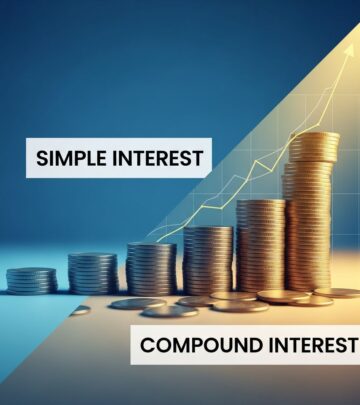
While simple interest applies only to the principal amount, compound interest introduces a different approach where interest earned in previous periods gets added to the principal for subsequent calculations. This distinction significantly impacts the total amount you’ll pay or receive.
| Aspect | Simple Interest | Compound Interest |
|---|---|---|
| Calculation basis | Original principal only | Principal plus accumulated interest |
| Interest growth | Linear and uniform | Exponential and accelerating |
| Annual interest amount | Remains constant | Increases each period |
| Typical use | Short-term loans | Long-term investments |
| Total amount earned/owed | Lower than compound | Higher than simple |
Over extended periods, the difference between simple and compound interest becomes increasingly significant. For borrowers, simple interest results in lower total costs. For investors, compound interest generates substantially larger returns.
Real-World Applications of Simple Interest
Simple interest appears in various financial contexts beyond basic personal loans:
Automobile Financing
Many auto loans utilize simple interest calculations, making it easier for borrowers to understand their total payment obligations upfront. This transparency helps buyers make informed decisions about vehicle purchases.
Bond Investments
Bonds with fixed coupon rates use simple interest methodology. For example, a $1,000 bond with a 6% coupon pays $60 annually in simple interest payments.
Short-Term Business Loans
Many small business lines of credit and short-term loans employ simple interest because of its straightforward calculation and predictability.
Certificates of Deposit
Some certificate of deposit products offer simple interest earnings, providing guaranteed returns on your investment over a specified term.
Advantages of Simple Interest Arrangements
Simple interest offers several practical benefits:
- Predictability: You know exactly how much interest you’ll pay or earn each year
- Simplicity: The calculation is straightforward and doesn’t require advanced mathematical understanding
- Transparency: Borrowers can easily verify that they’re being charged correctly
- Lower costs: For borrowers, simple interest results in lower total interest payments compared to compound interest
- Easy budgeting: Predictable interest amounts make financial planning easier
Limitations to Consider
While simple interest offers advantages, it also has limitations:
- Lower returns: For investors, simple interest generates less wealth than compound interest over time
- Less common: Most modern financial products favor compound interest structures
- Limited growth: The linear nature of growth means no acceleration of earnings
Frequently Asked Questions
How does simple interest differ from APR?
Simple interest is the actual interest calculation method, while APR (Annual Percentage Rate) is how lenders express the interest rate charged annually. APR may include additional fees beyond simple interest charges.
Can simple interest be calculated for periods shorter than a year?
Yes. The formula can be adjusted to use months or days. For example, T could be expressed as 6/12 for a six-month period or 180/365 for approximately six months.
Which is better for borrowers: simple or compound interest?
Simple interest is better for borrowers because it results in lower total interest payments. Compound interest is more favorable for savers and investors.
Why do banks prefer compound interest?
Banks prefer compound interest for savings accounts because it grows their costs slower while maximizing returns through reinvestment, and it’s more competitive for attracting deposits.
Is simple interest still used in modern finance?
Yes, simple interest remains prevalent in short-term loans, auto financing, bonds, and certain savings products.
Key Takeaways About Simple Interest
Understanding simple interest empowers you to evaluate financial products more effectively. Remember that simple interest calculations depend on three factors: your principal amount, the interest rate, and the time period. The formula SI = (P × R × T) / 100 provides a reliable way to calculate exact interest amounts.
When comparing financial products, always ask whether they use simple or compound interest. For borrowers, simple interest represents a more favorable option, while investors should seek compound interest opportunities for long-term wealth building. By grasping these fundamentals, you’ll make more informed decisions about loans, savings accounts, and investments that align with your financial goals.
References
- Simple Interest — SplashLearn. 2024. https://www.splashlearn.com/math-vocabulary/simple-interest
- Simple Interest – Definition, Formula, Examples — Cuemath. 2024. https://www.cuemath.com/commercial-math/simple-interest/
- Simple Interest — Lumen Learning. 2024. https://courses.lumenlearning.com/waymakermath4libarts/chapter/simple-interest/
Similar Articles








Read full bio of medha deb