Silo Mentality: Definition, Effects & Solutions
Understand silo mentality, its organizational impact, and proven strategies to break down workplace silos.
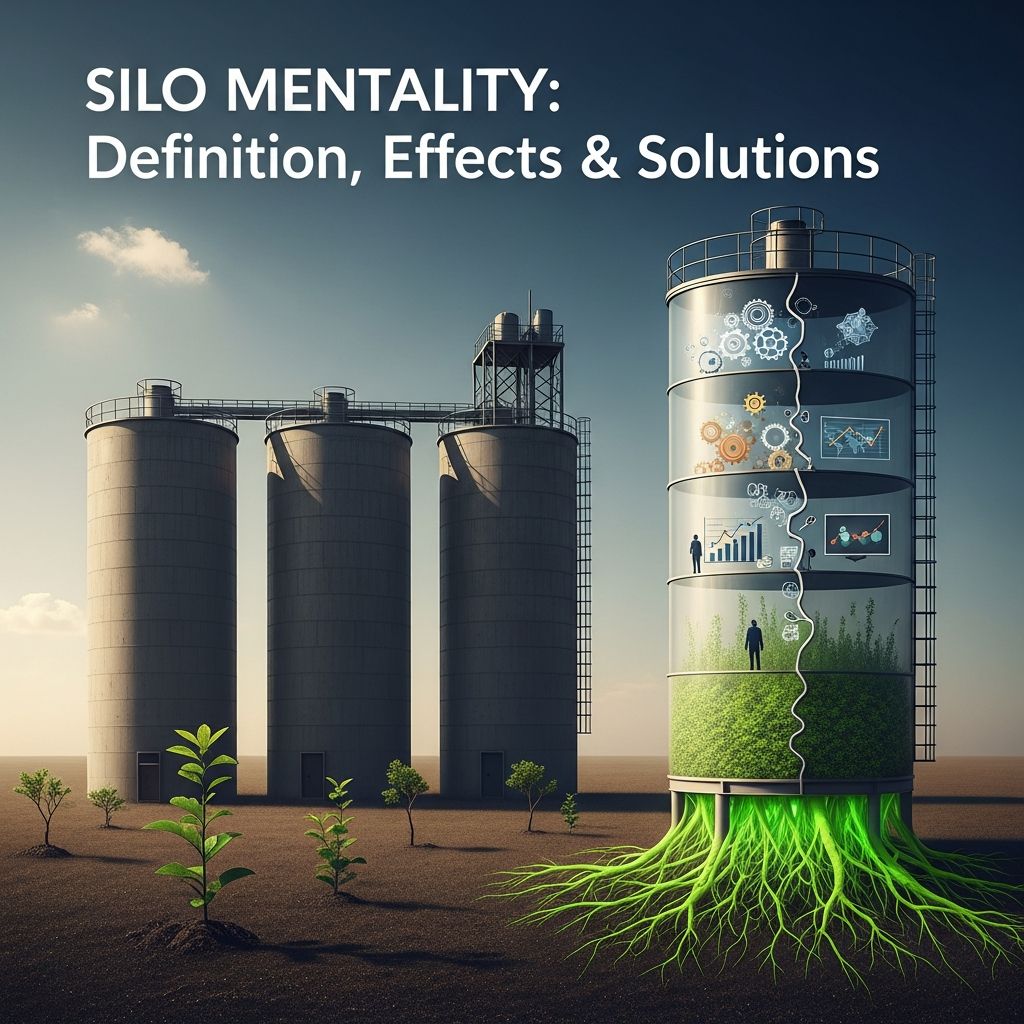
Silo mentality is a pervasive organizational challenge that undermines collaboration, efficiency, and innovation. It describes a workplace culture where departments, teams, or individuals operate in isolated bubbles, withholding information and refusing to collaborate effectively. The term derives from large freestanding storage buildings used in agriculture, metaphorically representing compartmentalized thinking within organizations. This destructive mindset prevents companies from achieving long-term goals, reduces employee engagement, and ultimately impacts customer satisfaction.
Understanding Silo Mentality
Silo mentality refers to when different teams or team members within the same company purposely do not share valuable information with other members of the organization. Rather than working toward unified business objectives, siloed teams operate independently, creating fragmented workflows and duplicated efforts. The silo mindset directly contradicts the collaborative approach necessary for modern business success.
At its core, silo mentality is characterized by rigid, simplistic thinking patterns. Individuals who think in silos struggle to see beyond established ways of doing things and lack what experts call “fluid intelligence”—the capacity to think flexibly across boundaries. While such employees might be specialists in their particular fields, they fail to connect their work to the contributions of other departments or individuals.
Common Causes of Silo Mentality
Several interconnected factors contribute to the formation of organizational silos:
Communication Breakdowns
At its foundation, silo mentality is caused by a lack of communication between teams. Without open channels for discussion and collaboration, departments naturally drift apart. This communication gap can occur between teams, departments, colleagues, or even upper management and stakeholders. When everyone is not on the same page, serious problems inevitably arise.
Internal Competition and Politics
Unhealthy internal competition breeds silos. When departments compete for budgets, recognition, or resources rather than working toward shared goals, information hoarding becomes a competitive strategy. Managers may withhold information to maintain an advantage or preserve their department’s status as experts in their field.
Poor Leadership and Management Structure
Organizational hierarchies can inadvertently encourage silos when leadership fails to establish clear communication protocols or incentivize collaboration. Remote work environments, particularly across different time zones, further complicate cross-departmental communication.
Specialized Roles and Expertise
While specialization is necessary, it can create functional silos when teams become too focused on their domain expertise and fail to integrate with other functions. Developers, designers, marketers, and other specialized roles may resist transparency, creating what some call a “Bermuda Triangle” where valuable information disappears.
Identifying Silo Mentality in Your Organization
Recognizing silo mentality requires understanding its key symptoms and manifestations:
| Symptom | Manifestation | Business Impact |
|---|---|---|
| Poor Communication | Teams unwilling or unable to share information and collaborate | Duplicated efforts, missed opportunities |
| Organizational Divides | Clear boundaries between departments or teams emerge | Reduced cohesion, weakened company culture |
| Gatekeeping Behavior | Groups withhold knowledge to preserve status as experts | Bottlenecks, slower innovation cycles |
| Slow Workflows | New initiatives known to one group but not communicated to others | Delayed projects, inefficient processes |
| Tunnel Vision | Employees struggle to understand perspectives outside their department | Poor decision-making, missed insights |
Additional Signs of Silo Mentality
Collaboration considered impossible: Teams view working together as impractical or unnecessary, reinforcing isolation through cultural messaging that “we do things our way here.”
Resistance to change: Siloed individuals are typically “set in their ways,” unable to think flexibly and resistant to beneficial change that challenges their established methods.
Speculation and mistrust: The less often teams communicate, the more disconnected they become. This disconnect breeds speculation, assumptions, and suspicion that can snowball into mistrust and interpersonal friction.
Unclear accountability: When teams don’t collaborate, responsibility gaps emerge. Team A might believe a task is Team B’s responsibility, while Team B assumes it belongs to Team A. The task remains incomplete, and neither team realizes the failure until significant damage occurs.
Real-World Examples of Silo Mentality
Department versus Department Silos
A business operates three departments, each specializing in services for different market sectors. These departments maintain minimal communication, functioning as independent silos. When the company outsources marketing to a third party, the external agency must communicate separately with each department, attempting to balance their distinct needs and messaging styles. This fragmentation reduces marketing effectiveness and wastes resources on redundant coordination efforts.
Stakeholder Disagreement Creating Multiple Standards
Two stakeholders fundamentally disagree about quality control approaches. Each gathers middle managers to their side and instructs them to perform QC according to their preferred methodology. This creates multiple departments performing quality assurance with different standards, resulting in inconsistent documentation and quality variations across the organization.
Remote Team Isolation
A team consists of four remote solicitors, each managing several company clients with autonomy over their caseloads. The team manager does not encourage active communication or collaboration. Over time, each solicitor develops distinct working styles with different good and bad habits. Company ethos becomes fragmented, and consistent service standards disappear.
Negative Consequences of Silo Mentality
Reduced Innovation and Creativity
Innovation flourishes at the intersection of different perspectives and expertise. When teams operate in silos, they lose access to diverse viewpoints that spark creative breakthroughs. Cross-functional collaboration often reveals novel solutions that single departments cannot generate independently.
Inefficiency and Duplicated Efforts
Siloed organizations often duplicate work across departments. Without shared knowledge of initiatives, projects, or solutions, teams solve identical problems multiple times, wasting time and resources.
Compromised Decision-Making
Decisions made within silos lack the benefit of comprehensive organizational perspective. Teams make choices based on incomplete information, leading to suboptimal outcomes that might have been improved through cross-departmental input.
Decreased Employee Morale
Working in silos creates frustration and disengagement. Employees feel isolated, undervalued, and disconnected from organizational goals. This toxic environment increases turnover and reduces productivity.
Diminished Customer Satisfaction
When departments operate independently, customers experience inconsistent service quality and messaging. This fragmentation directly impacts customer experience and loyalty.
Slower Time-to-Market
Products and services reach market more slowly when teams cannot collaborate efficiently. Siloed organizations struggle with information bottlenecks that delay decision-making and implementation.
Silo Mentality in Technology Companies
Technology organizations face particularly acute challenges from silo mentality. Development teams often hoard critical technical knowledge, believing their specialized expertise provides job security and departmental influence. Product management groups operate with limited engineering input, creating roadmaps that lack thorough technical feasibility assessments. Meanwhile, data science teams frequently work in isolation, developing sophisticated models disconnected from practical business applications.
In cross-functional “Bermuda Triangle” scenarios—involving developers, designers, and marketers—teams proudly maintain unique workflows and resist transparency about their knowledge and processes. Yet their mutual dependency is high, meaning when one team loses access to critical information or resources, entire projects may be delayed or stall completely.
Types of Organizational Silos
Departmental silos: Limited cross-department communication driven by budget competition and performance metrics focused on individual departments rather than organizational outcomes.
Hierarchical silos: Information hoarding by management levels, driven by power dynamics and career advancement concerns. Upper management isolation from development teams represents a particularly damaging variation.
Geographic silos: Location-based isolation exacerbated by remote work challenges and cultural differences between headquarters and offshore teams.
Functional silos: Skill-based segregation caused by technical specialization and tool differences, particularly between frontend and backend development teams.
Product silos: Product line isolation resulting from resource allocation decisions and market focus differences between mobile app teams and web platform teams, for example.
Data silos: Information access restrictions driven by security concerns and system limitations, preventing analytics teams and operations teams from collaborating effectively.
Cultural silos: Value and belief misalignment stemming from acquisition integration challenges or generational gaps between startup culture and enterprise mindset.
Breaking Down Organizational Silos
Establish Clear Communication Channels
Create formal mechanisms for cross-departmental communication. Regular interdepartmental meetings, collaborative platforms, and open communication policies ensure information flows freely throughout the organization.
Align Performance Metrics with Collaboration
Restructure performance evaluation systems to reward collaborative contributions alongside individual achievements. When employees are evaluated partly on their ability to work with other departments, behavior changes dramatically.
Implement Cultural Transformation Initiatives
The most sustainable approach to eliminating silo mentality involves comprehensive cultural transformation addressing underlying beliefs and behaviors. Leading companies like Salesforce emphasize “Ohana” culture—family-like relationships and mutual support regardless of functional area or organizational level. This cultural foundation creates strong incentives for collaboration while discouraging competitive behaviors that drive silo formation.
Foster Cross-Functional Teams
Create project teams that deliberately include members from different departments. These teams develop relationships, understanding, and appreciation for diverse perspectives that persist even after projects conclude.
Invest in Shared Tools and Platforms
Modern collaboration tools facilitate information sharing and reduce communication barriers. Investing in integrated platforms ensures all departments access the same information and work toward shared goals.
Develop Transparent Leadership
Leaders must model collaborative behavior and communicate transparently about organizational goals, decisions, and challenges. When leaders share information openly, employees throughout the organization follow suit.
Frequently Asked Questions
Q: What is the main cause of silo mentality?
A: The primary cause is poor communication between teams and departments. Without open channels for discussion and collaboration, silos naturally form as groups operate independently.
Q: How does silo mentality affect organizational performance?
A: Silo mentality reduces efficiency through duplicated efforts, slows innovation, compromises decision-making, lowers employee morale, and ultimately diminishes customer satisfaction.
Q: Can silo mentality be completely eliminated?
A: While complete elimination is challenging, comprehensive cultural transformation initiatives can substantially reduce silos. This requires long-term commitment to reshaping organizational culture around collaboration, transparency, and shared success.
Q: Which types of organizations are most vulnerable to silo mentality?
A: Silo mentality can affect businesses in any industry and of any size, though technology companies face particular challenges due to high specialization levels and cross-functional dependencies.
Q: How can remote work environments prevent silos?
A: Remote organizations should establish clear communication protocols, use integrated collaboration platforms, schedule regular cross-departmental meetings, and explicitly value collaboration in performance evaluations.
References
- The Silo Mentality Explained: Breaking Bad Habits — Verto 365. 2024. https://vertocloud.co.uk/blog/the-silo-mentality-explained/
- Silo Mentality: Definition, Effects and How To Prevent It — Indeed Career Advice. 2024. https://www.indeed.com/career-advice/career-development/silo-mentality
- What is Silo Mentality? How Working in Silos is Dangerous — Miro. 2024. https://miro.com/blog/overcome-silo-mentality/
- Silo Mentality: 7 Devastating Types Destroying Tech Companies — Coach Pedro Pinto. 2024. https://coachpedropinto.com/silo-mentality-types-countermeasures/
- Silo Mentality: What Are Organizational Silos and Their Impact — HelpJuice. 2024. https://helpjuice.com/blog/organizational-silos
- What Does Working In Silos Mean? — Ideagen. 2024. https://www.ideagen.com/thought-leadership/blog/working-in-silos
- Silo Mentality: How to Overcome Workplace Silos — MasterClass. 2025. https://www.masterclass.com/articles/silo-mentality
Similar Articles








Read full bio of Sneha Tete