Signature Loan: Definition, Uses & How They Work
Complete guide to signature loans: unsecured personal financing backed by your promise to pay.
What Is a Signature Loan?
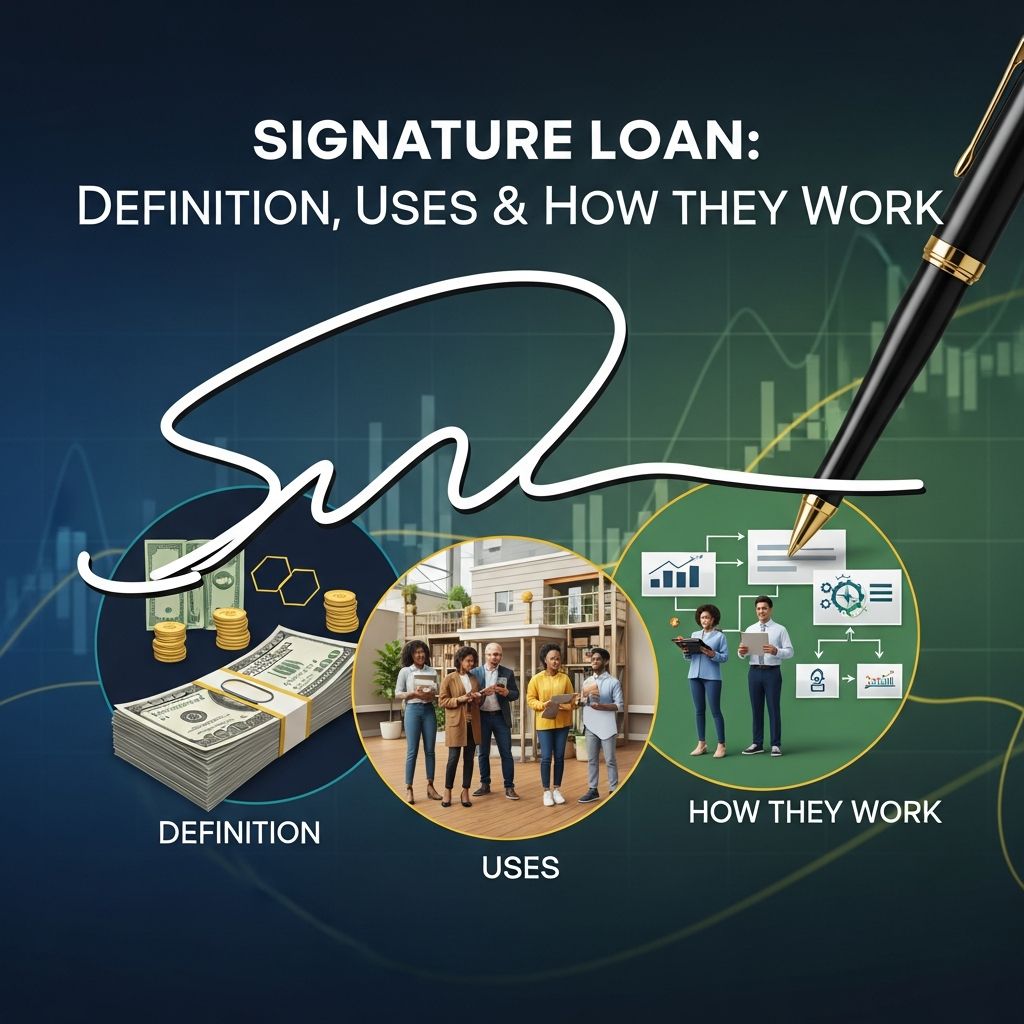
A signature loan is a type of unsecured personal loan that relies on a borrower’s signature as a legal promise to repay borrowed funds. Also known as a “good faith loan” or “character loan,” a signature loan does not require any collateral—physical assets like a house, car, or savings account that a lender could seize if you fail to repay the debt. Instead, lenders approve these loans based primarily on your creditworthiness, income stability, and credit history.
The term “signature loan” is somewhat dated and less commonly used by modern lenders, but it remains relevant for understanding how many personal loans work today. Essentially, all signature loans are personal loans, though not all personal loans are signature loans. The defining characteristic is the absence of collateral and the reliance on the borrower’s signature as the sole guarantee of repayment.
How Signature Loans Work
Understanding the mechanics of signature loans helps borrowers make informed financial decisions. The process involves several key steps:
The Application Process
When you apply for a signature loan, you’ll typically need to provide personal and financial information. The lender will request details about your income, employment history, existing debts, and monthly expenses. This information helps the lender assess your ability to repay the loan.
Lender Evaluation
Lenders evaluate multiple factors to determine approval and interest rates. Your credit score and credit history are primary considerations—they reveal your track record of managing debt and making on-time payments. Additionally, lenders examine your debt-to-income ratio, which compares your total monthly debt payments to your gross monthly income. In some cases, lenders may request a co-signer or witness signature as additional security, particularly if the borrower’s creditworthiness is borderline.
Funding and Repayment
Once approved, the lender disburses funds as a lump sum directly to your bank account, often within a few days. You then repay the borrowed amount plus interest through fixed monthly installments over a predetermined term. Repayment periods typically range from 24 to 60 months, though some lenders offer terms as short as 3 months or as long as 96 months, depending on the loan amount and the lender’s policies. Each monthly payment includes both principal and interest.
Key Characteristics of Signature Loans
Unsecured Nature
The unsecured nature of signature loans means they carry greater risk for lenders. Because no collateral backs the loan, lenders have limited recourse if you default on payments. This increased risk is reflected in higher interest rates compared to secured loans like mortgages or auto loans.
Fixed Interest Rates and Terms
Most signature loans feature fixed interest rates and fixed repayment terms. This means your interest rate and monthly payment amount remain constant throughout the loan period, providing predictability and making budgeting easier. However, interest rates for signature loans typically fall between credit card rates and secured loan rates.
Loan Amounts
Signature loans typically range from $500 to $50,000, depending on the lender and your creditworthiness. Smaller loans often have shorter repayment periods, while larger loans may extend over longer terms.
Common Uses for Signature Loans
Borrowers use signature loans for various purposes, limited only by the lender’s policies:
Debt Consolidation: One of the most popular uses is consolidating high-interest debt, particularly credit card balances. If you carry multiple credit cards with interest rates ranging from 10% to 15% and can obtain a signature loan at 5%, using that loan to pay off your credit cards results in significant interest savings.
Emergency Expenses: Medical emergencies, unexpected home repairs, or urgent travel needs can be financed through signature loans, which offer faster fund disbursement than many alternatives.
Major Purchases and Life Events: Common uses include wedding expenses, vehicle repairs, home improvements, appliance purchases, and vacation funding.
Business Needs: Some borrowers use signature loans for small business startup costs or operational expenses, though business loans are typically a better option.
Advantages of Signature Loans
Signature loans offer several compelling benefits for qualified borrowers:
No Collateral Required: The most significant advantage is that you don’t risk losing valuable assets. Unlike mortgage loans or auto loans, you cannot have your home or vehicle seized if you default.
Quick Approval and Funding: Signature loans typically have faster approval processes than secured loans. Funds are often deposited into your account within days, making them ideal for time-sensitive financial needs.
Fixed Payments: Fixed interest rates and monthly payments provide certainty and simplify budgeting, unlike variable-rate loans or credit cards where payments may fluctuate.
Lower Rates Than Credit Cards: For those carrying credit card debt, a signature loan’s interest rate is often substantially lower than typical credit card rates, resulting in interest savings.
Flexibility: You can use signature loan funds for virtually any purpose, giving you flexibility in how you allocate the borrowed money.
Disadvantages of Signature Loans
Despite their advantages, signature loans come with notable drawbacks:
Higher Rates Than Secured Loans: Because lenders bear greater risk without collateral, interest rates are typically higher than mortgages or auto loans.
Eligibility Requirements: You must have a decent credit score and stable income to qualify. Those with poor credit may face rejection or significantly higher rates.
Fees: Many lenders charge origination fees, prepayment penalties, or other fees that increase the total cost of borrowing.
Rigid Repayment Schedule: Unlike revolving credit lines, signature loans have fixed repayment schedules. You cannot adjust payment amounts or access additional funds without applying for a new loan.
Debt Accumulation Risk: Easy access to funds can encourage overspending and debt accumulation, particularly for those without strong financial discipline.
Signature Loans vs. Other Loan Types
| Loan Type | Collateral Required | Interest Rate Range | Approval Speed | Best For |
|---|---|---|---|---|
| Signature Loan | No | Medium (varies by credit) | Fast (days) | Debt consolidation, emergencies |
| Secured Personal Loan | Yes | Lower | Medium | Larger borrowing needs |
| Mortgage | Yes (home) | Lowest | Slow (weeks) | Home purchases |
| Auto Loan | Yes (vehicle) | Low-Medium | Medium | Vehicle purchases |
| Credit Card | No | Highest | Fast | Small purchases, convenience |
| Home Equity Line | Yes (home) | Low-Medium | Medium | Large expenses, flexibility |
Where to Find Signature Loans
Several types of financial institutions offer signature loans:
Traditional Banks: Most major banks offer personal loans, including signature loans, typically to customers with good to excellent credit.
Credit Unions: Credit unions often offer competitive rates to their members and may have more flexible lending criteria than banks.
Online Lenders: Online lending platforms have emerged as popular alternatives, often offering quick approval processes and serving borrowers with various credit profiles.
Finance Companies: Specialized finance companies focus on personal lending and may work with borrowers who don’t qualify at traditional banks.
Qualifying for a Signature Loan
To qualify for a signature loan, lenders typically require:
Credit Score: Most lenders prefer a credit score of 620 or higher, though requirements vary. Better scores qualify for lower interest rates.
Stable Income: Lenders want assurance that you can repay the loan. Consistent employment or reliable income sources are important.
Debt-to-Income Ratio: Lenders typically want your total monthly debt payments to be no more than 40-50% of your gross monthly income.
Employment History: A stable employment history demonstrates financial reliability.
Bank Account: Most lenders require a checking or savings account for direct fund deposit and automatic payment withdrawal.
Signature Loans vs. Personal Loans: Understanding the Difference
The terms “signature loan” and “personal loan” are often used interchangeably, but subtle distinctions exist. A personal loan is a broad category encompassing both secured and unsecured loans. A signature loan is specifically an unsecured personal loan that relies solely on the borrower’s signature as a promise to repay.
Think of it this way: all signature loans are personal loans, but not all personal loans are signature loans. A personal loan could be secured (backed by collateral) or unsecured (like a signature loan). The signature loan is the specific subset of unsecured personal loans where the lender’s only recourse is your promise to pay.
Signature Loans vs. Revolving Credit
A major difference between signature loans and revolving credit (like credit cards) is the funding mechanism and speed. With revolving credit, the lender conducts a complete assessment of your qualifications each time you request funds, which can create funding delays. With signature loans, funds are disbursed quickly as a lump sum, allowing you to address financial needs sooner.
Additionally, signature loans feature fixed repayment schedules with predetermined monthly payments, while revolving credit allows flexibility in payment amounts (subject to minimum payments) and permits repeated borrowing up to your credit limit.
Tips for Getting the Best Signature Loan
Check Your Credit: Before applying, obtain your credit report and credit score. Address any errors and work on improving your score if needed.
Compare Multiple Lenders: Interest rates and terms vary significantly among lenders. Compare offers from at least three to five sources.
Improve Your Application: A co-signer with excellent credit can strengthen your application and potentially lower your interest rate.
Consider Timing: Applying with stable employment and minimal recent credit inquiries improves approval odds.
Review the Fine Print: Understand all fees, including origination fees, prepayment penalties, and late payment fees.
Frequently Asked Questions
Q: What is the difference between a signature loan and a personal loan?
A: All signature loans are personal loans, but not all personal loans are signature loans. Signature loans specifically refer to unsecured personal loans backed by your signature. Personal loans can be either secured or unsecured.
Q: Can I get a signature loan with bad credit?
A: It’s challenging but possible. Some lenders work with borrowers with lower credit scores, though you’ll likely face higher interest rates. Credit unions and online lenders may be more flexible than traditional banks.
Q: How long does it take to get approved for a signature loan?
A: Approval typically takes a few days, with funds often deposited within a week. Some online lenders provide same-day or next-day approval and funding.
Q: Can I pay off a signature loan early?
A: Yes, most lenders allow early repayment, though some charge prepayment penalties. Check your loan agreement for details.
Q: What happens if I default on a signature loan?
A: Defaulting damages your credit score, triggers late fees, and may result in legal action. The lender may pursue wage garnishment or bank account levies to recover the debt.
Q: Are signature loans better than credit cards for consolidating debt?
A: Often yes. Signature loans typically offer lower interest rates than credit cards and provide fixed repayment schedules, making them effective for debt consolidation.
Q: Can I use a signature loan for any purpose?
A: Generally yes. Most lenders don’t restrict how you use signature loan funds, though some may exclude high-risk uses like investing or gambling.
Q: What is the maximum amount I can borrow with a signature loan?
A: Typical signature loan amounts range from $500 to $50,000, though some lenders offer higher maximums for well-qualified borrowers.
References
- What is a Signature Loan? Meaning, Uses & Differences — Adobe Acrobat. 2024. https://www.adobe.com/acrobat/business/resources/whats-a-signature-loan.html
- Signature Loan – Overview, How It Works, Examples — Corporate Finance Institute. 2024. https://corporatefinanceinstitute.com/resources/commercial-lending/signature-loan/
- What is a Signature Loan? — OneMain Financial. 2024. https://www.onemainfinancial.com/resources/loan-basics/what-is-a-signature-loan
- What Is A Signature Loan And How Does It Work? — Bankrate. 2024. https://www.bankrate.com/loans/personal-loans/what-is-a-signature-loan-and-how-does-it-work/
- What Are Signature Loans & How Do They Work? — SoFi. 2024. https://www.sofi.com/learn/content/what-is-a-signature-loan/
Similar Articles








Read full bio of Sneha Tete