Electric Cars: Smart Buy Or Not? 2026 Guide
Weigh the costs, savings, perks, and drawbacks of electric vehicles to decide if an EV makes financial sense for your next car purchase.
Electric vehicles (EVs) have surged in popularity, promising lower operating costs, environmental benefits, and modern perks. But with higher upfront prices, range limitations, and evolving technology, is an EV truly the smart financial choice for your next car? This article breaks down the key factorsosts, savings, incentives, challenges, and morend morend more to help you decide.
Upfront Costs: The Premium Price Tag
Electric cars typically cost more than comparable gas-powered models. For instance, a base-model electric Kia Soul might carry a premium of $3,700 to $7,500 even after federal tax rebates. These rebates, ranging from $3,700 for plug-in hybrids to $7,500 for full EVs, help offset the difference, but buyers still face a higher initial outlay.
In 2026, average EV prices have stabilized around $50,000-$60,000 for mid-range models, compared to $35,000-$45,000 for gas equivalents, influenced by battery production costs and supply chain improvements. Financing an EV often means larger monthly payments unless offset by incentives or trade-ins.
- Higher battery costs: Lithium-ion batteries remain the priciest component, though prices have dropped 89% since 2010 per U.S. Department of Energy data.
- Tax credits: Eligible buyers can claim up to $7,500 via IRS Form 8936, but income limits and battery sourcing rules apply.
- State incentives: California offers up to $7,500 more, plus HOV lane access.
Table comparing sample models (2026 estimates):
| Model | Gas Price | EV Price (pre-rebate) | After $7,500 Rebate |
|---|---|---|---|
| Kia Soul | $25,000 | $32,000 | $24,500 |
| Tesla Model 3 | N/A | $42,000 | $34,500 |
| Chevy Bolt | $28,000 (equiv.) | $35,000 | $27,500 |
Fuel Savings: Electricity vs. Gasoline
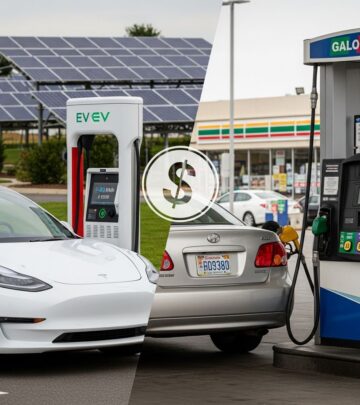
One of the biggest selling points is fuel cost savings. Driving 15,000 miles annually, an EV like the Kia Soul euses about 33.7 kWh per 105 miles. At 12 cents per kWh (national average), that’s roughly $578 yearly. A comparable gas Soul at 30 MPG and $3.50/gallon costs $1,750 $1,172 annual savings, adjusted for 2026 gas prices hovering at $3.20-$3.80/gallon.
Real-world savings vary by location: coastal areas with cheap hydropower see lower electricity rates (8-10 cents/kWh), while others pay 15-20 cents. Workplace or public free chargers can slash costs further.
- Break-even analysis: At $900-$1,200 yearly fuel savings, payback on a $5,000 premium takes 4-8 years.
- Inflation hedge: Gas prices fluctuate wildly; electricity is more stable.
- Home solar synergy: Pairing EVs with rooftop solar maximizes savings, potentially netting zero fuel costs.
Maintenance and Repairs: Fewer Oil Changes, But…
EVs shine in maintenance: no oil changes, fewer moving parts, regenerative braking extends brake life. RepairPal estimates average annual costs at $267 for a Kia Soul EV vs. $446 for gas, a $179 savings. Over 10 years, this adds $1,790 in pocket.
However, tire wear is higher due to instant torque, and battery replacements (rare within 8-10 years) cost $10,000-$20,000. Most warranties cover batteries for 8 years/100,000 miles at 70% capacity retention.
| Maintenance Item | Gas Car Cost/Year | EV Cost/Year | Savings |
|---|---|---|---|
| Oil Changes | $100 | $0 | $100 |
| Brakes | $200 | $100 | $100 |
| Total Avg. | $446 | $267 | $179 |
Tax Incentives and Perks
Beyond federal rebates, EVs unlock perks: insurance discounts (5-10% from Progressive/Geico), free public charging in some cities, and HOV/carpool lane access (e.g., California’s Clean Air Vehicle stickers). In traffic-heavy areas like the Bay Area, this shaves commute times dramatically.
2026 updates include expanded IRA incentives for used EVs ($4,000 credit) and commercial charging credits. Check dsireusa.org for state rebates.
- Carpool access: Worth thousands in time savings for commuters.
- Insurance: Lower risk profiles yield premiums 10-20% less.
- Parking: Free EV spots in major cities.
Resale Value and Depreciation
EVs depreciate faster than gas cars due to rapid tech advancesnd morend morend more. Three-year resale drops 50-60% for EVs vs. 40% for gas.
Toyota and Mercedes-Benz have scaled back full-EV commitments, citing poor resale and viability without subsidies. Buyers prefer new EVs for latest batteries, hurting used market.
Range Anxiety and Charging Infrastructure
Modern EVs boast 250-400 mile ranges, but ‘range anxiety’ persists for road trips. Level 2 home chargers (overnight full charge) are ideal, but public DC fast chargers (Electrify America, Tesla Superchargers) number over 100,000 nationwide in 2026 per DOE.
- Home charging: 8-12 hours for 240V; install costs $500-$1,500 with rebates.
- Public network: 350kW chargers add 200 miles in 15 minutes.
- Cold weather hit: Range drops 20-40% in freezing temps.
Environmental Impact
EVs cut tailpipe emissions to zero, with lifecycle emissions 50-70% lower than gas cars per DOE, even on coal-heavy grids. As grids green (40% renewables in U.S. 2026), benefits grow. Battery mining raises concerns, but recycling rates hit 95% for lithium.
Who Should Buy an EV?
- Yes if: You drive <200 miles/day, have home charging, qualify for incentives, prioritize environment/quiet ride.
- No if: Frequent long trips, no garage charging, tight budget, value high resale.
Hybrids offer a middle ground with 40-50 MPG and no plugs.
Frequently Asked Questions (FAQs)
Q: How long to break even on an EV?
A: 4-9 years at 15,000 miles/year, saving $900+ on fuel/maintenance.
Q: Do EVs really save on maintenance?
A: Yes, 35-50% less due to no engine/oil needs.
Q: What’s the biggest EV drawback?
A: Upfront cost and faster depreciation from tech evolution.
Q: Are EV incentives still available in 2026?
A: Yes, up to $7,500 federal, plus state perks; check IRS eligibility.
Q: How’s the charging network?
A: Robust for cities/highways, but rural gaps remain; improving yearly.
References
- How Long Does It Take to Break Even With an Electric Car — WiseBread. 2015 (data relevant as costs stable per DOE trends). https://www.wisebread.com/how-long-does-it-take-break-even-with-an-electric-car
- EVs are ‘not economically viable’ and ‘can’t last the distance’ — YouTube (Ian Plimer interview). 2023-10-01. https://www.youtube.com/watch?v=394wkflzyx0
- Why Do EVs DEPRECIATE So Much Faster Than Gas Cars? — YouTube. 2023. https://www.youtube.com/watch?v=8hWprXPOGk4
- Alternative Fuels Data Center: Electric Vehicle Benefits and Considerations — U.S. Department of Energy. 2026-01-10. https://afdc.energy.gov/vehicles/electric-benefits
- Federal Tax Credits for Electric Vehicles — IRS.gov. 2025-12-31. https://www.irs.gov/credits-deductions/credits-for-new-clean-vehicles-purchased-in-2023-or-after
Similar Articles








Read full bio of medha deb